Hyperparameter tuning
Modeling with tidymodels in R

David Svancer
Data Scientist
Hyperparameters
Model parameters whose values are set prior to model training and control model complexity
parsnip decision tree
cost_complexity- Penalizes large number of terminal nodes
tree_depth- Longest path from root to terminal node
min_n- Minimum data points required in a node for further splitting
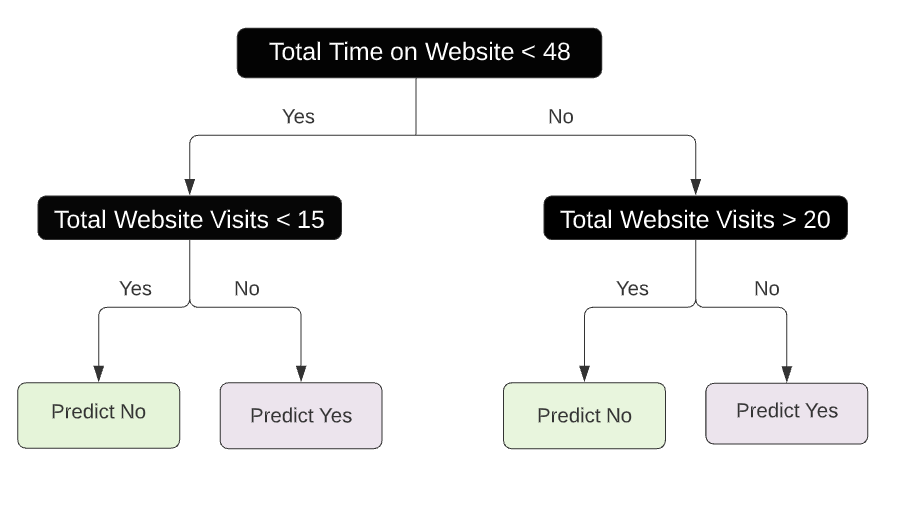
Default hyperparameter values
decision_tree() function sets default hyperparameter values
cost_complexityis set to 0.01tree_depthis set to 30min_nis set to 20
These may not be the best values for all datasets
- Hyperparameter tuning
- Process of using cross validation to find the optimal set of hyperparameter values
dt_model <- decision_tree() %>%
  set_engine('rpart') %>%
  set_mode('classification')
Labeling hyparameters for tuning
The tune() function from the tune package
- To label hyperparameters for tuning, set them equal to
tune()inparsnipmodel specification - Creates model object with tuning parameters
- Will let other functions know that they need to be optimized
dt_tune_model <- decision_tree(cost_complexity = tune(), tree_depth = tune(), min_n = tune()) %>% set_engine('rpart') %>% set_mode('classification')dt_tune_model
Decision Tree Model Specification (classification)

Main Arguments:
  cost_complexity = tune()
  tree_depth = tune()
  min_n = tune()

Computational engine: rpart
Creating a tuning workflow
workflow objects can be easily updated
- Prior
leads_wkfl- Feature engineering steps for lead scoring data and decision tree model with default hyperparameters
- Pass
leads_wkfltoupdate_model()and provide new decision tree model with tuning parameters
leads_tune_wkfl <- leads_wkfl %>%update_model(dt_tune_model)leads_tune_wkfl
== Workflow ===============
Preprocessor: Recipe
Model: decision_tree()
-- Preprocessor -----------
3 Recipe Steps
* step_corr()
* step_normalize()
* step_dummy()
-- Model ------------------
Decision Tree Model Specification (classification)
Main Arguments: cost_complexity = tune()
                tree_depth = tune()
                min_n = tune()
Computational engine: rpart
Grid search
Most common method for tuning hyperparameters
- Generate a grid of unique combinations of hyperparameter values
- For each combination, use cross validation to estimate model performance
- Choose best performing combination
| cost_complexity | tree_depth | min_n |
|---|---|---|
| 0.001 | 20 | 35 |
| 0.001 | 20 | 15 |
| 0.001 | 35 | 35 |
| 0.001 | 35 | 15 |
| 0.2 | 20 | 35 |
| ... | ... | ... |
Identifying hyperparameters
The parameters() function from the dials package
- Takes a
parsnipmodel object - Returns a tibble with the hyperparameters labeled by the
tune()function, if any- Used for generating tuning grids with the
dialspackage
- Used for generating tuning grids with the
parameters(dt_tune_model)
Collection of 3 parameters for tuning

  identifier            type     object
cost_complexity  cost_complexity nparam[+]
tree_depth       tree_depth      nparam[+]
min_n            min_n           nparam[+]
Random grid
Generating random combinations
- This method tends to provide greater chances of finding optimal hyperparameter values
The grid_random() function
- First argument is the results of the
parameters()function sizesets the number of random combinations to generate- Execute
set.seed()function beforegrid_random()for reproducibility
- Execute
set.seed(214) grid_random(parameters(dt_tune_model),size = 5)
# A tibble: 5 x 3
  cost_complexity  tree_depth min_n
            <dbl>      <int>  <int>
1    0.0000000758        14     39
2    0.0243               5     34
3    0.00000443          11      8
4    0.000000600          3      5
5    0.00380              5     36
Saving a tuning grid
First step in hyperparameter tuning
- Create and save a tuning grid
dt_gridcontains 5 random combinations of hyperparameter values
set.seed(214) dt_grid <- grid_random(parameters(dt_tune_model), size = 5)dt_grid
# A tibble: 5 x 3
  cost_complexity  tree_depth min_n
            <dbl>      <int>  <int>
1    0.0000000758        14     39
2    0.0243               5     34
3    0.00000443          11      8
4    0.000000600          3      5
5    0.00380              5     36
Hyperparameter tuning with cross validation
The tune_grid() function performs hyperparameter tuning
Takes the following arguments:
workfloworparsnipmodel- Cross validation object,
resamples - Tuning grid,
grid - Optional
metricsfunction
Returns tibble of results
.metrics- List column with results for each fold
dt_tuning <- leads_tune_wkfl %>%tune_grid(resamples = leads_folds,grid = dt_grid,metrics = leads_metrics)
dt_tuning
# Tuning results
# 10-fold cross-validation using stratification
# A tibble: 10 x 4
   splits             id       .metrics         ..
   <list>            <chr>      <list>          ..
<split [896/100]>   Fold01   <tibble [15 x 7]>  ..
................    ......   ...............    ..
<split [897/99]>    Fold09   <tibble [15 x 7]>  ..
<split [897/99]>    Fold10   <tibble [15 x 7]>  ..
Exploring tuning results
The collect_metrics() function provides summarized results by default
- Average estimated metric values across all folds per combination
dt_tuning %>%
  collect_metrics()
# A tibble: 15 x 9
   cost_complexity tree_depth min_n .metric .estimator  mean     n std_err .config
             <dbl>      <int> <int> <chr>   <chr>      <dbl> <int>   <dbl> <chr>
 1    0.0000000758         14    39 roc_auc binary     0.827    10 0.0147  Model1
 2    0.0000000758         14    39 sens    binary     0.728    10 0.0277  Model1
 3    0.0000000758         14    39 spec    binary     0.865    10 0.0156  Model1
 4    0.0243                5    34 roc_auc binary     0.823    10 0.0147  Model2
 .    ......               ..    .. ....    ......     .....    .. .....   ......
14    0.00380               5    36 sens    binary     0.747    10 0.0209  Model5
15    0.00380               5    36 spec    binary     0.858    10 0.0161  Model5
Let's get tuning!
Modeling with tidymodels in R