Vergleich von Stichprobe und Bootstrap-Verteilung
Stichprobenziehung in Python

James Chapman
Curriculum Manager, DataCamp
Kaffee-Fokus-Subset
coffee_sample = coffee_ratings[["variety", "country_of_origin", "flavor"]]\
    .reset_index().sample(n=500)
     index         variety       country_of_origin  flavor
132    132           Other              Costa Rica    7.58
51      51            None  United States (Hawaii)    8.17
42      42  Yellow Bourbon                  Brazil    7.92
569    569         Bourbon               Guatemala    7.67
..     ...             ...                     ...     ...
643    643          Catuai              Costa Rica    7.42
356    356         Caturra                Colombia    7.58
494    494            None               Indonesia    7.58
169    169            None                  Brazil    7.81

[500 rows x 4 columns]
Bootstrap der mittleren Kaffeearomen
import numpy as np
mean_flavors_5000 = []
for i in range(5000):
    mean_flavors_5000.append(
        np.mean(coffee_sample.sample(frac=1, replace=True)['flavor'])
    )
bootstrap_distn = mean_flavors_5000
Mittelwert: Bootstrap-Verteilung der Aromen
import matplotlib.pyplot as plt
plt.hist(bootstrap_distn, bins=15)
plt.show()
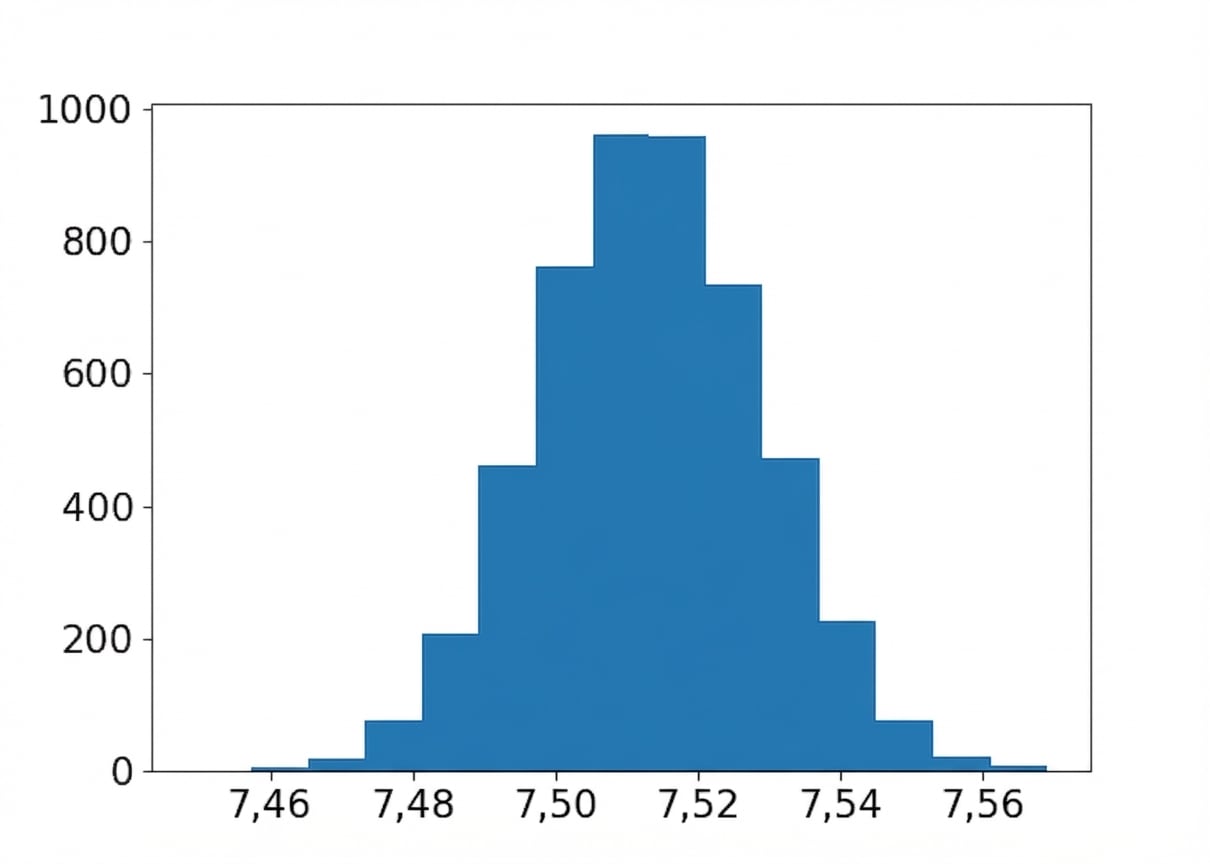
Mittelwerte: Stichprobe, Bootstrap-Verteilung, Population
Stichprobenmittel:
coffee_sample['flavor'].mean()
7.5132200000000005
Geschätzter Populationsmittelwert:
np.mean(bootstrap_distn)
7.513357731999999
Wahrer Populationsmittelwert:
coffee_ratings['flavor'].mean()
7.526046337817639
Mittelwerte interpretieren
Mittelwert der Bootstrap-Verteilung:
- Meist nah am Stichprobenmittel
- Schätzt den Populationsmittelwert evtl. schlecht
Bootstrapping korrigiert keine Stichprobenverzerrungen
Stichproben-SD vs. Bootstrap-Verteilungs-SD
Stichproben-Standardabweichung:
coffee_sample['flavor'].std()
0.3540883911928703
Geschätzte Populations-Standardabweichung?
np.std(bootstrap_distn, ddof=1)
0.015768474367958217
SD: Stichprobe, Bootstrap-Verteilung, Population
Stichproben-Standardabweichung:
coffee_sample['flavor'].std()
0.3540883911928703
Geschätzte Populations-Standardabweichung:
standard_error = np.std(bootstrap_distn, ddof=1)
Standardfehler ist die Standardabweichung der interessierenden Statistik
Wahre Standardabweichung:
coffee_ratings['flavor'].std(ddof=0)
0.34125481224622645
standard_error * np.sqrt(500)
0.3525938058821761
Standardfehler mal Wurzel der Stichprobengröße ≈ Populations-Standardabweichung
Standardfehler interpretieren
- Geschätzter Standardfehler → Standardabweichung der Bootstrap-Verteilung einer Stichprobenstatistik
- $\text{Pop.-Stdabw} \approx \text{Std. Fehler} \times \sqrt{\text{Stichprobengröße}}$
Lass uns üben!
Stichprobenziehung in Python

