Comprendre la notation Big O
Structures de données et algorithmes en Python

Miriam Antona
Software Engineer
Notation Big O
- Mesure complexité du pire cas d’un algorithme
- Complexité temporelle : temps pour s’exécuter complètement
- Complexité spatiale : mémoire supplémentaire
- N’utilise pas secondes/octets
- Résultats différents selon le matériel
- Expressions mathématiques : $O(1)$, $O(n)$, $O(n^2)$…
Notation Big O
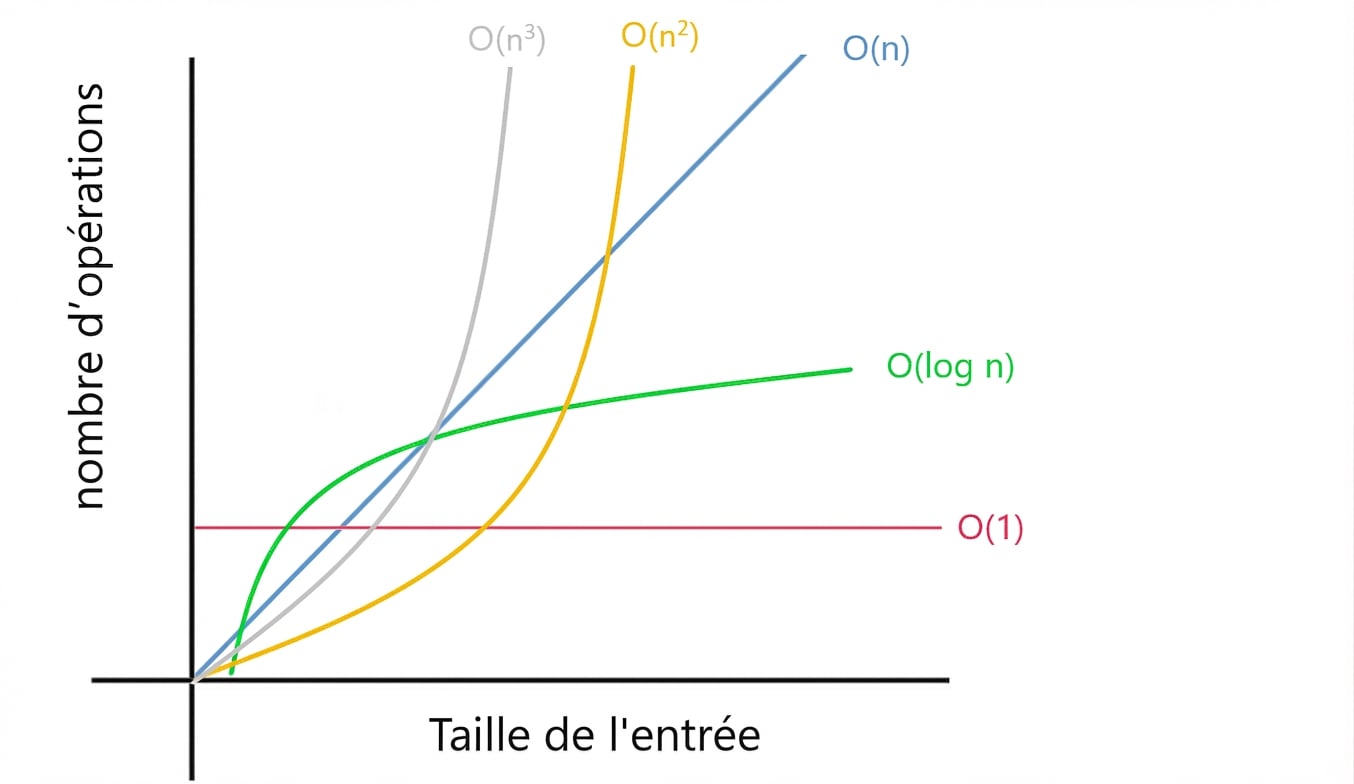
$O(1)$
colors = ['green', 'yellow', 'blue', 'pink']

def constant(colors):
    print(colors[2])

constant(colors)
blue
$O(1)$
colors = ['green', 'yellow', 'blue', 'pink', 'black', 'white', 'purple', 'red']

def constant(colors):
    print(colors[2])  # O(1)

constant(colors)
blue
$O(n)$
colors = ['green', 'yellow', 'blue', 'pink']

def linear(colors):
  for color in colors:
    print(color)

linear(colors)
greenyellowbluepink
$O(n)$
colors = ['green', 'yellow', 'blue', 'pink'] # n=4

def linear(colors):
  for color in colors:
    print(color)    # O(4)

linear(colors)
n=4: 4 opérations
$O(n)$
colors = ['green', 'yellow', 'blue', 'pink', 'black', 'white', 'purple'] # n=7

def linear(colors):
  for color in colors:
    print(color)    # O(7)

linear(colors)
n=4: 4 opérationsn=7: 7 opérationsn=100: 100 opérations- ...
- Complexité $O(n)$
$O(n^2)$
colors = ['green', 'yellow', 'blue']

def quadratic(colors):
  for first in colors:
      for second in colors:
          print(first, second)

quadratic(colors)
n=3: (3 x 3) 9 opérationsn=100: (100 x 100) 10 000 opérations- motif quadratique
- Complexité $O(n^2)$
green green
green yellow
green blue
yellow green
yellow yellow
yellow blue
blue green
blue yellow
blue blue
$O(n^3)$
colors = ['green', 'yellow', 'blue']

def cubic(colors):
  for color1 in colors:
      for color2 in colors:
          for color3 in colors:
              print(color1, color2, color3)

cubic(colors)
n=3: (3 x 3 x 3) 27 opérationsn=10: (10 x 10 x 10) 1 000 opérations- motif cubique
- Complexité $O(n^3)$
Calcul de la notation Big O
colors = ['green', 'yellow', 'blue', 'pink', 'black', 'white', 'purple']
other_colors = ['orange', 'brown']

def complex_algorithm(colors):
  color_count = 0

  for color in colors:
      print(color)
      color_count += 1

  for other_color in other_colors:
      print(other_color)
      color_count += 1

  print(color_count)

complex_algorithm(colors)
Calcul de la notation Big O
colors = ['green', 'yellow', 'blue', 'pink', 'black', 'white', 'purple'] # O(1) other_colors = ['orange', 'brown'] # O(1)def complex_algorithm(colors): color_count = 0 # O(1)for color in colors: print(color) # O(n) color_count += 1 # O(n)for other_color in other_colors: print(other_color) # O(m) color_count += 1 # O(m)print(color_count) # O(1)complex_algorithm(colors) # O(4
Calcul de la notation Big O
colors = ['green', 'yellow', 'blue', 'pink', 'black', 'white', 'purple']  # O(1)
other_colors = ['orange', 'brown']  # O(1)


def complex_algorithm(colors):
  color_count = 0          # O(1)


  for color in colors:
    print(color)           # O(n)
    color_count += 1       # O(n)


  for other_color in other_colors:
    print(other_color)     # O(m)
    color_count += 1       # O(m)


  print(color_count)       # O(1)


complex_algorithm(colors) # O(4 + 2n
Calcul de la notation Big O
colors = ['green', 'yellow', 'blue', 'pink', 'black', 'white', 'purple']  # O(1)
other_colors = ['orange', 'brown']  # O(1)

def complex_algorithm(colors):
  color_count = 0          # O(1)

  for color in colors:
    print(color)           # O(n)
    color_count += 1       # O(n)

  for other_color in other_colors:
    print(other_color)     # O(m)
    color_count += 1       # O(m)

  print(color_count)       # O(1)

complex_algorithm(colors) # O(4 + 2n + 2m)
Simplifier notation Big O
- Supprimer constantes
- $O(4 + 2n + 2m)$ -> $O(n + m)$
- Différentes variables pour différentes entrées
- $O(n + m)$
- Supprimer termes plus petits
- $O(n + n^2)$
Simplifier notation Big O
- Supprimer constantes
- $O(4 + 2n + 2m)$ -> $O(n + m)$
- Différentes variables pour différentes entrées
- $O(n + m)$
- Supprimer termes plus petits
- $O(n + n^2)$ -> $O(n^2)$
Passons à la pratique !
Structures de données et algorithmes en Python

