Introduction à la régression dans R
Richie Cotton
Data Evangelist at DataCamp
roach <- fish %>%
filter(species == "Roach")
| species | length_cm | mass_g |
|---|---|---|
| Gardon | 12,9 | 40 |
| Gardon | 16,5 | 69 |
| Gardon | 17,5 | 78 |
| Gardon | 18,2 | 87 |
| Gardon | 18,6 | 120 |
| ... | ... | ... |
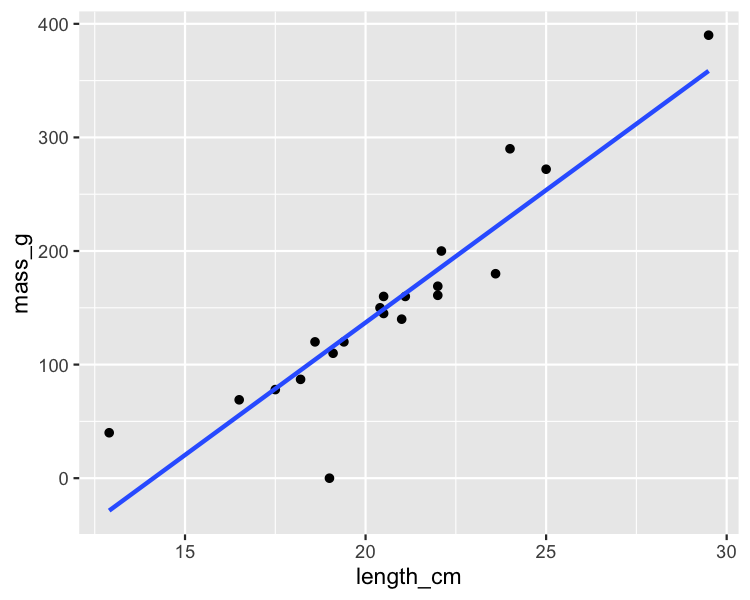
ggplot(roach, aes(length_cm, mass_g)) +
geom_point() +
geom_smooth(method = "lm", se = FALSE)

roach %>%
mutate(
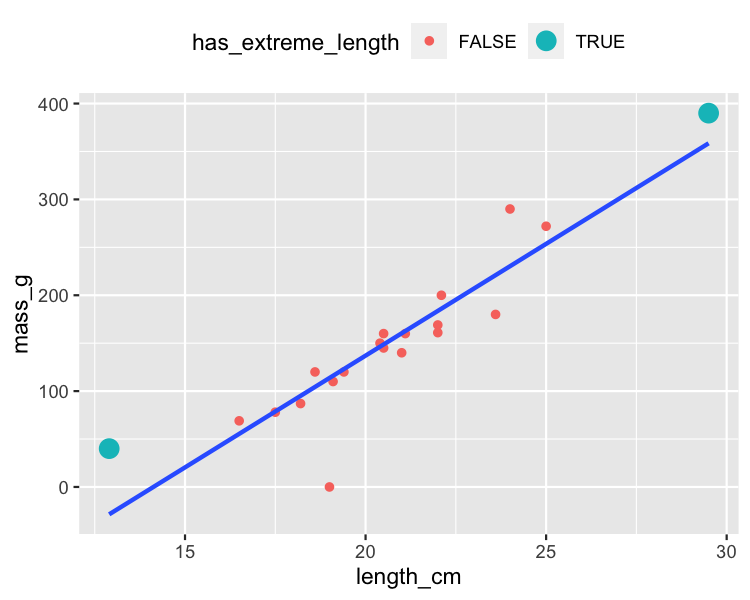
has_extreme_length = length_cm < 15 | length_cm > 26
) %>%
ggplot(aes(length_cm, mass_g)) +
geom_point(aes(color = has_extreme_length)) +
geom_smooth(method = "lm", se = FALSE)

roach %>%
mutate(
has_extreme_length = length_cm < 15 | length_cm > 26,
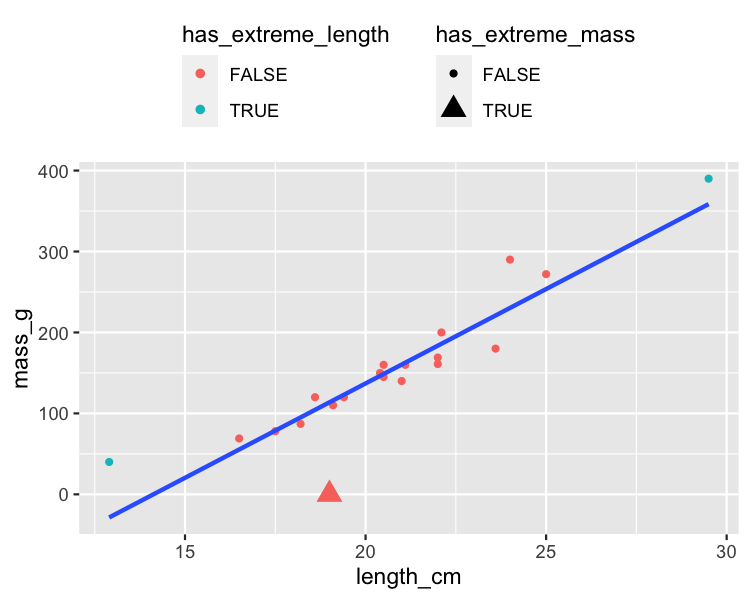
has_extreme_mass = mass_g < 1
) %>%
ggplot(aes(length_cm, mass_g)) +
geom_point(
aes(
color = has_extreme_length,
shape = has_extreme_mass
)
) +
geom_smooth(method = "lm", se = FALSE)

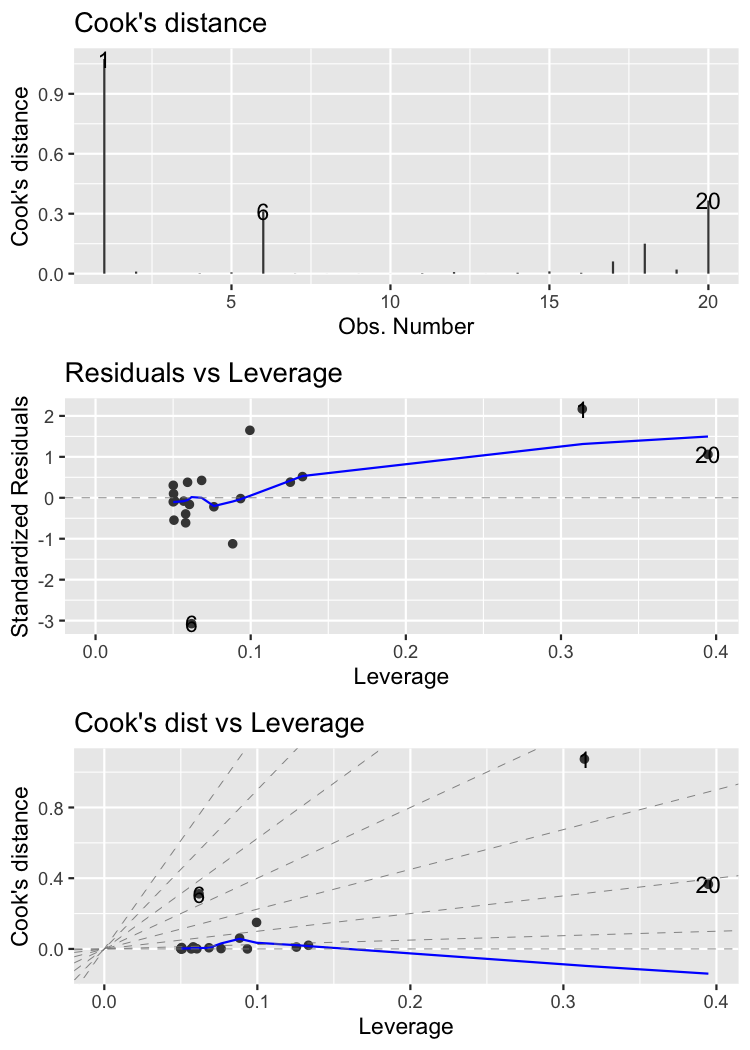
Le levier est une mesure de l'extrême variation des valeurs des variables explicatives.
mdl_roach <- lm(mass_g ~ length_cm, data = roach)
hatvalues(mdl_roach)
1 2 3 4 5 6 7
0.3137 0.1255 0.0935 0.0763 0.0684 0.0619 0.0605
8 9 10 11 12 13 14
0.0568 0.0503 0.0501 0.0501 0.0506 0.0509 0.0581
15 16 17 18 19 20
0.0581 0.0593 0.0884 0.0995 0.1334 0.3947
library(broom)
augment(mdl_roach)
# A tibble: 20 × 8
mass_g length_cm .fitted .resid .hat .sigma .cooksd .std.resid
<dbl> <dbl> <dbl> <dbl> <dbl> <dbl> <dbl> <dbl>
1 40 12.9 -28.6 68.6 0.314 33.8 1.07 2.17
2 69 16.5 55.4 13.6 0.126 39.1 0.0104 0.381
3 78 17.5 78.7 -0.711 0.0935 39.3 0.0000197 -0.0196
4 87 18.2 95.0 -8.03 0.0763 39.2 0.00198 -0.219
5 120 18.6 104. 15.6 0.0684 39.1 0.00661 0.424
...
mdl_roach %>%
augment() %>%
select(mass_g, length_cm, leverage = .hat) %>%
arrange(desc(leverage)) %>%
head()
# A tibble: 6 x 3
mass_g length_cm leverage
<dbl> <dbl> <dbl>
1 390 29.5 0.395 # really long roach
2 40 12.9 0.314 # really short roach
3 272 25 0.133
4 69 16.5 0.126
5 290 24 0.0995
6 78 17.5 0.0935
L'influence mesure dans quelle mesure le modèle changerait si vous retiriez l'observation de l'ensemble de données lors de la modélisation.

La distance de Cook est la mesure d'influence la plus couramment utilisée.
cooks.distance(mdl_roach)
1 2 3 4 5 6
1.07e+00 1.04e-02 1.97e-05 1.98e-03 6.61e-03 3.12e-01
7 8 9 10 11 12
8.53e-04 1.99e-04 2.57e-04 2.56e-04 2.45e-03 7.95e-03
13 14 15 16 17 18
1.37e-04 4.82e-03 1.15e-02 4.52e-03 6.12e-02 1.50e-01
19 20
2.06e-02 3.66e-01
library(broom)
augment(mdl_roach)
# A tibble: 20 x 9
mass_g length_cm .fitted .se.fit .resid .hat .sigma .cooksd .std.resid
<dbl> <dbl> <dbl> <dbl> <dbl> <dbl> <dbl> <dbl> <dbl>
1 40 12.9 -28.6 21.4 68.6 0.314 33.8 1.07 2.17
2 69 16.5 55.4 13.5 13.6 0.126 39.1 0.0104 0.381
3 78 17.5 78.7 11.7 -0.711 0.0935 39.3 0.0000197 -0.0196
4 87 18.2 95.0 10.5 -8.03 0.0763 39.2 0.00198 -0.219
5 120 18.6 104. 9.98 15.6 0.0684 39.1 0.00661 0.424
...
mdl_roach %>%
augment() %>%
select(mass_g, length_cm, cooks_dist = .cooksd) %>%
arrange(desc(cooks_dist)) %>%
head()
# A tibble: 6 x 3
mass_g length_cm cooks_dist
<dbl> <dbl> <dbl>
1 40 12.9 1.07 # really short roach
2 390 29.5 0.366 # really long roach
3 0 19 0.312 # zero mass roach
4 290 24 0.150
5 180 23.6 0.0612
6 272 25 0.0206
roach_not_short <- roach %>%
filter(length != 12.9)
ggplot(roach, aes(length_cm, mass_g)) +
geom_point() +
geom_smooth(method = "lm", se = FALSE) +
geom_smooth(
method = "lm", se = FALSE,
data = roach_not_short, color = "red"
)

Introduction à la régression dans R