Préparation des données

Marketing Analytics : prédire l’attrition client en Python

Mark Peterson

Director of Data Science, Infoblox

Hypothèses des modèles

  • Quelques hypothèses des modèles :
    • Variables explicatives suivant une loi normale
    • Variables sur la même échelle


Marketing Analytics : prédire l’attrition client en Python

Types de données

  • Les algorithmes de Machine learning exigent des types numériques
    • Il faut encoder les variables catégorielles en numériques
Marketing Analytics : prédire l’attrition client en Python
telco.dtypes
Account_Length      int64
Vmail_Message       int64
Day_Mins          float64
Eve_Mins          float64
Night_Mins        float64
Intl_Mins         float64
CustServ_Calls      int64
Churn              object
Intl_Plan          object
Vmail_Plan         object
Day_Calls           int64
Day_Charge        float64
Eve_Calls           int64
Eve_Charge        float64
Night_Calls         int64
Night_Charge      float64
Intl_Calls          int64
Intl_Charge       float64
State              object
Area_Code           int64
Phone              object
dtype: object
Marketing Analytics : prédire l’attrition client en Python

Encodage des variables binaires

telco['Intl_Plan'].head()
0     no
1     no
2     no
3    yes
4    yes
Name: Intl_Plan, dtype: object
Marketing Analytics : prédire l’attrition client en Python

Encodage des variables binaires

Option 1 : .replace()


telco['Intl_Plan'].replace({'no':0 , 'yes':1})

telco['Intl_Plan'].head()
0    0
1    0
2    0
3    1
4    1
Name: Intl_Plan, dtype: int64

Option 2 : LabelEncoder()

from sklearn.preprocessing import LabelEncoder

LabelEncoder().fit_transform(telco["Intl_Plan"])

telco['Intl_Plan'].head()
0    0
1    0
2    0
3    1
4    1
Name: Intl_Plan, dtype: int64
Marketing Analytics : prédire l’attrition client en Python

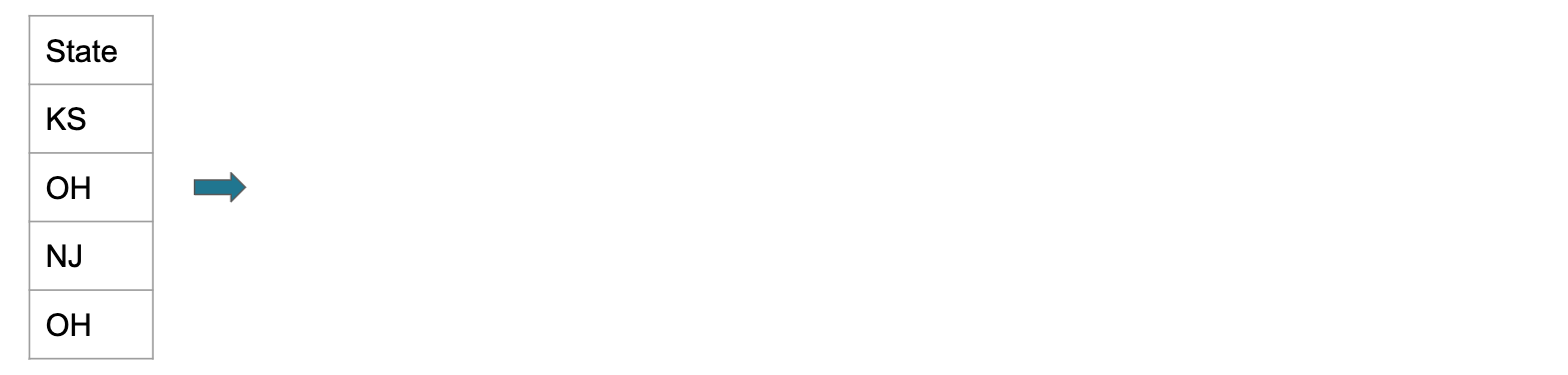
Encodage de l'État

telco['State'].head(4)
0    KS
1    OH
2    NJ
3    OH
Name: State, dtype: object
  • On pourrait attribuer un numéro à chaque État
0    0
1    1
2    2
3    1
Name: State, dtype: int64
  • Mauvaise idée
  • Cela rendrait votre modèle moins performant
Marketing Analytics : prédire l’attrition client en Python

One-hot encoding

Encodage one-hot

Marketing Analytics : prédire l’attrition client en Python

One-hot encoding

Encodage one-hot – partie 2

Marketing Analytics : prédire l’attrition client en Python

One-hot encoding

Encodage one-hot – partie 3

Marketing Analytics : prédire l’attrition client en Python

Mise à l'échelle des variables

  • Les variables doivent être sur la même échelle
  • Rarement vrai avec des données réelles
Marketing Analytics : prédire l’attrition client en Python

Mise à l'échelle des variables

telco['Intl_Calls'].describe()
count    3333.000000
mean        4.479448
std         2.461214
min         0.000000
25%         3.000000
50%         4.000000
75%         6.000000
max        20.000000
Name: Intl_Calls, dtype: float64
telco['Night_Mins'].describe()
count    3333.000000
mean      200.872037
std        50.573847
min        23.200000
25%       167.000000
50%       201.200000
75%       235.300000
max       395.000000
Name: Night_Mins, dtype: float64
Marketing Analytics : prédire l’attrition client en Python

Standardisation

  • Centre la distribution autour de la moyenne
  • Calcule, pour chaque point, l'écart-type à la moyenne
from sklearn.preprocessing import StandardScaler

df = StandardScaler().fit_transform(df)
Marketing Analytics : prédire l’attrition client en Python

Passons à la pratique !

Marketing Analytics : prédire l’attrition client en Python

Preparing Video For Download...