Rassembler le tout

Feature engineering en R

Jorge Zazueta

Research Professor. Head of the Modeling Group at the School of Economics, UASLP

Un flux de modélisation stylisé

Étapes types d'un modèle au niveau macro.
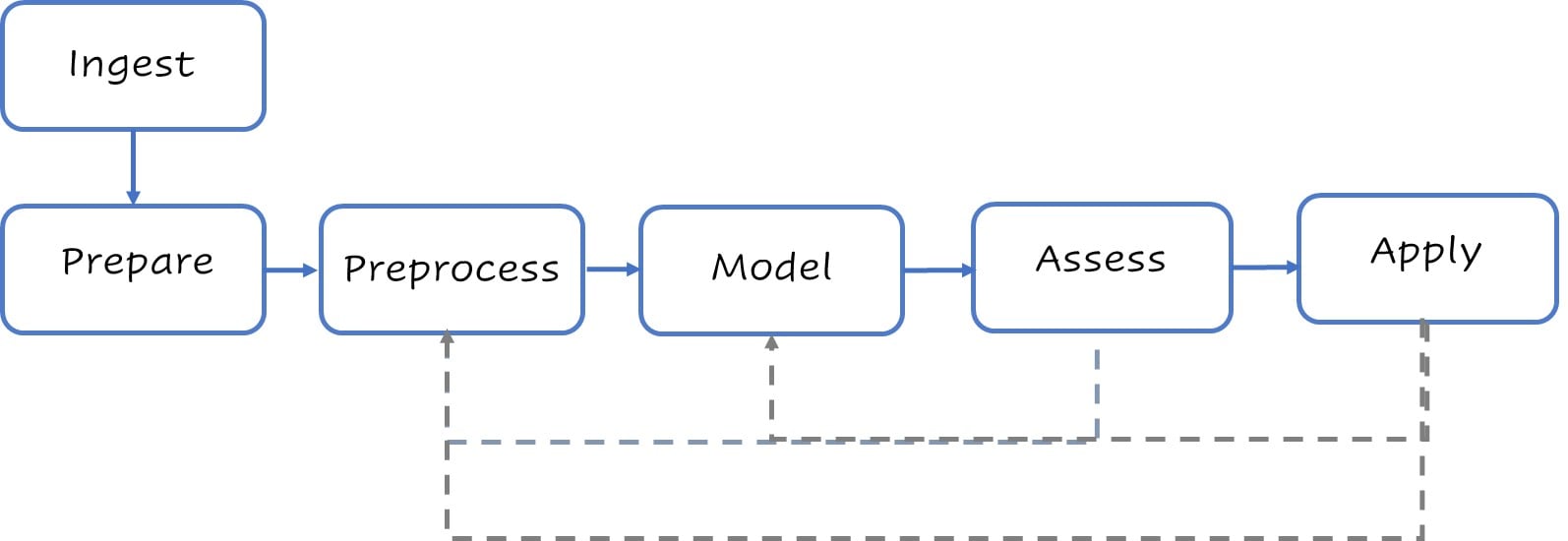
Organigramme du processus de modélisation.

Feature engineering en R

Un flux de modélisation stylisé

Étapes types d'un modèle au niveau macro.
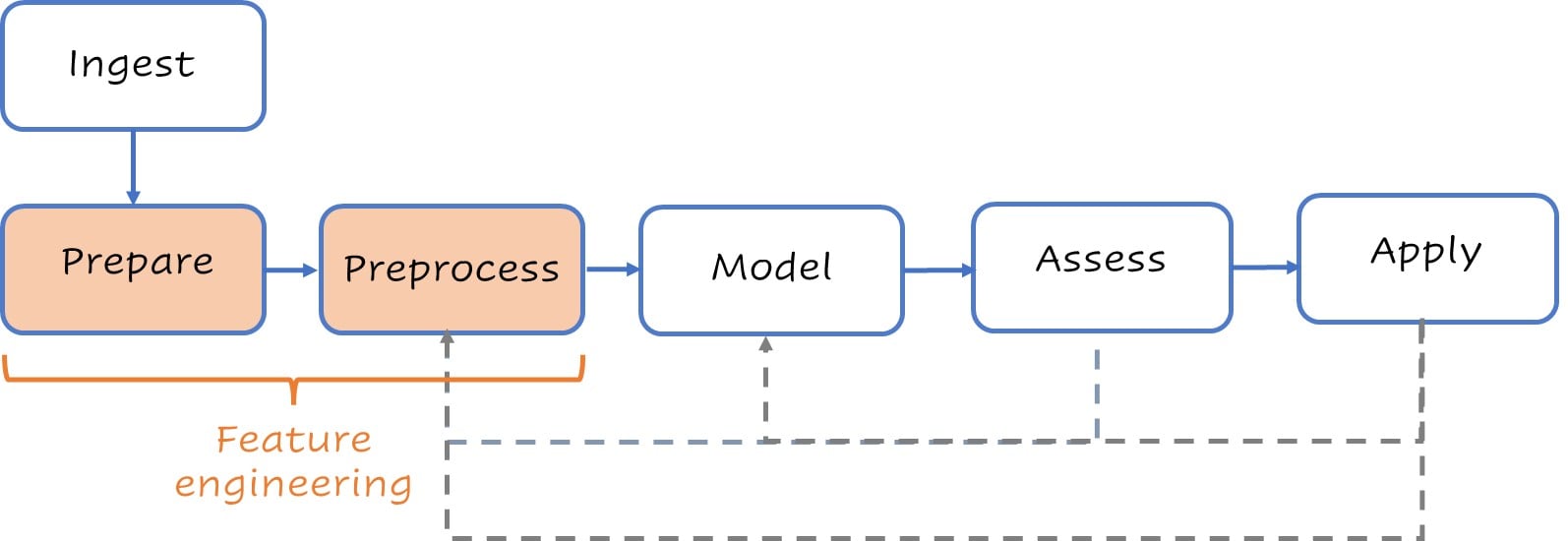
Flux de travail de modélisation, avec focus sur l'ingénierie des variables.

Feature engineering en R

Préparer

Commencez par un peu de ménage et créez les découpages.

loans <- # Basic housekeeping
  loans %>%
  mutate(across(where(is_character),
                  as_factor)) %>%
  mutate(across(Credit_History,
                  as_factor))

set.seed(123) # Set up splits
split <- initial_split(loans, 
        strata = Loan_Status)
test <- testing(split)
train <- training(split)
glimpse(train)
Rows: 460
Columns: 13
$ Loan_ID           <fct> LP001003...
$ Gender            <fct> Male, Ma...
$ Married           <fct> Yes, No,...
$ Dependents        <fct> 1, 0, 0,...
$ Education         <fct> Graduate...
$ Self_Employed     <fct> No, No, ...
$ ApplicantIncome   <dbl> 4583, 18...
$ CoapplicantIncome <dbl> 1508, 28...
$ LoanAmount        <dbl> 128, 114...
$ Loan_Amount_Term  <dbl> 360, 360...
$ Credit_History    <fct> 1, 1, 0,...
$ Property_Area     <fct> Rural, R...
$ Loan_Status       <fct> N, N, N,...
Feature engineering en R

Prétraiter

Notre recette peut être très courte ou très complexe.

recipe <- recipe(Loan_Status ~ .,
data = train) %>%
  update_role(Loan_ID, 
  new_role = "ID") %>%
  step_normalize(all_numeric_predictors()) %>% 
  step_impute_knn(all_predictors()) %>%
  step_dummy(all_nominal_predictors())
recipe
Recipe

Inputs:

      role #variables
        ID          1
   outcome          1
 predictor         11

Operations:

Centering and scaling for all_numeric_predictors()
K-nearest neighbor imputation for all_predictors()
Dummy variables from all_nominal_predictors()
Feature engineering en R

Modéliser

Configurer le workflow

lr_model <- logistic_reg() %>%
  set_engine("glmnet") %>%
  set_args(mixture = 1, penalty = tune())

lr_penalty_grid <- grid_regular(
  penalty(range = c(-3, 1)),
  levels = 30)

lr_workflow <-
  workflow() %>%
  add_model(lr_model) %>%
  add_recipe(recipe)
lr_workflow
--Workflow -------------------------------
Preprocessor: Recipe
Model: logistic_reg()

-- Preprocessor --------------------------
3 Recipe Steps
- step_normalize()
- step_impute_knn()
- step_dummy()

-- Model ---------------------------------
Logistic Regression Model Specification (classification)

Main Arguments:
  penalty = tune()
  mixture = 1
Computational engine: glmnet
Feature engineering en R

Évaluer

Ajuster la pénalité pour Lasso

lr_tune_output <- tune_grid( 
  lr_workflow,
  resamples = vfold_cv(train, v = 5),
  metrics = metric_set(roc_auc),
  grid = penalty_grid)

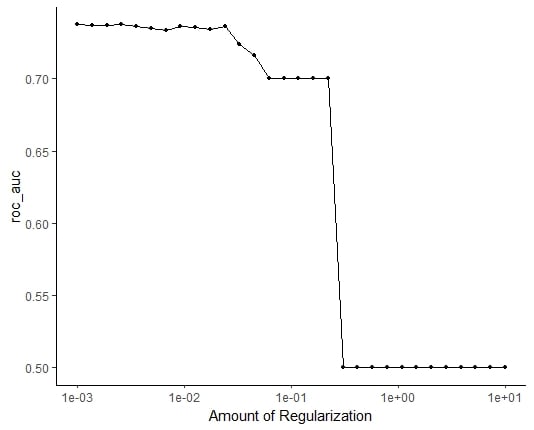
autoplot(tune_output)

ROC_AUC vs. régularisation

Graphique de ROC_AUC en fonction de la régularisation.

Feature engineering en R

Évaluer

Ajuster le modèle final

best_penalty <-
select_by_one_std_err(lr_tune_output,
metric = 'roc_auc', desc(penalty)) 

lr_final_fit<-
finalize_workflow(lr_workflow, best_penalty) %>%
  fit(data = train)

lr_final_fit %>%
  augment(test) %>% 
  class_evaluate(truth = Loan_Status,
              estimate = .pred_class,
                         .pred_Y)

Nos métriques de performance

# A tibble: 2 × 3
  .metric  .estimator .estimate
  <chr>    <chr>          <dbl>
1 accuracy binary         0.818
2 roc_auc  binary         0.813
Feature engineering en R

Passons à la pratique !

Feature engineering en R

Preparing Video For Download...