Transformations de variables courantes

Feature engineering en R

Jorge Zazueta

Research Professor and Head of the Modeling Group at the School of Economics, UASLP

Deux familles de transformations

Box-Cox

  • Transforme une variable non normale pour la rapprocher de la normale
  • Famille incluant comme cas particuliers l'inverse, le log, les racines carrée et cubique
  • S'applique aux valeurs strictement positives
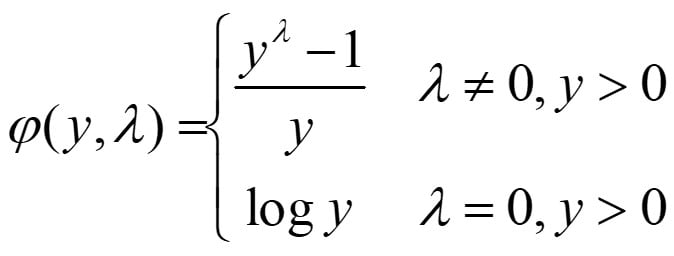
Équation de la transformation Box-Cox.

Yeo-Johnson

  • Propriétés proches de Box-Cox
  • Gère les valeurs nulles et négatives
  • Pour $y$ positif, équivaut à Box-Cox de $y+1$
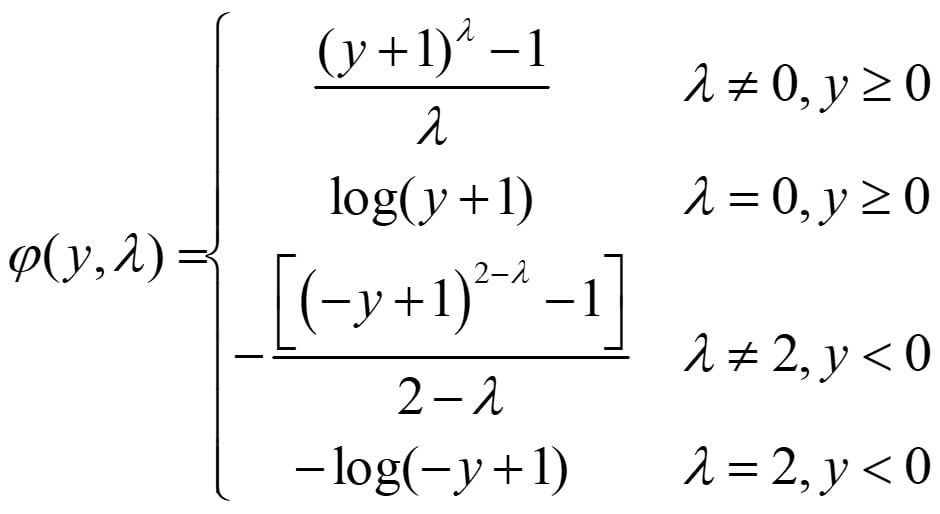
Équation de la transformation Yeo-Johnson.

Feature engineering en R

Le jeu de données loans_num

glimpse(loans_num)
Rows: 480
Columns: 6
$ Loan_Status       <fct> N, Y, Y, Y, Y, Y, N, Y, N, Y, Y, N, Y, Y, N...
$ ApplicantIncome   <dbl> 4583, 3000, 2583, 6000, 5417, 2333, 3036, 4...
$ CoapplicantIncome <dbl> 1508, 0, 2358, 0, 4196, 1516, 2504, 1526, 1...
$ LoanAmount        <dbl> 128, 66, 120, 141, 267, 95, 158, 168, 349, ...
$ Loan_Amount_Term  <dbl> 360, 360, 360, 360, 360, 360, 360, 360, 360...
$ Credit_History    <fct> 1, 1, 1, 1, 1, 1, 0, 1, 1, 1, 1, 1, 1, 1, 0...
Feature engineering en R

Appliquer des transformations

Recette simple

lr_recipe_plain <- # Define recipe
  recipe(Loan_Status ~., data = train)
lr_workflow_plain <- # Bundle workflows
  workflow() %>%
  add_model(lr_model) %>%
  add_recipe(lr_recipe_plain)
lr_fit_plain <- # fit and augment
  lr_workflow_plain %>%
  fit(train)

Évaluer les performances

lr_aug_plain %>% # Assess
  class_evaluate(truth = Loan_Status,
                 estimate = .pred_class,
                 .pred_N)
# A tibble: 2 × 3
  .metric  .estimator .estimate
  <chr>    <chr>          <dbl>
1 accuracy binary         0.817
2 roc_auc  binary         0.641
Feature engineering en R

Appliquer des transformations

Recette Box-Cox

lr_recipe_BC <- # Define recipe
  recipe(Loan_Status ~., data = train) %>%
  step_BoxCox(all_numeric())
lr_workflow_BC <- # Bundle workflows
  workflow() %>%
  add_model(lr_model) %>%
  add_recipe(lr_recipe_BC)
lr_fit_BC <- # fit and augment
  lr_workflow_BC %>%
  fit(train)

Message d'avertissement

Box-Cox ne peut pas traiter des valeurs non positives

Warning messages:
1: Non-positive values in selected
variable. 
2: No Box-Cox transformation could be 
estimated for: `CoapplicantIncome`
Feature engineering en R

Appliquer des transformations

Recette Box-Cox (2e essai)

Désélectionnons maintenant CoappliantIncome pour éviter l'avertissement.

lr_recipe_BC <- # Define recipe
  recipe(Loan_Status ~., data = train) %>%
  step_BoxCox(all_numeric(), 
              -CoapplicantIncome)
lr_workflow_BC <- # Bundle workflows
  workflow() %>%
  add_model(lr_model) %>%
  add_recipe(lr_recipe_BC)
lr_fit_BC <- # fit and augment
  lr_workflow_BC %>%
  fit(train)

Évaluer les performances

lr_aug_BC %>% # Assess
  class_evaluate(truth = Loan_Status,
                 estimate = .pred_class,
                 .pred_N)
# A tibble: 2 × 3
  .metric  .estimator .estimate
  <chr>    <chr>          <dbl>
1 accuracy binary         0.817
2 roc_auc  binary         0.599
Feature engineering en R

Appliquer des transformations

Recette Yeo-Johnson

lr_recipe_YJ <- # Define recipe
  recipe(Loan_Status ~., data = train) %>%
  step_YeoJohnson(all_numeric())
lr_workflow_YJ <- # Bundle workflows
  workflow() %>%
  add_model(lr_model) %>%
  add_recipe(lr_recipe_YJ)
lr_fit_YJ <- # fit and augment
  lr_workflow_YJ %>%
  fit(train)

Évaluer les performances

lr_aug_YJ %>% # Assess
  class_evaluate(truth = Loan_Status,
                 estimate = .pred_class,
                 .pred_N)
# A tibble: 2 × 3
  .metric  .estimator .estimate
  <chr>    <chr>          <dbl>
1 accuracy binary         0.817
2 roc_auc  binary         0.700
Feature engineering en R

Passons à la pratique !

Feature engineering en R

Preparing Video For Download...