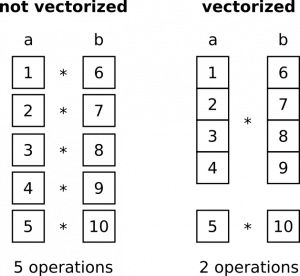
Vectorisation sur des séries pandas

Écrire du code efficace avec pandas

Leonidas Souliotis

PhD Candidate

DataFrames comme tableaux

Logo GitHub

Écrire du code efficace avec pandas

Comment faire une vectorisation pandas

start_time = time.time()
poker[['R1', 'R2', 'R3', 'R4', 'R5']].sum(axis=1)
print("Time using pandas vectorization: {} sec".format(time.time() - start_time))
Time using pandas vectorization: 0.0026819705 sec
poker[['R1', 'R2', 'R3', 'R4', 'R5']].sum(axis=1).head()
|              |    | 
|--------------|----| 
| 0            | 47 | 
| 1            | 47 | 
| 2            | 47 | 
| 3            | 47 | 
| 4            | 47 | 
| dtype: int64 | -- |
Écrire du code efficace avec pandas

Comparaison avec les méthodes précédentes

data_generator = data.iterrows()

start_time = time.time()
for index, value in data_generator:
        sum([value[1], value[3], value[5], value[7]])
print("Time using .iterrows(){} seconds" % (time.time() - start_time))
Results from the above operation calculated in 3.37918996 seconds
start_time = time.time()
data[['R1', 'R2', 'R3', 'R4', 'R5']].apply(lambda x: sum(x),axis=1)
print("Results from the above operation calculated in %s seconds" % (time.time() - start_time))
Results from the above operation calculated in 0.637711048 seconds
- Difference between vectorization and the `.iterows()` function: 111,800.75%
- Difference between vectorization and the `.apply()` function: 20,853%
Écrire du code efficace avec pandas

Passons à la pratique !

Écrire du code efficace avec pandas

Preparing Video For Download...