A família de funções map

Machine Learning no tidyverse

Dmitriy (Dima) Gorenshteyn

Lead Data Scientist, Memorial Sloan Kettering Cancer Center

Fluxo de colunas de lista

Machine Learning no tidyverse

Fluxo de colunas de lista

Machine Learning no tidyverse

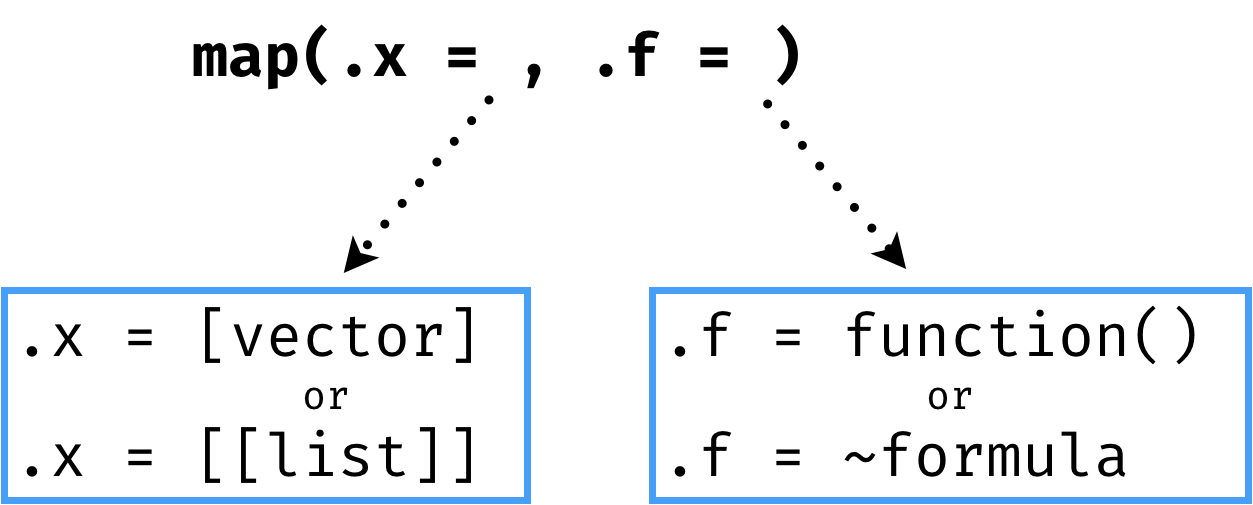
A função map

Machine Learning no tidyverse

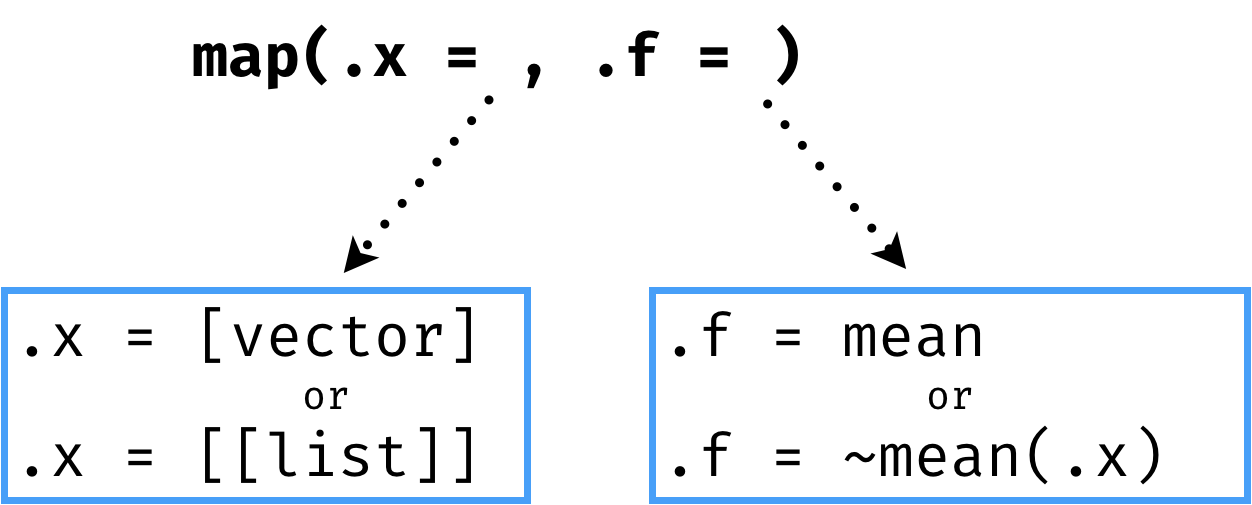
A função map

Machine Learning no tidyverse

A função map

Machine Learning no tidyverse

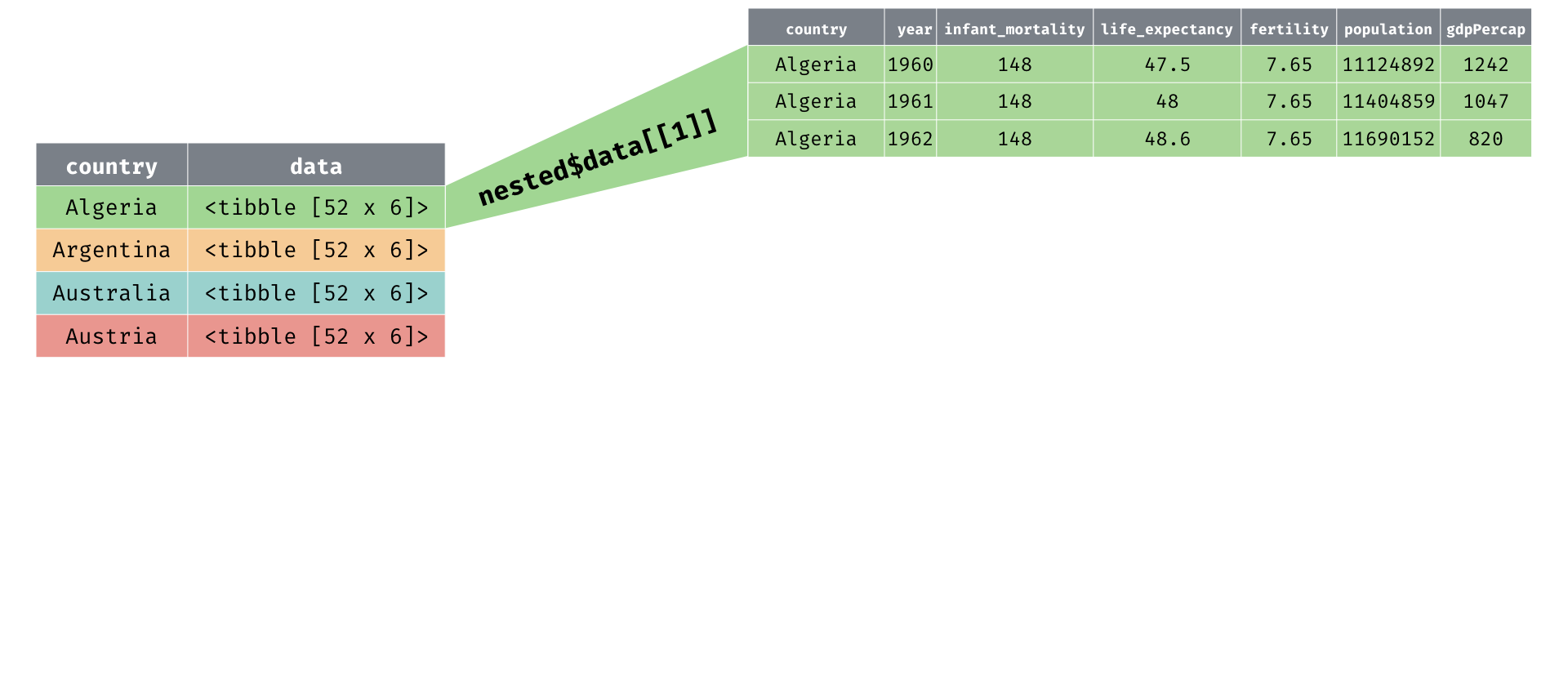
Média da população por país

mean(nested$data[[1]]$population)
[1] 23129438
Machine Learning no tidyverse

Média da população por país

map(.x = nested$data, .f = ~mean(.x$population))
[[1]]
[1] 23129438

[[2]]
[1] 30783053

[[3]]
[1] 16074837

[[4]]
[1] 7746272
Machine Learning no tidyverse

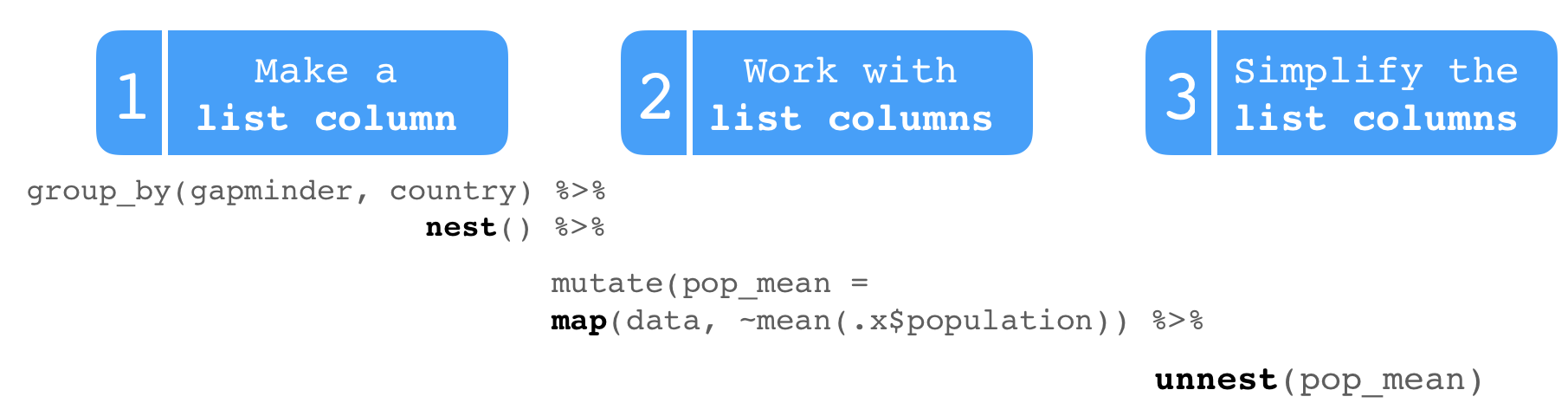
2: Trabalhe com colunas de lista - map() e mutate()

pop_df <- nested %>% 
  mutate(pop_mean = map(data, ~mean(.x$population)))

pop_df
# A tibble: 77 x 3
   country    data              pop_mean 
   <fct>      <list>            <list>   
 1 Algeria    <tibble [52 × 6]> <dbl [1]>
 2 Argentina  <tibble [52 × 6]> <dbl [1]>
 3 Australia  <tibble [52 × 6]> <dbl [1]>
 4 Austria    <tibble [52 × 6]> <dbl [1]>
 5 Bangladesh <tibble [52 × 6]> <dbl [1]>
Machine Learning no tidyverse

3: Simplifique colunas de lista - unnest()

pop_df %>% 
  unnest(pop_mean)
# A tibble: 77 x 3
   country    data               pop_mean
   <fct>      <list>                <dbl>
 1 Algeria    <tibble [52 × 6]>  23129438
 2 Argentina  <tibble [52 × 6]>  30783053
 3 Australia  <tibble [52 × 6]>  16074837
 4 Austria    <tibble [52 × 6]>   7746272
 5 Bangladesh <tibble [52 × 6]>  97649407
Machine Learning no tidyverse

Fluxo de colunas de lista

Machine Learning no tidyverse

Trabalhe e simplifique colunas de lista com map_*()

function returns
map() list
map_dbl() double
map_lgl() logical
map_chr() character
map_int() integer
Machine Learning no tidyverse

Trabalhe e simplifique colunas de lista com map_dbl()

nested %>% 
  mutate(pop_mean = map_dbl(data, ~mean(.x$population)))
# A tibble: 77 x 3
   country    data               pop_mean
   <fct>      <list>                <dbl>
 1 Algeria    <tibble [52 × 6]>  23129438
 2 Argentina  <tibble [52 × 6]>  30783053
 3 Australia  <tibble [52 × 6]>  16074837
 4 Austria    <tibble [52 × 6]>   7746272
 5 Bangladesh <tibble [52 × 6]>  97649407
Machine Learning no tidyverse

Crie modelos com map()

nested %>%
   mutate(model = map(data, ~lm(formula = population~fertility, 
             data = .x)))
# A tibble: 77 x 3
   country    data              model   
   <fct>      <list>            <list>  
 1 Algeria    <tibble [52 × 6]> <S3: lm>
 2 Argentina  <tibble [52 × 6]> <S3: lm>
 3 Australia  <tibble [52 × 6]> <S3: lm>
 4 Austria    <tibble [52 × 6]> <S3: lm>
 5 Bangladesh <tibble [52 × 6]> <S3: lm>
Machine Learning no tidyverse

Vamos mapear algo!

Machine Learning no tidyverse

Preparing Video For Download...