Machine Learning voor tijdreeksgegevens in Python
Chris Holdgraf
Fellow, Berkeley Institute for Data Science
print(df)
df
0 0.0
1 1.0
2 2.0
3 3.0
4 4.0
# Verschuif een DataFrame/Series 3 indexwaarden naar het verleden
print(df.shift(3))
df
0 NaN
1 NaN
2 NaN
3 0.0
4 1.0
# data is a pandas Series containing time series data
data = pd.Series(...)
# Shifts
shifts = [0, 1, 2, 3, 4, 5, 6, 7]
# Create a dictionary of time-shifted data
many_shifts = {'lag_{}'.format(ii): data.shift(ii) for ii in shifts}
# Convert them into a dataframe
many_shifts = pd.DataFrame(many_shifts)
# Fit het model met deze inputfeatures
model = Ridge()
model.fit(many_shifts, data)
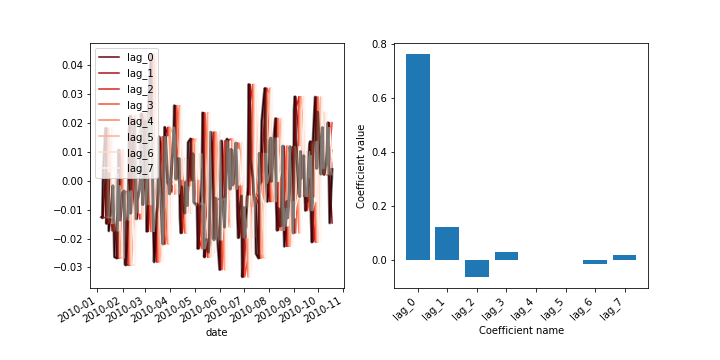
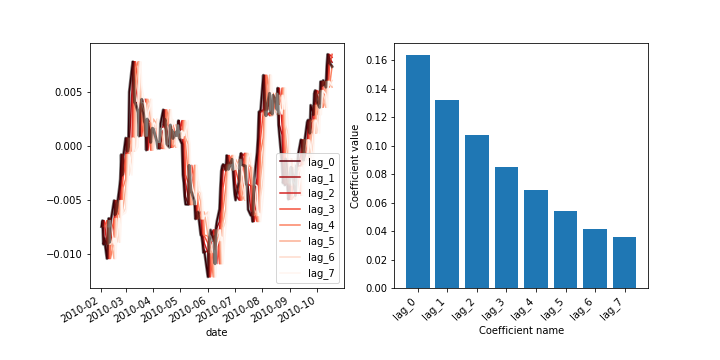
# Visualiseer de modelcoëfficiënten
fig, ax = plt.subplots()
ax.bar(many_shifts.columns, model.coef_)
ax.set(xlabel='Naam coëfficiënt', ylabel='Waarde coëfficiënt')
# Opmaak zodat het er netjes uitziet
plt.setp(ax.get_xticklabels(), rotation=45, horizontalalignment='right')


Machine Learning voor tijdreeksgegevens in Python