Introducing Grid Search

Ottimizzazione degli iperparametri in Python

Alex Scriven

Data Scientist

Automating 2 Hyperparameters

Your previous work:

neighbors_list = [3,5,10,20,50,75]
accuracy_list = []
for test_number in neighbors_list:
    model = KNeighborsClassifier(n_neighbors=test_number)
    predictions = model.fit(X_train, y_train).predict(X_test)
    accuracy = accuracy_score(y_test, predictions)
    accuracy_list.append(accuracy)

Which we then collated in a dataframe to analyse.

Ottimizzazione degli iperparametri in Python

Automating 2 Hyperparameters


What about testing values of 2 hyperparameters?

Using a GBM algorithm:

  • learn_rate [0.001, 0.01, 0.05]
  • max_depth [4,6,8,10]

We could use a (nested) for loop!

Ottimizzazione degli iperparametri in Python

Automating 2 Hyperparameters

Firstly a model creation function:

def gbm_grid_search(learn_rate, max_depth):
    model = GradientBoostingClassifier(
            learning_rate=learn_rate,
            max_depth=max_depth)

predictions = model.fit(X_train, y_train).predict(X_test)
return([learn_rate, max_depth, accuracy_score(y_test, predictions)])
Ottimizzazione degli iperparametri in Python

Automating 2 Hyperparameters


Now we can loop through our lists of hyperparameters and call our function:

results_list = []

for learn_rate in learn_rate_list:
    for max_depth in max_depth_list:
        results_list.append(gbm_grid_search(learn_rate,max_depth))

Ottimizzazione degli iperparametri in Python

Automating 2 Hyperparameters


We can put these results into a DataFrame as well and print out:

results_df = pd.DataFrame(results_list, columns=['learning_rate', 'max_depth', 'accuracy'])
print(results_df)
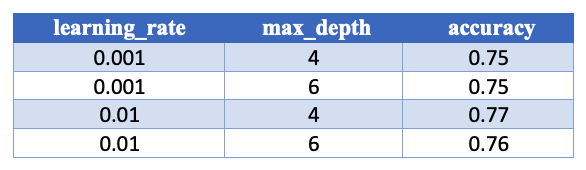
results table

Ottimizzazione degli iperparametri in Python

How many models?


There were many more models built by adding more hyperparameters and values.

  • The relationship is not linear, it is exponential
  • One more value of a hyperparameter is not just one model
  • 5 for Hyperparameter 1 and 10 for Hyperparameter 2 is 50 models!

What about cross-validation?

  • 10-fold cross-validation would make 50x10 = 500 models!
Ottimizzazione degli iperparametri in Python

From 2 to N hyperparameters


What about adding more hyperparameters?

We could nest our loop!

# Adjust the list of values to test
learn_rate_list = [0.001, 0.01, 0.1, 0.2, 0.3, 0.4, 0.5]
max_depth_list = [4,6,8, 10, 12, 15, 20, 25, 30]
subsample_list = [0.4,0.6, 0.7, 0.8, 0.9]
max_features_list = ['auto', 'sqrt']
Ottimizzazione degli iperparametri in Python

From 2 to N hyperparameters

Adjust our function:

def gbm_grid_search(learn_rate, max_depth,subsample,max_features):
    model = GradientBoostingClassifier(
        learning_rate=learn_rate, 
        max_depth=max_depth,
        subsample=subsample,
        max_features=max_features)
    predictions = model.fit(X_train, y_train).predict(X_test)
    return([learn_rate, max_depth, accuracy_score(y_test, predictions)])
Ottimizzazione degli iperparametri in Python

From 2 to N hyperparameters

Adjusting our for loop (nesting):

for learn_rate in learn_rate_list:
    for max_depth in max_depth_list:
        for subsample in subsample_list:
            for max_features in max_features_list:
                results_list.append(gbm_grid_search(learn_rate,max_depth,
                                     subsample,max_features))
results_df = pd.DataFrame(results_list, columns=['learning_rate',
                         'max_depth', 'subsample', 'max_features','accuracy'])
print(results_df)
Ottimizzazione degli iperparametri in Python

From 2 to N hyperparameters


How many models now?

  • 7x9x5x2 = 630 (6,300 if cross-validated!)

We can't keep nesting forever!

Plus, what if we wanted:

  • Details on training times & scores
  • Details on cross-validation scores
Ottimizzazione degli iperparametri in Python

Introducing Grid Search

Let's create a grid:

  • Down the left all values of max_depth
  • Across the top all values of learning_rate
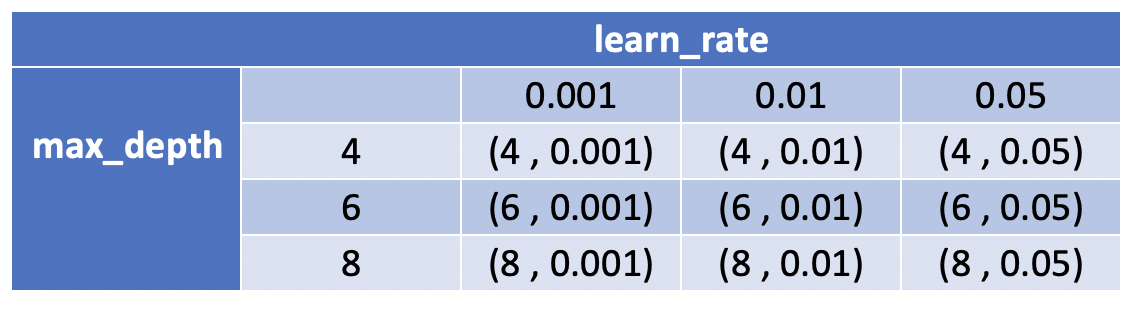
Table of hyperparameter combinations

Ottimizzazione degli iperparametri in Python

Introducing Grid Search

Working through each cell on the grid:

table of hyperparameter combinations

(4,0.001) is equivalent to making an estimator like so:

GradientBoostingClassifier(max_depth=4, learning_rate=0.001)
Ottimizzazione degli iperparametri in Python

Grid Search Pros & Cons


Some advantages of this approach:

Advantages:

  • You don't have to write thousands of lines of code
  • Finds the best model within the grid (*special note here!)
  • Easy to explain
Ottimizzazione degli iperparametri in Python

Grid Search Pros & Cons


Some disadvantages of this approach:

  • Computationally expensive! Remember how quickly we made 6,000+ models?
  • It is 'uninformed'. Results of one model don't help creating the next model.


We will cover 'informed' methods later!

Ottimizzazione degli iperparametri in Python

Let's practice!

Ottimizzazione degli iperparametri in Python

Preparing Video For Download...