Modern portfolio theory

Gestione quantitativa del rischio in Python

Jamsheed Shorish

Computational Economist

The risk-return trade-off

  • Risk factors: sources of uncertainty affecting return
  • Intuitively: greater uncertainty (more risk) compensated by greater return
  • Cannot guarantee return: need some measure of expected return
    • average (mean) historical return: proxy for expected future return
Gestione quantitativa del rischio in Python

Investor risk appetite

  • Investor survey: minimum return required for given level of risk?
  • Survey response creates (risk, return) risk profile "data point"
  • Vary risk level => set of (risk, return) points
  • Investor risk appetite: defines one quantified relationship between risk and return
Gestione quantitativa del rischio in Python

Choosing portfolio weights

  • Vary portfolio weights of given portfolio => creates set of (risk, return) pairs
  • Changing weights = beginning risk management!
  • Goal: change weights to maximize expected return, given risk level
    • Equivalently: minimize risk, given expected return level
  • Changing weights = adjusting investor's risk exposure
Gestione quantitativa del rischio in Python

Modern portfolio theory

  • Efficient portfolio: portfolio with weights generating highest expected return for given level of risk
  • Modern Portfolio Theory (MPT), 1952
    • H. M. Markowitz (Nobel Laureate 1990)
  • Efficient portfolio weight vector $w^\star$ solves:

Optimization problem equations for finding the efficient portfolio

Gestione quantitativa del rischio in Python

The efficient frontier

  • Compute many efficient portfolios for different levels of risk
  • Efficient frontier: locus of (risk, return) pairs created by efficient portfolios
  • PyPortfolioOpt library: optimized tools for MPT
    • EfficientFrontier class: generates one optimal portfolio at a time
    • Constrained Line Algorithm (CLA) class: generates the entire efficient frontier
      • Requires covariance matrix of returns
      • Requires proxy for expected future returns: mean historical returns
Gestione quantitativa del rischio in Python

Investment bank portfolio 2005 - 2010

  • Expected returns: historical data
  • Covariance matrix: Covariance Shrinkage improves efficiency of estimate
  • Constrained Line Algorithm object CLA
  • Minimum variance portfolio: cla.min_volatility()
  • Efficient frontier: cla.efficient_frontier()


expected_returns = mean_historical_return(prices)

efficient_cov = CovarianceShrinkage(prices).ledoit_wolf()
cla = CLA(expected_returns, efficient_cov)
minimum_variance = cla.min_volatility()
(ret, vol, weights) = cla.efficient_frontier()
Gestione quantitativa del rischio in Python

Visualizing the efficient frontier

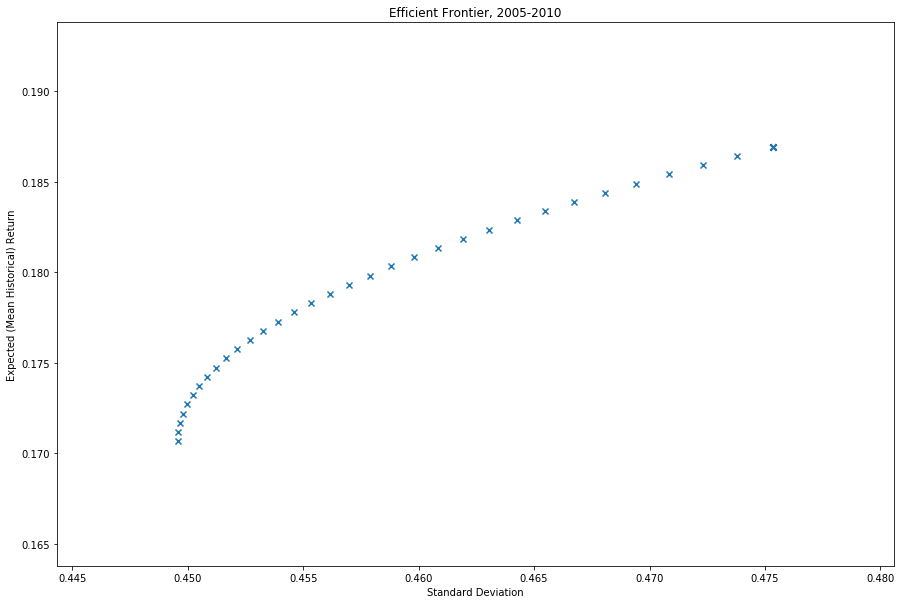
  • Scatter plot of (vol, ret) pairs

The efficient frontier graph plotted as a series of (risk, return) pairs

Gestione quantitativa del rischio in Python

Visualizing the efficient frontier

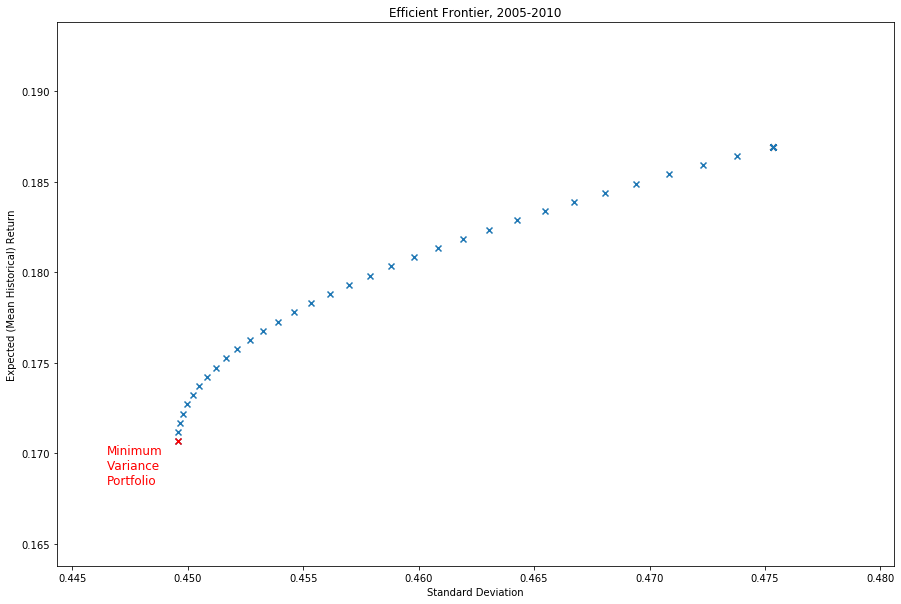
  • Scatter plot of (vol, ret) pairs
  • Minimum variance portfolio: smallest volatility of all possible efficient portfolios

The minimum variance portfolio highlighted on the efficient frontier graph

Gestione quantitativa del rischio in Python

Visualizing the efficient frontier

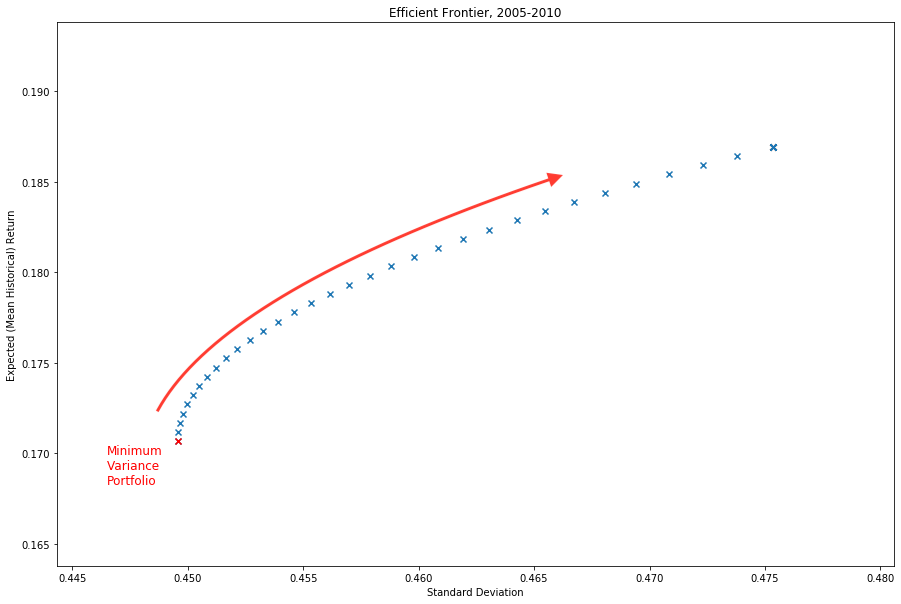
  • Scatter plot of (vol, ret) pairs
  • Minimum variance portfolio: smallest volatility of all possible efficient portfolios
  • Increasing risk appetite: move along the frontier

Movement along the efficient frontier graph depicted as an arrow moving in the direction of higher risk and higher reward

Gestione quantitativa del rischio in Python

Let's practice!

Gestione quantitativa del rischio in Python

Preparing Video For Download...