Confronto tra ereditarietà e rappresentazione in stringa
Introduzione alla programmazione orientata agli oggetti in Python

George Boorman
Curriculum Manager, DataCamp
Confronto di oggetti di classi diverse
class Customer:
    def __init__(self, acc_id, name):
        self.acc_id, self.name = acc_id, name

    def __eq__(self, other):
        # Returns True if the objects have the same attributes
        # and are of the same type
        return (self.acc_id == other.acc_id) and (self.name == other.name)\n            and (type(self) == type(other))
Confrontare oggetti con l'ereditarietà
E se un oggetto eredita dalla classe dell'altro oggetto?
Conti bancari e di risparmio
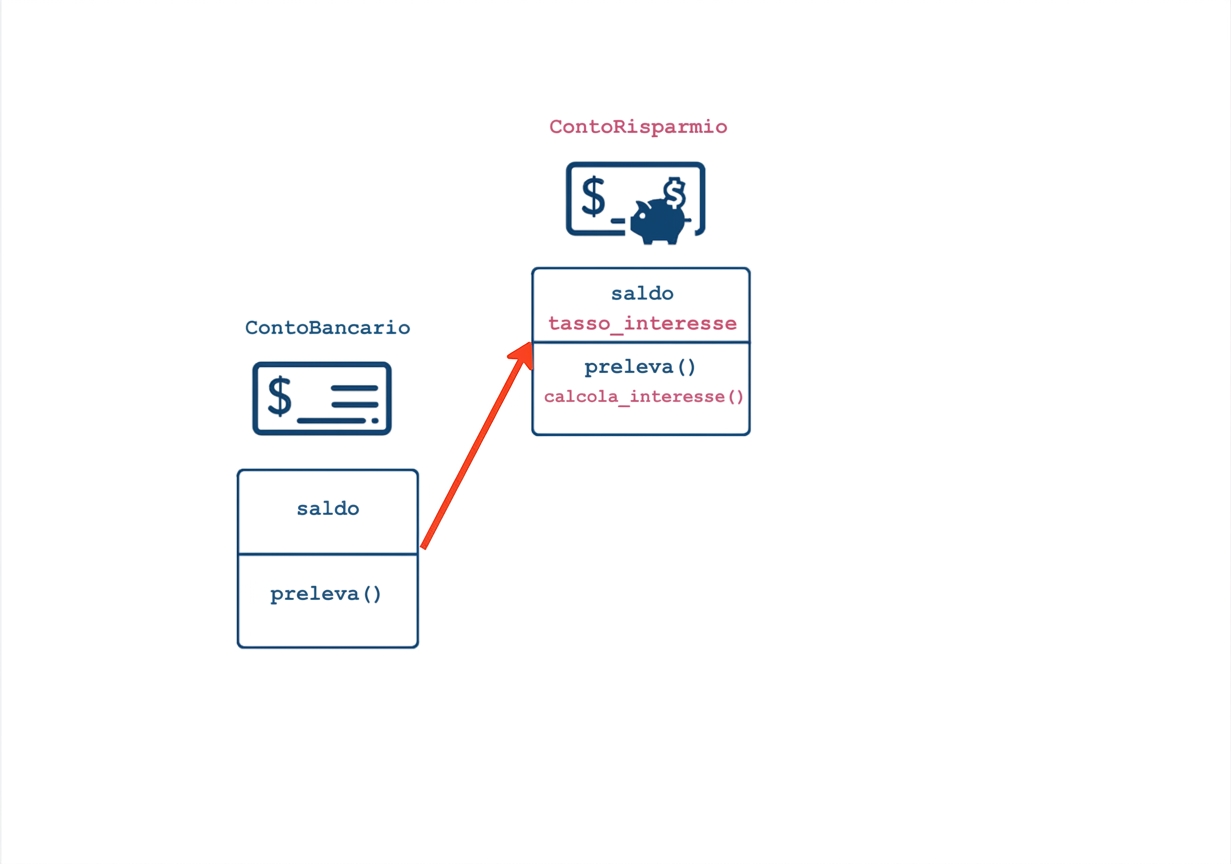
__eq__ nelle classi padre/figlio
class BankAccount:
    def __init__(self, number, balance=0):
        self.balance = balance
        self.number = number

    def withdraw(self, amount):
        self.balance -= amount

    # Define __eq__ that returns True
    # if the number attributes are equal
    def __eq__(self, other):
        print("BankAccount __eq__() called")
        return self.number == other.number
class SavingsAccount(BankAccount):
    def __init__(self, number, balance, interest_rate):
        BankAccount.__init__(self, number,
                             balance)
          self.interest_rate = interest_rate

    # Define __eq__ that returns True
    # if the number attributes are equal
    def __eq__(self, other):
        print("SavingsAccount __eq__() called")
        return self.number == other.number
Confronto tra oggetti padre e figlio
ba = BankAccount(123, 10000)
sa = SavingsAccount(456, 2000, 0.05)
# Compare the two objects
ba == sa
SavingsAccount __eq__() called
False
sa == ba
SavingsAccount __eq__() called
False
Stampa di un oggetto
class Customer:
    def __init__(self, name, balance):
        self.name, self.balance = name, balance

cust = Customer("Maryam Azar", 3000)
print(cust)
<__main__.Customer at 0x1f8598e2240>
a_list = [1,2,3]
print(a_list)
[1, 2, 3]
__str__()
print(obj),str(obj)
print(np.array([1,2,3]))
[1 2 3]
str(np.array([1,2,3]))
'[1 2 3]'
- informale, per l'utente finale
- strrappresentazione
__repr__()
repr(obj), stampa nella console
repr(np.array([1,2,3]))
'array([1,2,3])'
np.array([1,2,3])
array([1, 2, 3])
- formale, per sviluppatore
- reproducibile representazione
- fallback per
print()
Implementazione: repr
class Customer: def __init__(self, name, balance): self.name = name self.balance = balance def __repr__(self):# Notice the '...' around name return f"Customer('{self.name}', {self.balance})"cust = Customer("Maryam Azar", 3000) # Will implicitly call __repr__() cust
Customer('Maryam Azar', 3000)
Implementazione: str
class Customer:
    def __init__(self, name, balance):
        self.name = name
        self.balance = balance
    def __str__(self):
        cust_str = f"""
        Customer:
            name: {self.name}
            balance: {self.balance}
            """
        return cust_str
cust = Customer("Maryam Azar", 3000)

# Will implicitly call __str__()
print(cust)
Customer:
  name: Maryam Azar
  balance: 3000
Passiamo alla pratica!
Introduzione alla programmazione orientata agli oggetti in Python

