Continuing the infer pipeline

Test di ipotesi in R

Richie Cotton

Data Evangelist at DataCamp

Recap: hypotheses and dataset

$H_{0}$: The proportion of hobbyists under 30 is the same as the prop'n of hobbyists at least 30.

$H_{A}$: The proportion of hobbyists under 30 is different from the prop'n of hobbyists at least 30.

alpha <- 0.1

stack_overflow_imbalanced %>% 
  count(hobbyist, age_cat, .drop = FALSE)
  hobbyist     age_cat    n
1       No At least 30    0
2       No    Under 30  191
3      Yes At least 30   15
4      Yes    Under 30 1025
Test di ipotesi in R

Recap: workflow

null_distn <- dataset %>% 
  specify() %>% 
  hypothesize() %>% 
  generate() %>% 
  calculate()
observed_stat <- dataset %>% 
  specify() %>% 
  calculate()
get_p_value(null_distn, observed_stat)
stack_overflow_imbalanced %>%
  specify(hobbyist ~ age_cat, success = "Yes") %>% 
  hypothesize(null = "independence")
Response: hobbyist (factor)
Explanatory: age_cat (factor)
Null Hypothesis: independence
# A tibble: 1,231 x 2
  hobbyist age_cat    
  <fct>    <fct>      
1 Yes      At least 30
2 Yes      At least 30
3 Yes      At least 30
4 Yes      Under 30   
5 Yes      At least 30
6 Yes      At least 30
7 No       Under 30   
# ... with 1,224 more rows
Test di ipotesi in R

Motivating generate()

$H_{0}$: The proportion of hobbyists under 30 is the same as the prop'n of hobbyists at least 30.

If $H_{0}$ is true, then

  • In each row, the hobbyist value could have appeared with either age category with equal probability.
  • To simulate this, we can permute (shuffle) the hobbyist values while keeping the age categories fixed.
Test di ipotesi in R
stack_overflow_imbalanced


# A tibble: 1,231 x 2
  hobbyist age_cat    
  <fct>    <fct>      
1 Yes      At least 30
2 Yes      At least 30
3 Yes      At least 30
4 Yes      Under 30   
5 Yes      At least 30
6 Yes      At least 30
7 No       Under 30   
# ... with 1,224 more rows
bind_cols(
  stack_overflow_imbalanced %>% 
    select(hobbyist) %>% 
    slice_sample(prop = 1),
  stack_overflow_imbalanced %>% 
    select(age_cat)
)
# A tibble: 1,231 x 2
  hobbyist age_cat    
  <fct>    <fct>      
1 Yes      At least 30
2 Yes      At least 30
3 No       At least 30
4 No       Under 30   
5 Yes      At least 30
6 Yes      At least 30
7 Yes      Under 30   
# ... with 1,224 more rows
Test di ipotesi in R

Generating many replicates

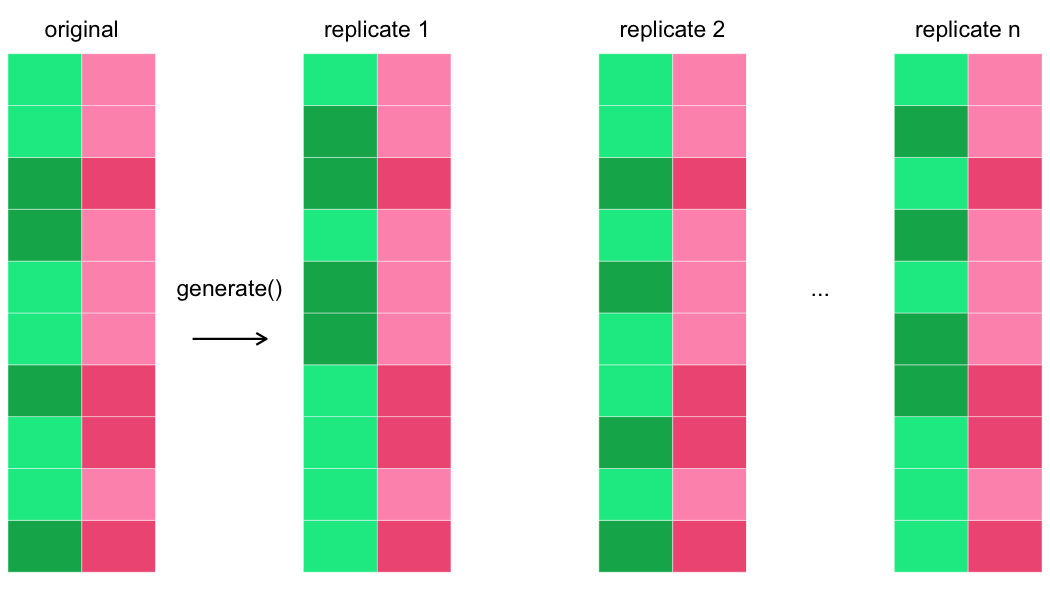
The two-column rectangular grid that was the result of the specifying columns is shown on the left. To the right of this is the word generate with an arrow pointing right. To the right of this arrow are three more two-column rectangular grids, representing replicates. The right-hand column of each replicate is identical to the right-hand column of the original dataset, representing the fact that the explanatory variable in the dataset is unchanged. The left-hand column of each replicate is different, representing the fact that the response variable is permuted.

Test di ipotesi in R

generate()

generate() generates simulated data reflecting the null hypothesis.

  • For "independence" null hypotheses, set type to "permute".
  • For "point" null hypotheses, set type to "bootstrap" or "simulate".
stack_overflow_imbalanced %>%
  specify(hobbyist ~ age_cat, success = "Yes") %>% 
  hypothesize(null = "independence") %>% 
  generate(reps = 5000, type = "permute")
Response: hobbyist (factor)
Explanatory: age_cat (factor)
Null Hypothesis: independence
# A tibble: 6,155,000 x 3
# Groups:   replicate [5,000]
  hobbyist age_cat     replicate
  <fct>    <fct>           <int>
1 Yes      At least 30         1
2 Yes      At least 30         1
3 Yes      At least 30         1
4 Yes      Under 30            1
5 Yes      At least 30         1
6 Yes      At least 30         1
7 Yes      Under 30            1
# ... with 6,154,993 more rows
Test di ipotesi in R

Calculating the test statistic

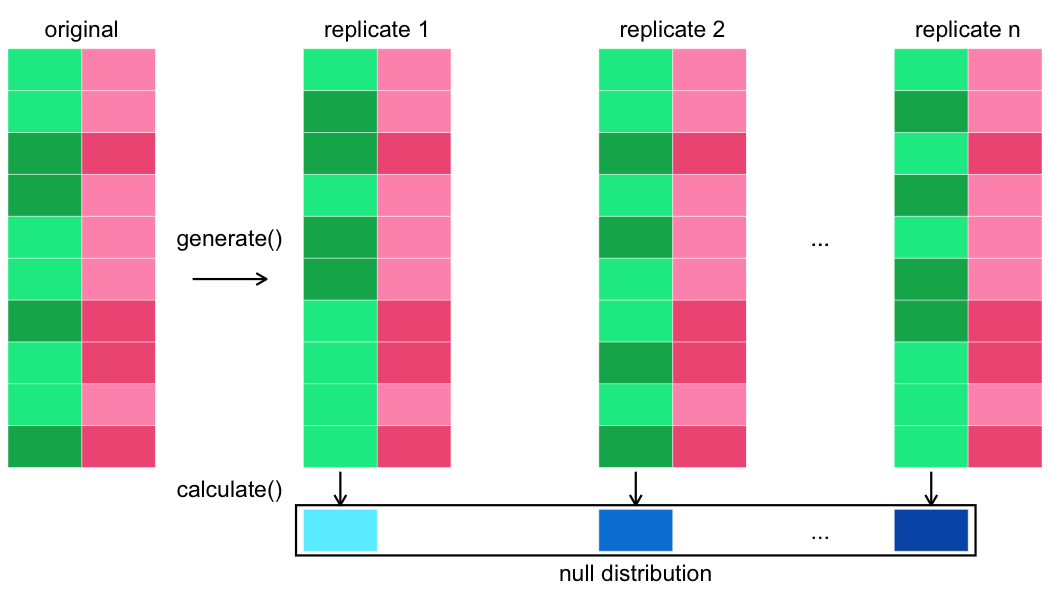
The rectangular grids representing the original dataset and replicates, that you saw in the generation step, are shown. Underneath these, the word 'calculate' is shown, and underneath each replicate is a downward arrow. Underneath each arrow is a single shaded cell representing a test statistic. A box is drawn around all the test statistics for the replicates, and labeled 'null distribution'.

Test di ipotesi in R

calculate()

calculate() calculates a distribution of test statistics known as the null distribution.

null_distn <- stack_overflow_imbalanced %>%
  specify(
    hobbyist ~ age_cat, 
    success = "Yes"
  ) %>%
  hypothesize(null = "independence") %>%
  generate(reps = 5000, type = "permute") %>%
  calculate(
    stat = "diff in props", 
    order = c("At least 30", "Under 30")
  )
# A tibble: 5,000 x 2
  replicate    stat
      <int>   <dbl>
1         1  0.0896
2         2  0.0896
3         3 -0.180 
4         4  0.157 
5         5  0.0896
6         6 -0.113 
7         7  0.0221
# ... with 4,993 more rows
1 The ?calculate help page lists all possible test statistics.
Test di ipotesi in R

Visualizing the null distribution

visualize(null_distn)
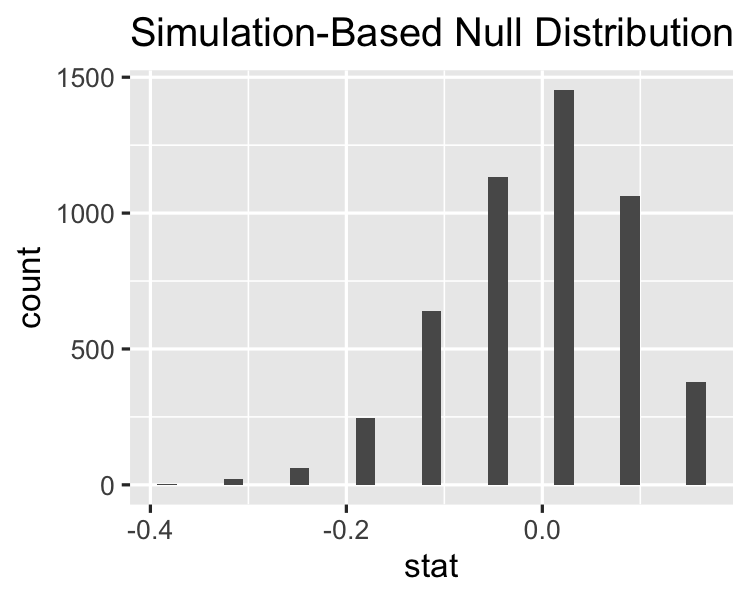
A histogram of the null distribution. It is left-skewed, and there are nine distinct values.

null_distn %>% count(stat)
# A tibble: 9 x 2
     stat     n
    <dbl> <int>
1 -0.383      2
2 -0.315     22
3 -0.248     63
4 -0.180    246
5 -0.113    641
6 -0.0454  1132
7  0.0221  1453
8  0.0896  1063
9  0.157    378
Test di ipotesi in R

Calculating the test statistic on the original dataset
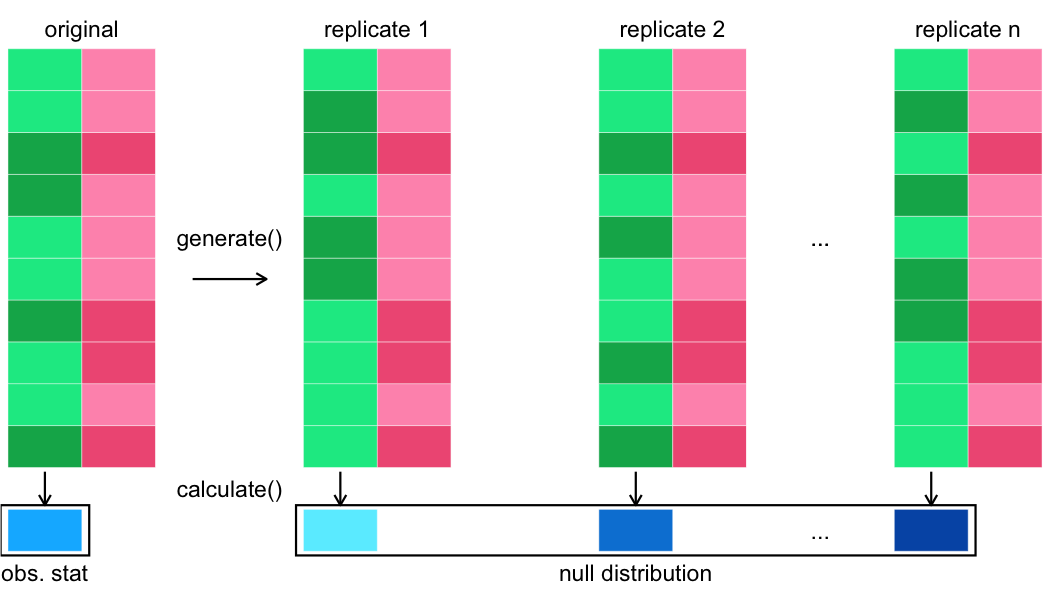
The rectangular grids representing the original dataset and replicates, along with the null distribution cells that you saw in the calculate step, are shown. This time, there is also a downward arrow below the original dataset, and underneath that, a shaded cell. This cell has a box around it labeled 'observed statistic'.

Test di ipotesi in R

Observed statistic: specify() %>% calculate()

obs_stat <- stack_overflow_imbalanced %>%
  specify(hobbyist ~ age_cat, success = "Yes") %>%
  # hypothesize(null = "independence") %>%
  # generate(reps = 5000, type = "permute") %>%
  calculate(
    stat = "diff in props",
    order = c("At least 30", "Under 30")
  )
# A tibble: 1 x 1
   stat
  <dbl>
1 0.157
Test di ipotesi in R

Visualizing the null distribution vs the observed stat
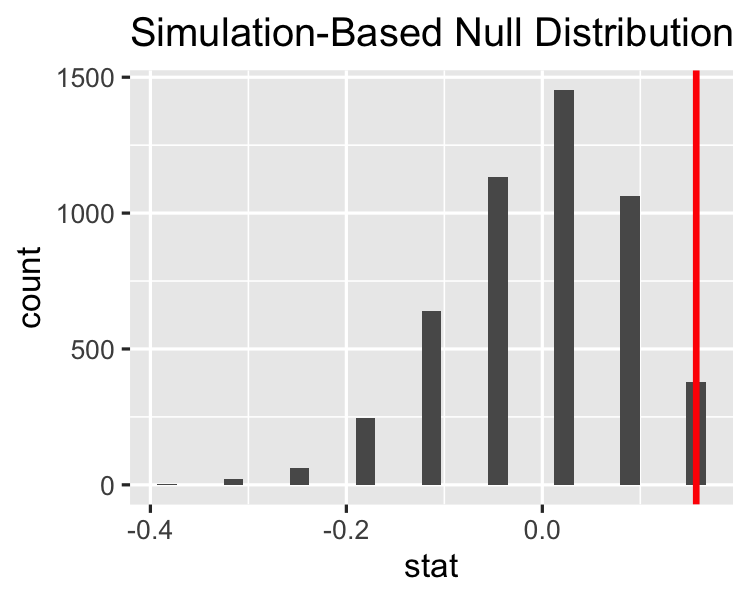
visualize(null_distn) +
  geom_vline(
    aes(xintercept = stat),
    data = observed_stat, 
    color = "red"
  )

The histogram of the null distribution, with an additional red vertical line at the observed statistic. The vertical line is over the right-most bar in the histogram.

Test di ipotesi in R

Get the p-value

get_p_value(
  null_distn, obs_stat, 
  direction = "two sided"   # Not alternative = "two.sided"
)
# A tibble: 1 x 1
  p_value
    <dbl>
1   0.151
# A tibble: 1 x 6
  statistic chisq_df p_value alternative lower_ci upper_ci
      <dbl>    <dbl>   <dbl> <chr>          <dbl>    <dbl>
1      2.79        1  0.0949 two.sided    0.00718   0.0217
Test di ipotesi in R

Let's practice!

Test di ipotesi in R

Preparing Video For Download...