ANOVA tests
Test di ipotesi in R

Richie Cotton
Data Evangelist at DataCamp
Job satisfaction: 5 categories
stack_overflow %>%
  count(job_sat)
# A tibble: 5 x 2
  job_sat                   n
  <fct>                 <int>
1 Very dissatisfied       187
2 Slightly dissatisfied   385
3 Neither                 245
4 Slightly satisfied      777
5 Very satisfied          981
Visualizing multiple distributions
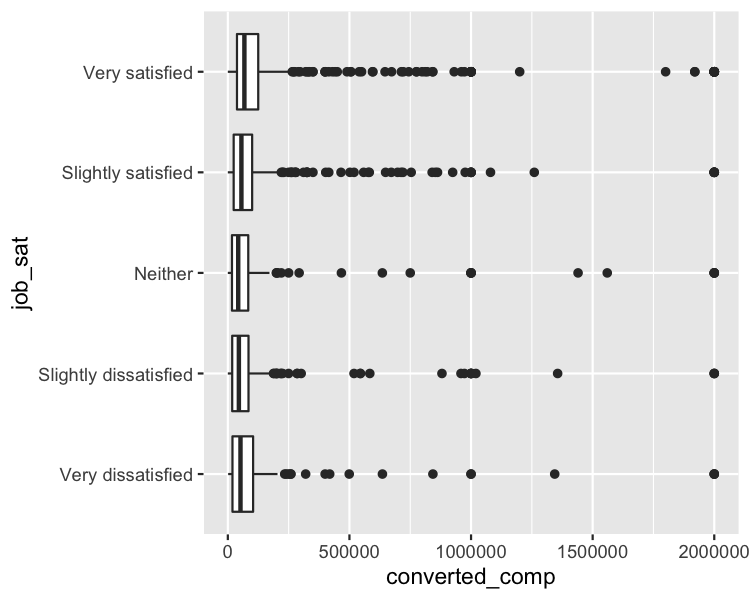
Question: Is mean annual compensation different for different levels of job satisfaction?
stack_overflow %>%
  ggplot(aes(x = job_sat, y = converted_comp)) +
  geom_boxplot() +
  coord_flip()
Analysis of variance (ANOVA)
mdl_comp_vs_job_sat <- lm(converted_comp ~ job_sat, data = stack_overflow)
anova(mdl_comp_vs_job_sat)
Analysis of Variance Table

Response: converted_comp
            Df   Sum Sq  Mean Sq F value Pr(>F)
job_sat      4 1.09e+12 2.73e+11    3.65 0.0057 **
Residuals 2570 1.92e+14 7.47e+10

Signif. codes:  0 '***' 0.001 '**' 0.01 '*' 0.05 '.' 0.1 ' ' 1
1 Linear regressions with lm() are taught in "Introduction to Regression in R"
Pairwise tests
- $\mu_{\text{very dissatisfied}} \neq \mu_{\text{slightly dissatisfied}}$
- $\mu_{\text{very dissatisfied}} \neq \mu_{\text{neither}}$
- $\mu_{\text{very dissatisfied}} \neq \mu_{\text{slightly satisfied}}$
- $\mu_{\text{very dissatisfied}} \neq \mu_{\text{very satisfied}}$
- $\mu_{\text{slightly dissatisfied}} \neq \mu_{\text{neither}}$
- $\mu_{\text{slightly dissatisfied}} \neq \mu_{\text{slightly satisfied}}$
- $\mu_{\text{slightly dissatisfied}} \neq \mu_{\text{very satisfied}}$
- $\mu_{\text{neither}} \neq \mu_{\text{slightly satisfied}}$
- $\mu_{\text{neither}} \neq \mu_{\text{very satisfied}}$
- $\mu_{\text{slightly satisfied}} \neq \mu_{\text{very satisfied}}$
Set significance level to $\alpha = 0.2$.
pairwise.t.test()
pairwise.t.test(stack_overflow$converted_comp, stack_overflow$job_sat, p.adjust.method = "none")
    Pairwise comparisons using t tests with pooled SD

data:  stack_overflow$converted_comp and stack_overflow$job_sat

                      Very dissatisfied Slightly dissatisfied Neither Slightly satisfied
Slightly dissatisfied 0.26860           -                     -       -
Neither               0.79578           0.36858               -       -
Slightly satisfied    0.29570           0.82931               0.41248 -
Very satisfied        0.34482           0.00384               0.15939 0.00084

P value adjustment method: none
Significant differences: "Very satisfied" vs. "Slightly dissatisfied"; "Very satisfied" vs. "Neither"; "Very satisfied" vs. "Slightly satisfied"
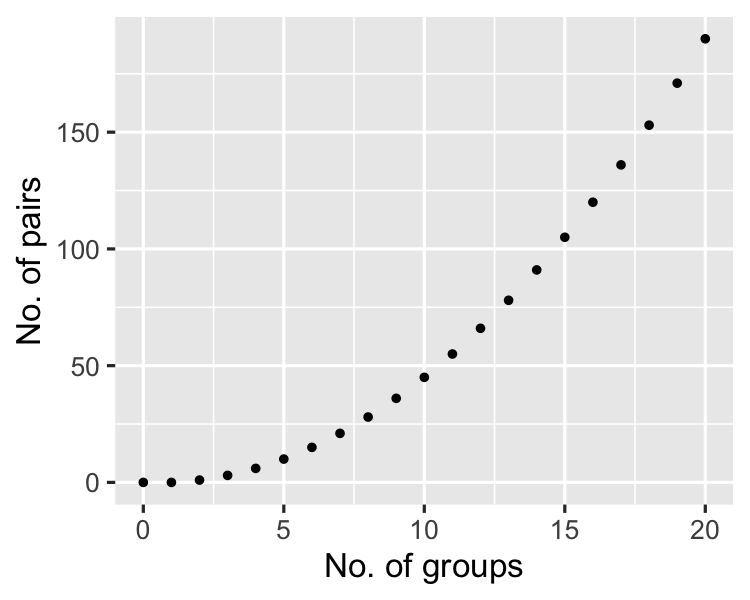
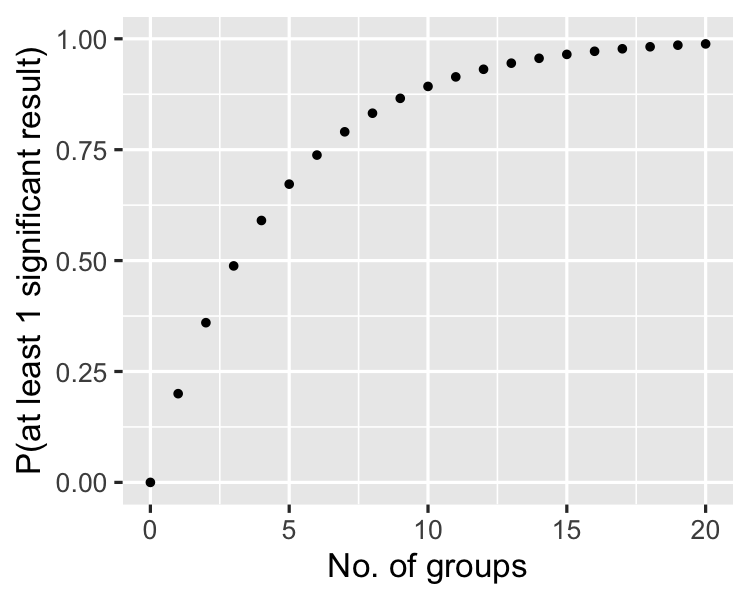
As the no. of groups increases...
Bonferroni correction
pairwise.t.test(stack_overflow$converted_comp, stack_overflow$job_sat, p.adjust.method = "bonferroni")
    Pairwise comparisons using t tests with pooled SD

data:  stack_overflow$converted_comp and stack_overflow$job_sat

                      Very dissatisfied Slightly dissatisfied Neither Slightly satisfied
Slightly dissatisfied 1.0000            -                     -       -
Neither               1.0000            1.0000                -       -
Slightly satisfied    1.0000            1.0000                1.0000  -
Very satisfied        1.0000            0.0384                1.0000  0.0084

P value adjustment method: bonferroni
Significant differences: "Very satisfied" vs. "Slightly dissatisfied"; "Very satisfied" vs. "Slightly satisfied"
More methods
p.adjust.methods
"holm" "hochberg" "hommel" "bonferroni" "BH" "BY" "fdr" "none"
Bonferroni and Holm adjustments
p_values
0.268603 0.795778 0.295702 0.344819 0.368580 0.829315 0.003840 0.412482 0.159389 0.000838
Bonferroni
pmin(1, 10 * p_values)
1.00000 1.00000 1.00000 1.00000 1.00000 1.00000 0.03840 1.00000 1.00000 0.00838
Holm (roughly)
pmin(1, 10:1 * sort(p_values))
0.00838 0.03456 1.00000 1.00000 1.00000 1.00000 1.00000 1.00000 1.00000 0.82931
Let's practice!
Test di ipotesi in R

