Big-O-notatie begrijpen
Datastructuren en algoritmen in Python

Miriam Antona
Software Engineer
Big-O-notatie
- Meet de worstcasescomplexiteit van een algoritme
- Tijdcomplexiteit: tijd tot volledige uitvoering
- Geheugencomplexiteit: extra geheugengebruik
- Geen seconden/bytes
- Resultaat verschilt per hardware
- Wiskundige notatie: $O(1)$, $O(n)$, $O(n^2)$...
Big-O-notatie
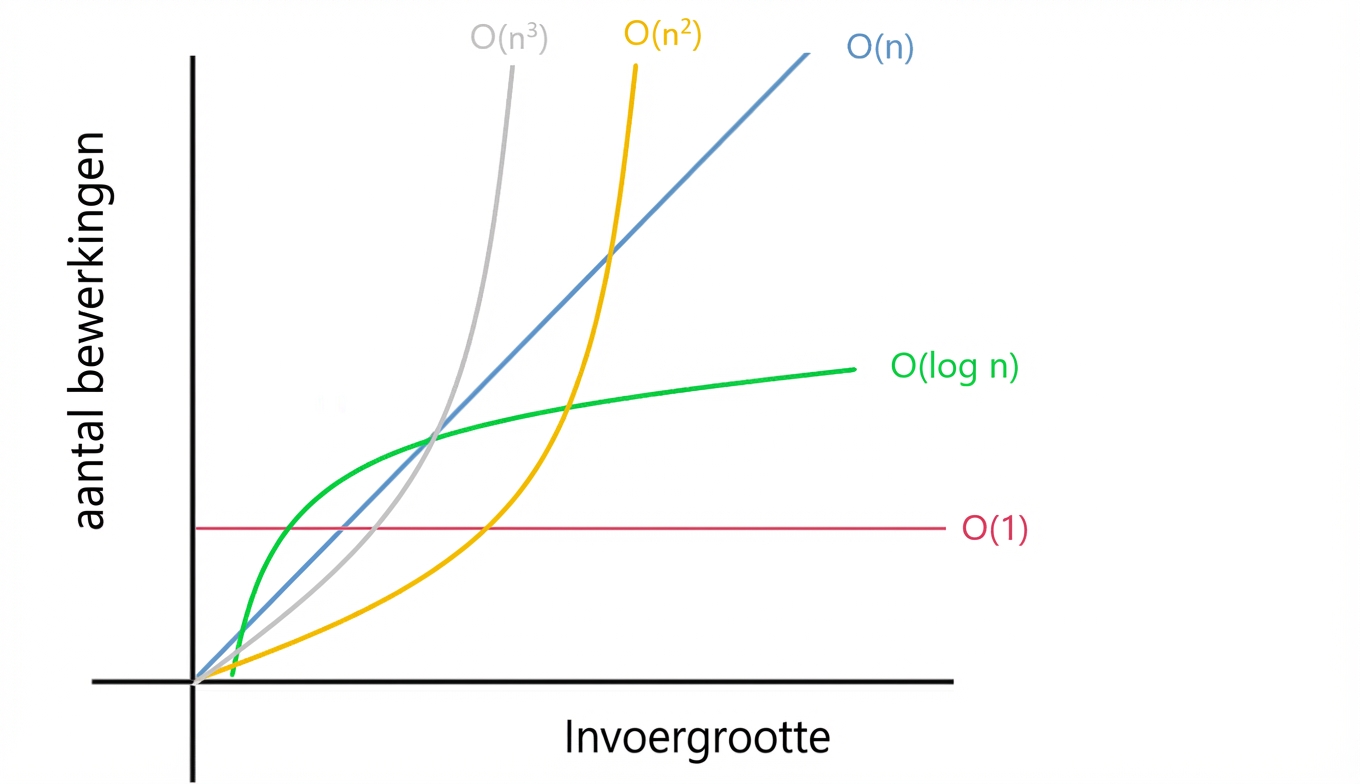
$O(1)$
colors = ['green', 'yellow', 'blue', 'pink']

def constant(colors):
    print(colors[2])

constant(colors)
blue
$O(1)$
colors = ['green', 'yellow', 'blue', 'pink', 'black', 'white', 'purple', 'red']

def constant(colors):
    print(colors[2])  # O(1)

constant(colors)
blue
$O(n)$
colors = ['green', 'yellow', 'blue', 'pink']

def linear(colors):
  for color in colors:
    print(color)

linear(colors)
greenyellowbluepink
$O(n)$
colors = ['green', 'yellow', 'blue', 'pink'] # n=4

def linear(colors):
  for color in colors:
    print(color)    # O(4)

linear(colors)
n=4: 4 bewerkingen
$O(n)$
colors = ['green', 'yellow', 'blue', 'pink', 'black', 'white', 'purple'] # n=7

def linear(colors):
  for color in colors:
    print(color)    # O(7)

linear(colors)
n=4: 4 bewerkingenn=7: 7 bewerkingenn=100: 100 bewerkingen- ...
- $O(n)$-complexiteit
$O(n^2)$
colors = ['green', 'yellow', 'blue']

def quadratic(colors):
  for first in colors:
      for second in colors:
          print(first, second)

quadratic(colors)
n=3: (3 x 3) 9 bewerkingenn=100: (100 x 100) 10.000 bewerkingen- kwadratisch patroon
- $O(n^2)$-complexiteit
green green
green yellow
green blue
yellow green
yellow yellow
yellow blue
blue green
blue yellow
blue blue
$O(n^3)$
colors = ['green', 'yellow', 'blue']

def cubic(colors):
  for color1 in colors:
      for color2 in colors:
          for color3 in colors:
              print(color1, color2, color3)

cubic(colors)
n=3: (3 x 3 x 3) 27 bewerkingenn=10: (10 x 10 x 10) 1.000 bewerkingen- kubisch patroon
- $O(n^3)$-complexiteit
Big-O-notatie berekenen
colors = ['green', 'yellow', 'blue', 'pink', 'black', 'white', 'purple']
other_colors = ['orange', 'brown']

def complex_algorithm(colors):
  color_count = 0

  for color in colors:
      print(color)
      color_count += 1

  for other_color in other_colors:
      print(other_color)
      color_count += 1

  print(color_count)

complex_algorithm(colors)
Big-O-notatie berekenen
colors = ['green', 'yellow', 'blue', 'pink', 'black', 'white', 'purple'] # O(1) other_colors = ['orange', 'brown'] # O(1)def complex_algorithm(colors): color_count = 0 # O(1)for color in colors: print(color) # O(n) color_count += 1 # O(n)for other_color in other_colors: print(other_color) # O(m) color_count += 1 # O(m)print(color_count) # O(1)complex_algorithm(colors) # O(4
Big-O-notatie berekenen
colors = ['green', 'yellow', 'blue', 'pink', 'black', 'white', 'purple']  # O(1)
other_colors = ['orange', 'brown']  # O(1)


def complex_algorithm(colors):
  color_count = 0          # O(1)


  for color in colors:
    print(color)           # O(n)
    color_count += 1       # O(n)


  for other_color in other_colors:
    print(other_color)     # O(m)
    color_count += 1       # O(m)


  print(color_count)       # O(1)


complex_algorithm(colors) # O(4 + 2n
Big-O-notatie berekenen
colors = ['green', 'yellow', 'blue', 'pink', 'black', 'white', 'purple']  # O(1)
other_colors = ['orange', 'brown']  # O(1)

def complex_algorithm(colors):
  color_count = 0          # O(1)

  for color in colors:
    print(color)           # O(n)
    color_count += 1       # O(n)

  for other_color in other_colors:
    print(other_color)     # O(m)
    color_count += 1       # O(m)

  print(color_count)       # O(1)

complex_algorithm(colors) # O(4 + 2n + 2m)
Big-O-notatie vereenvoudigen
- Verwijder constanten
- $O(4 + 2n + 2m)$ -> $O(n + m)$
- Andere variabelen voor andere input
- $O(n + m)$
- Verwijder kleinere termen
- $O(n + n^2)$
Big-O-notatie vereenvoudigen
- Verwijder constanten
- $O(4 + 2n + 2m)$ -> $O(n + m)$
- Andere variabelen voor andere input
- $O(n + m)$
- Verwijder kleinere termen
- $O(n + n^2)$ -> $O(n^2)$
Laten we oefenen!
Datastructuren en algoritmen in Python

