Tijdreeksmodellen fitten
ARIMA-modellen in Python

James Fulton
Climate informatics researcher
Een model maken
from statsmodels.tsa.arima.model import ARIMA
# This is an ARMA(p,q) model
model = ARIMA(timeseries, order=(p,0,q))
AR- en MA-modellen maken
ar_model = ARIMA(timeseries, order=(p,0,0))
ma_model = ARIMA(timeseries, order=(0,0,q))
Model fitten en fit-samenvatting
model = ARIMA(timeseries, order=(2,0,1))results = model.fit()
print(results.summary())
Fit-samenvatting
                             SARIMAX Results
 ==============================================================================
 Dep. Variable:                      y   No. Observations:                 1000
 Model:                     ARMA(2, 1)   Log Likelihood                 148.580
 Date:                Thu, 25 Apr 2022   AIC                           -287.159
 Time:                        22:57:00   BIC                           -262.621
 Sample:                             0   HQIC                          -277.833
 Covariance Type:                    opg
 ==============================================================================
                 coef    std err          z      P>|z|      [0.025      0.975]
 ------------------------------------------------------------------------------
 const         -0.0017      0.012     -0.147      0.883      -0.025       0.021
 ar.L1.y        0.5253      0.054      9.807      0.000       0.420       0.630
 ar.L2.y       -0.2909      0.042     -6.850      0.000      -0.374      -0.208
 ma.L1.y        0.3679      0.052      7.100      0.000       0.266       0.469
Fit-samenvatting
                            SARIMAX Results
==============================================================================
Dep. Variable:                      y   No. Observations:                 1000
Model:                     ARMA(2, 1)   Log Likelihood                 148.580
Date:                Thu, 25 Apr 2022   AIC                           -287.159
Time:                        22:57:00   BIC                           -262.621
Sample:                             0   HQIC                          -277.833
Covariance Type:                    opg
Fit-samenvatting
============================================================================== coef std err z P>|z| [0.025 0.975] ------------------------------------------------------------------------------ const -0.0017 0.012 -0.147 0.883 -0.025 0.021 ar.L1.y 0.5253 0.054 9.807 0.000 0.420 0.630 ar.L2.y -0.2909 0.042 -6.850 0.000 -0.374 -0.208 ma.L1.y 0.3679 0.052 7.100 0.000 0.266 0.469sigma2 1.6306 0.339 6.938 0.000 0.583 1.943
Introductie tot ARMAX-modellen
- Exogene ARMA
Gebruik externe variabelen naast de tijdreeks
ARMAX = ARMA + lineaire regressie
ARMAX-vergelijking
ARMA(1,1)-model: $$y_t = a_1 y_{t-1} + m_1 \epsilon_{t-1} + \epsilon_t$$
ARMAX(1,1)-model: $$y_t = x_1 z_t + a_1 y_{t-1} + m_1 \epsilon_{t-1} + \epsilon_t$$
ARMAX-voorbeeld
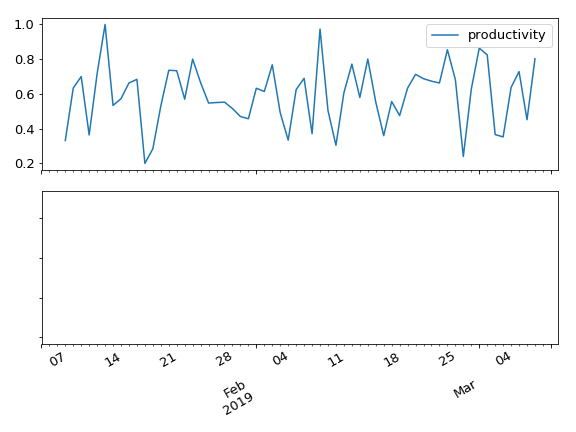
ARMAX-voorbeeld
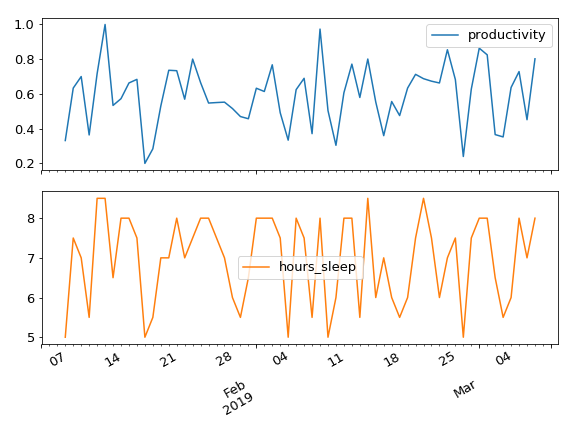
ARMAX fitten
# Instantiate the model model = ARIMA(df['productivity'], order=(2,0,1), exog=df['hours_sleep'])# Fit the model results = model.fit()
ARMAX-samenvatting
 ==============================================================================
                 coef    std err          z      P>|z|      [0.025      0.975]
 -----------------------------------------------------------------------------
 const         -0.1936      0.092     -2.098      0.041      -0.375      -0.013
 x1             0.1131      0.013      8.602      0.000       0.087       0.139
 ar.L1.y        0.1917      0.252      0.760      0.450      -0.302       0.686
 ar.L2.y       -0.3740      0.121     -3.079      0.003      -0.612      -0.136
 ma.L1.y       -0.0740      0.259     -0.286      0.776      -0.581       0.433
Laten we oefenen!
ARIMA-modellen in Python

