Oefenen met coding-interviewvragen in Python
Kirill Smirnov
Data Science Consultant, Altran
$n! = n\cdot(n-1)\cdot(n-2)\cdot...\cdot1$
$n = 4$:
$4! = 4\cdot3\cdot2\cdot1$
4! = 24
$n! = n\cdot(n-1)\cdot(n-2)\cdot...\cdot1 = $
$ = 1\cdot2\cdot3\cdot...\cdot n$
Iteratieve oplossing:
# iterative factorial
def fact_iter(n):
result = 1
# looping over numbers from 1 to n
for num in range(1, n+1)
result = num * result
return result
$n = 4:$
result = 1
result = 1 * result(1) = 1result = 2 * result(1) = 2result = 3 * result(2) = 6result = 4 * result(4) = 24$4! = 1 \cdot 2 \cdot 3 \cdot 4 = 24$
$n!$ $=n\cdot(n-1)!$
def fact_rec(n):
return n * fact_rec(n-1)
Wat klopt er niet aan die code?
fact_rec(4)
RecursionError
We moeten een basisgeval definiëren!
$n! = n\cdot(n-1)\cdot(n-2)\cdot...\cdot1$
Een stopcriterium / basisgeval: $1! = 1$
def fact_rec(n):
if n == 1:
return 1
return n * fact_rec(n-1)
fact_rec(4)
24
Recursieve functies hebben twee hoofdonderdelen:


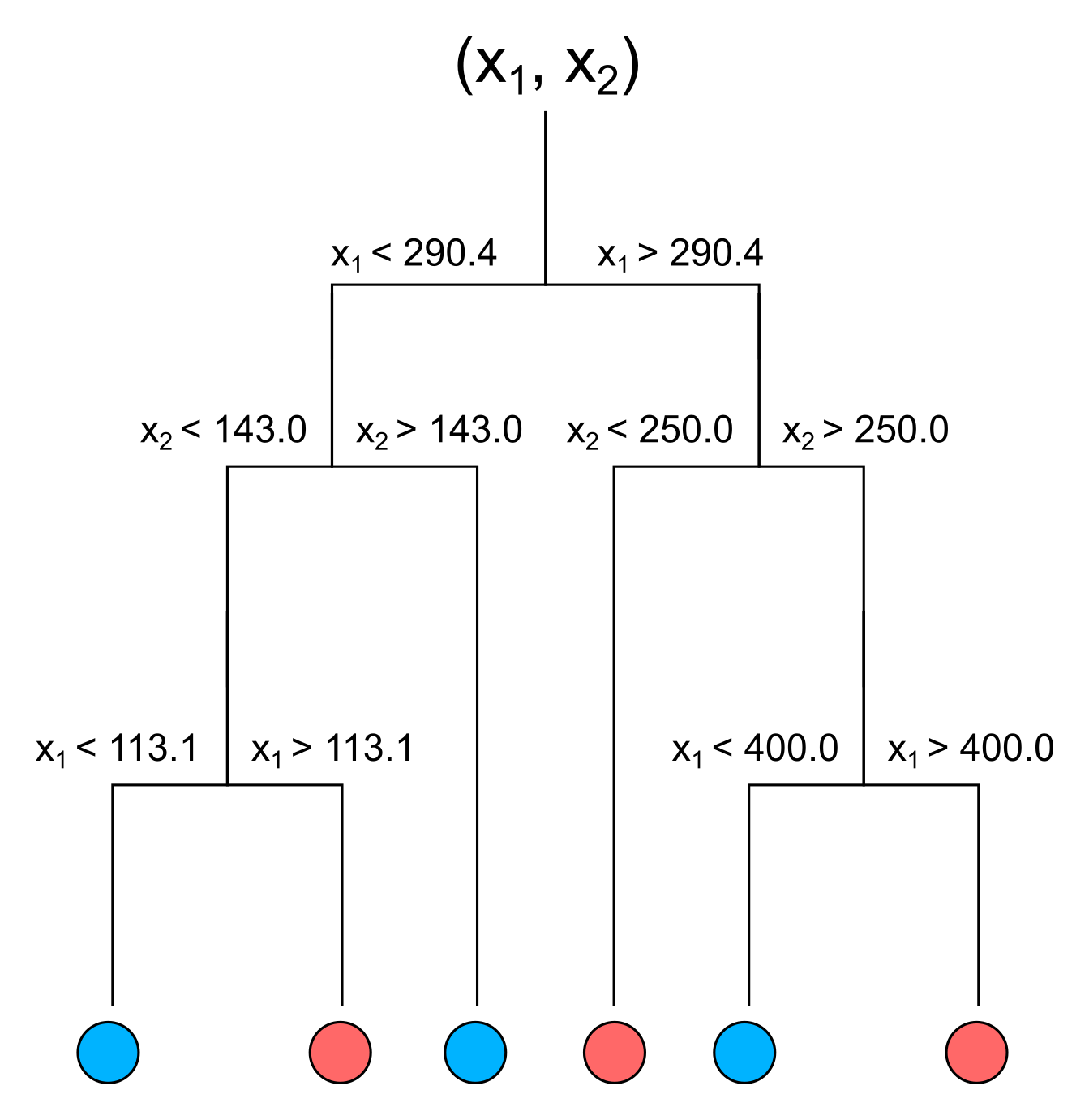
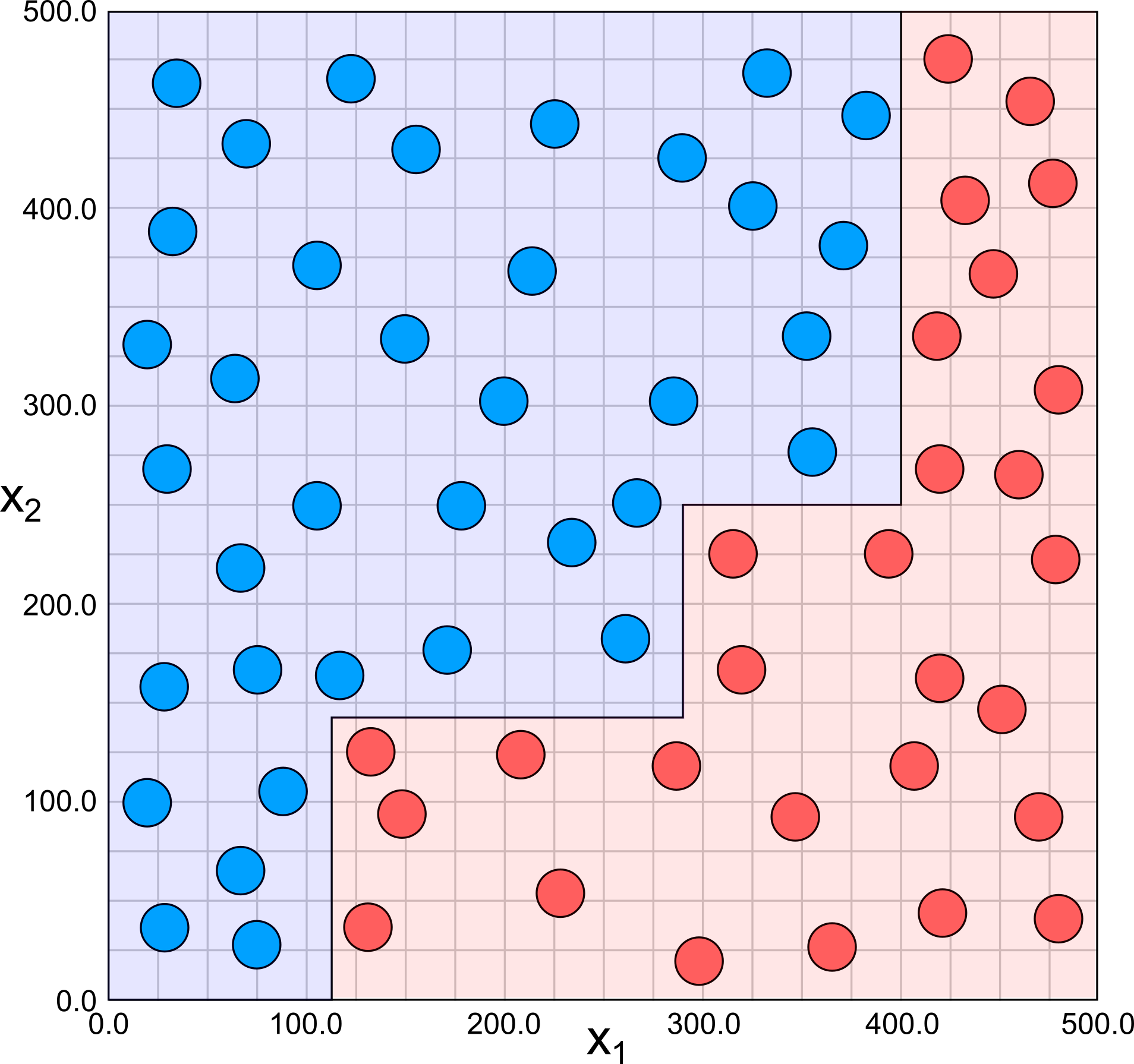
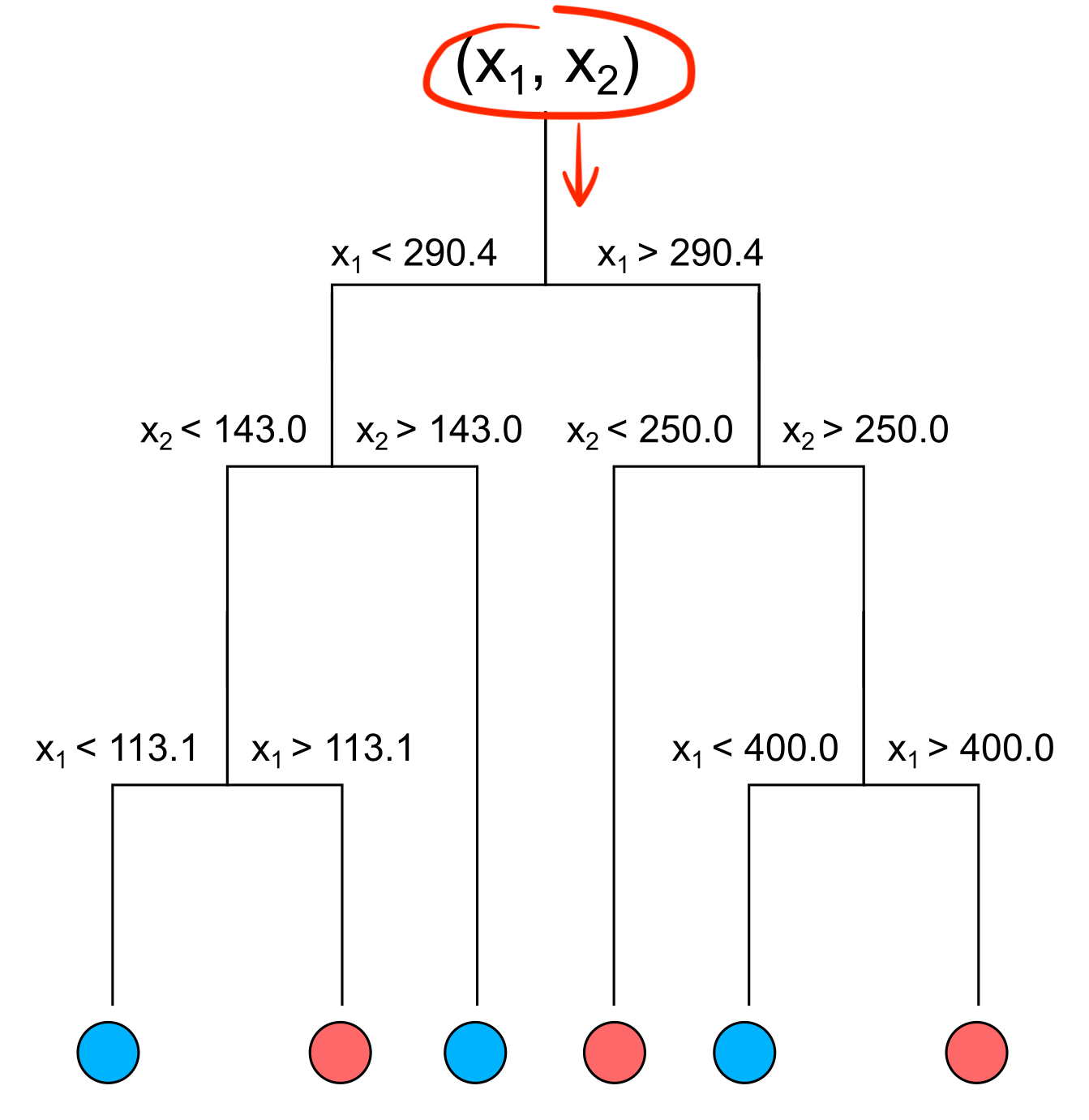
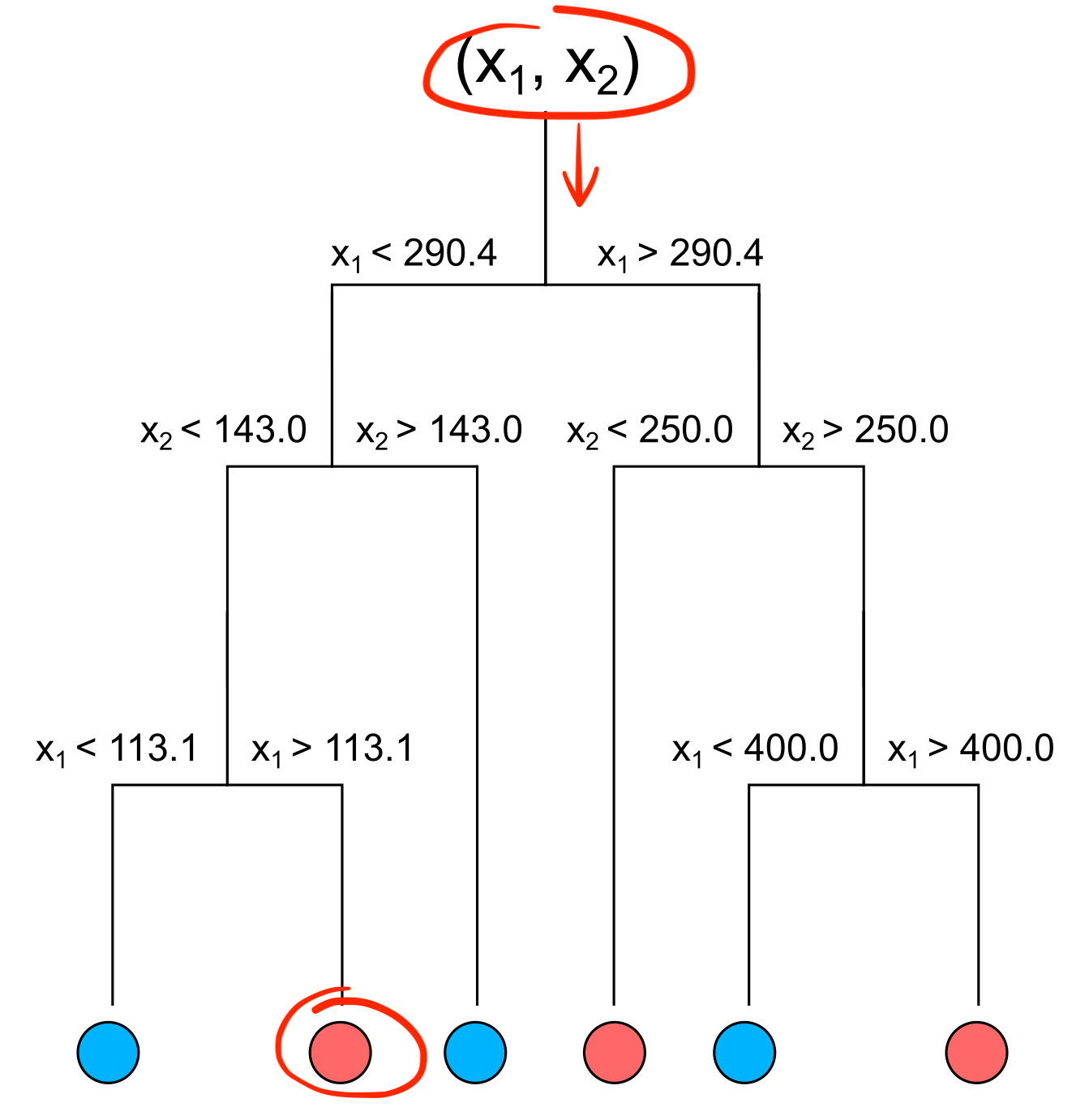
x - een nieuwe sample $(x_1, x_2)$
# Pseudo-algoritme om de categorie te vinden:category = pred(node, x):# Check of er een splitsing is if node.hasSplitting:# Bepaal naar welk kind je gaat if node.goToLeftChild(x): return pred(node.leftChild, x) if node.goToRightChild(x): return pred(node.rightChild, x)

x - een nieuwe sample $(x_1, x_2)$
# Pseudo-algoritme om de categorie te vinden:category = pred(node, x):# Check of er een splitsing is if node.hasSplitting:# Bepaal naar welk kind je gaat if node.goToLeftChild(x): return pred(node.leftChild, x) if node.goToRightChild(x): return pred(node.rightChild, x)# Categorie retourneren return node.category
Oefenen met coding-interviewvragen in Python