Plot aggregates of your data

Tijdreeksen visualiseren in Python

Thomas Vincent

Head of Data Science, Getty Images

Moving averages

  • In the field of time series analysis, a moving average can be used for many different purposes:
    • smoothing out short-term fluctuations
    • removing outliers
    • highlighting long-term trends or cycles.
Tijdreeksen visualiseren in Python

The moving average model

co2_levels_mean = co2_levels.rolling(window=52).mean()

ax = co2_levels_mean.plot()
ax.set_xlabel("Date")
ax.set_ylabel("The values of my Y axis")
ax.set_title("52 weeks rolling mean of my time series")

plt.show()
Tijdreeksen visualiseren in Python

A plot of the moving average for the CO2 data
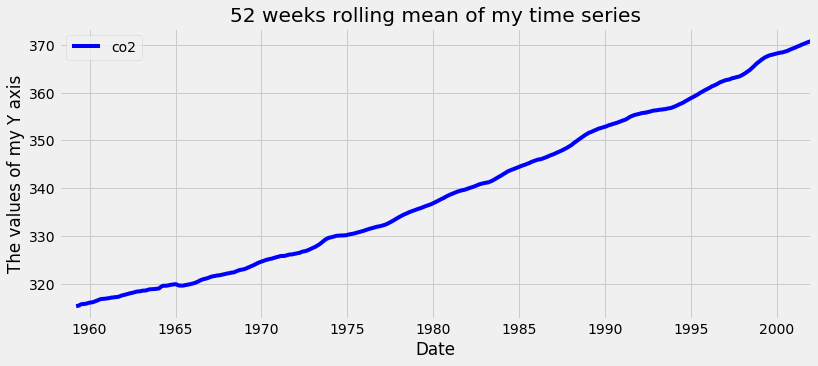
Rolling mean of a time series

Tijdreeksen visualiseren in Python

Computing aggregate values of your time series
co2_levels.index
DatetimeIndex(['1958-03-29', '1958-04-05',...],
              dtype='datetime64[ns]', name='datestamp', 
              length=2284, freq=None)
print(co2_levels.index.month)
array([ 3,  4,  4, ..., 12, 12, 12], dtype=int32)
print(co2_levels.index.year)
array([1958, 1958, 1958, ..., 2001,
      2001, 2001], dtype=int32)
Tijdreeksen visualiseren in Python

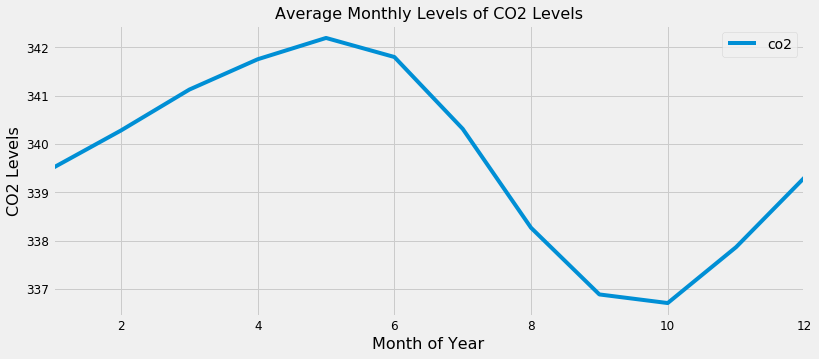
Plotting aggregate values of your time series

index_month = co2_levels.index.month
co2_levels_by_month = co2_levels.groupby(index_month).mean()
co2_levels_by_month.plot()

plt.show()
Tijdreeksen visualiseren in Python

Plotting aggregate values of your time series

Monthly aggregates of the CO2 levels data

Tijdreeksen visualiseren in Python

Let's practice!

Tijdreeksen visualiseren in Python

Preparing Video For Download...