Convex-beperkte optimalisatie met ongelijkheidsrestricties

Introductie tot optimalisatie in Python

Jasmin Ludolf

Content Developer

Hoek- versus interieuroplossing
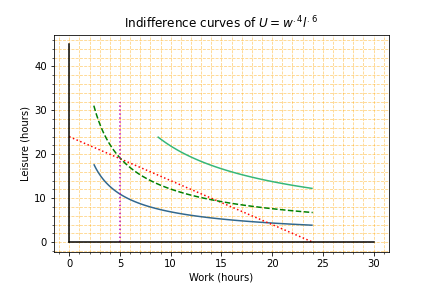
  • Alexia heeft maar 5 uur werk

$$ w\leq 5$$

  • Twee restricties:
    • 24 uur per dag
    • 5 uur werk
  • De restricties vormen een hoekoplossing
  • Interieuroplossing is geen snijpunt

Onverschilligheidscurven en restricties. De onverschilligheidscurve bij het optimale nut gaat door het snijpunt van de restricties.

Introductie tot optimalisatie in Python

Fabrikant met capaciteitsrestricties

  • Autobouwer produceert identieke auto's in twee fabrieken $A$, $B$
    • Hoeveelheden: $q_A$, $q_B$
    • Capaciteit: $q_A\leq 90$, $q_B\leq 90$
    • Kosten: $C_A(q)=3q$, $C_B(q)=3.5q$
  • Vraag:
    • $P=120-Q$
  • Contract:
    • $Q\geq 92$
  • Doel: winst maximaliseren
    • $\displaystyle\max \Pi(q_A,q_B)$

Autoproductielijn

Introductie tot optimalisatie in Python

Winst maximaliseren

  • Doel:
    • $\Pi = R-C$
      • $R = PQ$
Introductie tot optimalisatie in Python

Winst maximaliseren

  • Doel:
    • $\Pi = R-C$
      • $R = PQ = (120-Q)Q $
Introductie tot optimalisatie in Python

Winst maximaliseren

  • Doel:

    • $\Pi = R-C$
      • $R = PQ = (120-Q)Q=\left[120-(q_A+q_B)\right](q_A+q_B)$
      • $C=C_A+C_B=3q_A+3.5q_B$
  • Grenzen

    • $0\leq q_A, q_B\leq 90$
  • Restricties
    • $Q\geq92\Leftrightarrow 92\leq q_A+q_B$
Introductie tot optimalisatie in Python

Formulering

$$\max_{q_A,q_B}R(q_A,q_B)-C(q_A,q_B)$$

$$s.t.$$

$$R(q_A,q_B)=\left[120-(q_A+q_B)\right](q_A+q_B)$$

$$\ \ \ \ \ C(q_A,q_B)=3q_A+3.5q_B$$

$$\ \ \ 0\leq q_A, q_B\leq 90$$

$$ \ \ \ \ 92\leq q_A+q_B$$

from scipy.optimize import minimize,\
        Bounds, LinearConstraint


def R(q): return (120 - (q[0] + q[1] )) * (q[0] + q[1])
def C(q): return 3*q[0] + 3.5*q[1]
def profit(q): return R(q) - C(q)
bounds = Bounds([0, 0], [90, 90])
constraints = LinearConstraint([1, 1], lb=92)
Introductie tot optimalisatie in Python

Maximaliseer winst met SciPy

result = minimize(lambda q: -profit(q),

[50, 50],
bounds=bounds, constraints=constraints)
print(result.message) print(f'The optimal number of cars produced in plant A is: {result.x[0]:.2f}') print(f'The optimal number of cars produced in plant B is: {result.x[1]:.2f}') print(f'The firm made: ${-result.fun:.2f}')
Optimization terminated successfully
The optimal number of cars produced in plant A is: 90.00
The optimal number of cars produced in plant B is: 2.00
The firm made: $2299.00
Introductie tot optimalisatie in Python

Niet-lineaire restricties in SciPy

from scipy.optimize import NonlinearConstraint 
import numpy as np


constraints = NonlinearConstraint(lambda q: q[0] + q[1], lb=92, ub=np.inf)
result = minimize(lambda q: -profit(q), [50, 50], bounds=Bounds([0, 0], [90, 90]), constraints=constraints)
Introductie tot optimalisatie in Python

Oplossing met NonlinearConstraint

print(result.message)
print(f'The optimal number of cars produced in plant A is: {result.x[0]:.2f}')
print(f'The optimal number of cars produced in plant B is: {result.x[1]:.2f}')
print(f'The firm made: ${-result.fun:.2f}') 
Optimization terminated successfully
The optimal number of cars produced in plant A is: 90.00
The optimal number of cars produced in plant B is: 2.00
The firm made: $2299.00 
  • Gebruik LinearConstraint() voor simpele lineaire problemen
  • Anders NonlinearConstraint()
Introductie tot optimalisatie in Python

Laten we oefenen!

Introductie tot optimalisatie in Python

Preparing Video For Download...