Hyperparametertuning
Modelleren met tidymodels in R

David Svancer
Data Scientist
Hyperparameters
Modelparameters die je vooraf instelt en de modelcomplexiteit bepalen
parsnip decision tree
cost_complexity- Beboet een groot aantal terminale knopen
tree_depth- Langste pad van wortel naar terminale knoop
min_n- Minimum aantal punten in een knoop voor verdere splitsing
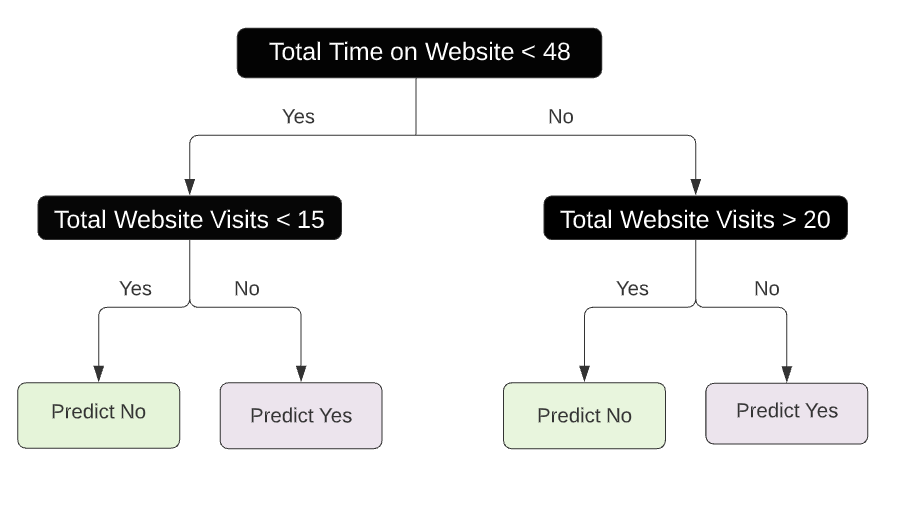
Standaardwaarden voor hyperparameters
De functie decision_tree() stelt standaardhyperparameters in
cost_complexityis 0,01tree_depthis 30min_nis 20
Dit zijn niet altijd de beste waarden voor elke dataset
- Hyperparametertuning
- Proces: via cross-validatie de optimale set hyperparameterwaarden vinden
dt_model <- decision_tree() %>%
  set_engine('rpart') %>%
  set_mode('classification')
Hyperparameters labelen voor tuning
De functie tune() uit het tune-pakket
- Label hyperparameters voor tuning door ze gelijk te zetten aan
tune()in deparsnip-modelspecificatie - Maakt een modelobject met te tunen parameters
- Laat andere functies weten dat deze geoptimaliseerd moeten worden
dt_tune_model <- decision_tree(cost_complexity = tune(), tree_depth = tune(), min_n = tune()) %>% set_engine('rpart') %>% set_mode('classification')dt_tune_model
Decision Tree Model Specification (classification)

Main Arguments:
  cost_complexity = tune()
  tree_depth = tune()
  min_n = tune()

Computational engine: rpart
Een tuning-workflow maken
workflow-objecten zijn makkelijk te updaten
- Eerder:
leads_wkfl- Feature engineering voor lead-scoring en decision tree met standaardhyperparameters
- Geef
leads_wkflaanupdate_model()en lever een nieuwe decision tree met te tunen parameters
leads_tune_wkfl <- leads_wkfl %>%update_model(dt_tune_model)leads_tune_wkfl
== Workflow ===============
Preprocessor: Recipe
Model: decision_tree()
-- Preprocessor -----------
3 Recipe Steps
* step_corr()
* step_normalize()
* step_dummy()
-- Model ------------------
Decision Tree Model Specification (classification)
Main Arguments: cost_complexity = tune()
                tree_depth = tune()
                min_n = tune()
Computational engine: rpart
Grid search
Meest gebruikte methode voor hyperparametertuning
- Maak een raster met unieke combinaties van hyperparameterwaarden
- Gebruik voor elke combinatie cross-validatie om prestaties te schatten
- Kies de best presterende combinatie
| cost_complexity | tree_depth | min_n |
|---|---|---|
| 0.001 | 20 | 35 |
| 0.001 | 20 | 15 |
| 0.001 | 35 | 35 |
| 0.001 | 35 | 15 |
| 0.2 | 20 | 35 |
| ... | ... | ... |
Hyperparameters identificeren
De functie parameters() uit het dials-pakket
- Neemt een
parsnip-modelobject - Geeft een tibble terug met hyperparameters die met
tune()gelabeld zijn, indien aanwezig- Te gebruiken voor het maken van tuning-grids met
dials
- Te gebruiken voor het maken van tuning-grids met
parameters(dt_tune_model)
Collection of 3 parameters for tuning

  identifier            type     object
cost_complexity  cost_complexity nparam[+]
tree_depth       tree_depth      nparam[+]
min_n            min_n           nparam[+]
Willekeurig grid
Willekeurige combinaties genereren
- Deze methode vergroot vaak de kans om optimale waarden te vinden
De functie grid_random()
- Eerste argument is de output van
parameters() sizebepaalt het aantal willekeurige combinaties- Voer
set.seed()uit vóórgrid_random()voor reproduceerbaarheid
- Voer
set.seed(214) grid_random(parameters(dt_tune_model),size = 5)
# A tibble: 5 x 3
  cost_complexity  tree_depth min_n
            <dbl>      <int>  <int>
1    0.0000000758        14     39
2    0.0243               5     34
3    0.00000443          11      8
4    0.000000600          3      5
5    0.00380              5     36
Een tuning-grid opslaan
Eerste stap in hyperparametertuning
- Maak en bewaar een tuning-grid
dt_gridbevat 5 willekeurige combinaties van hyperparameterwaarden
set.seed(214) dt_grid <- grid_random(parameters(dt_tune_model), size = 5)dt_grid
# A tibble: 5 x 3
  cost_complexity  tree_depth min_n
            <dbl>      <int>  <int>
1    0.0000000758        14     39
2    0.0243               5     34
3    0.00000443          11      8
4    0.000000600          3      5
5    0.00380              5     36
Hyperparametertuning met cross-validatie
De functie tune_grid() voert hyperparametertuning uit
Neemt de volgende argumenten:
workflowofparsnip-model- Cross-validatieobject,
resamples - Tuning-grid,
grid - Optionele
metrics-functie
Geeft een tibble met resultaten terug
.metrics- Lijstkolom met resultaten per fold
dt_tuning <- leads_tune_wkfl %>%tune_grid(resamples = leads_folds,grid = dt_grid,metrics = leads_metrics)
dt_tuning
# Tuning results
# 10-fold cross-validation using stratification
# A tibble: 10 x 4
   splits             id       .metrics         ..
   <list>            <chr>      <list>          ..
<split [896/100]>   Fold01   <tibble [15 x 7]>  ..
................    ......   ...............    ..
<split [897/99]>    Fold09   <tibble [15 x 7]>  ..
<split [897/99]>    Fold10   <tibble [15 x 7]>  ..
Tuningresultaten verkennen
De functie collect_metrics() geeft standaard samengevatte resultaten
- Gemiddelde metriekwaarden over alle folds per combinatie
dt_tuning %>%
  collect_metrics()
# A tibble: 15 x 9
   cost_complexity tree_depth min_n .metric .estimator  mean     n std_err .config
             <dbl>      <int> <int> <chr>   <chr>      <dbl> <int>   <dbl> <chr>
 1    0.0000000758         14    39 roc_auc binary     0.827    10 0.0147  Model1
 2    0.0000000758         14    39 sens    binary     0.728    10 0.0277  Model1
 3    0.0000000758         14    39 spec    binary     0.865    10 0.0156  Model1
 4    0.0243                5    34 roc_auc binary     0.823    10 0.0147  Model2
 .    ......               ..    .. ....    ......     .....    .. .....   ......
14    0.00380               5    36 sens    binary     0.747    10 0.0209  Model5
15    0.00380               5    36 spec    binary     0.858    10 0.0161  Model5
Aan de slag met tunen!
Modelleren met tidymodels in R

