Het Cox Proportional Hazards‑model fitten
Survivalanalyse in Python

Shae Wang
Senior Data Scientist
Hazardfunctie en hazardrate
Hazardfunctie $h(t)$: kans dat het event optreedt op tijd t, gegeven overleving tot dan.
Hazardrate: het instantane tempo waarop het event optreedt
$$h(t)=-\frac{d}{dt}logS(t)$$
De hazardfunctie $h(t)$ en de overlevingsfunctie $S(t)$ zijn wederzijds afleidbaar.
De proportional hazards‑aanname
De proportional hazards‑aanname: alle individuele hazards zijn proportioneel aan elkaar.
Voor individu $A$ en $B$: $$h_A(t)=c h_B(t)$$
- Er is een baseline‑hazardfunctie; andere hazards krijgen schaalfactoren.
- De relatieve overlevingsimpact van een variabele verandert niet in de tijd (tijdinvariant).
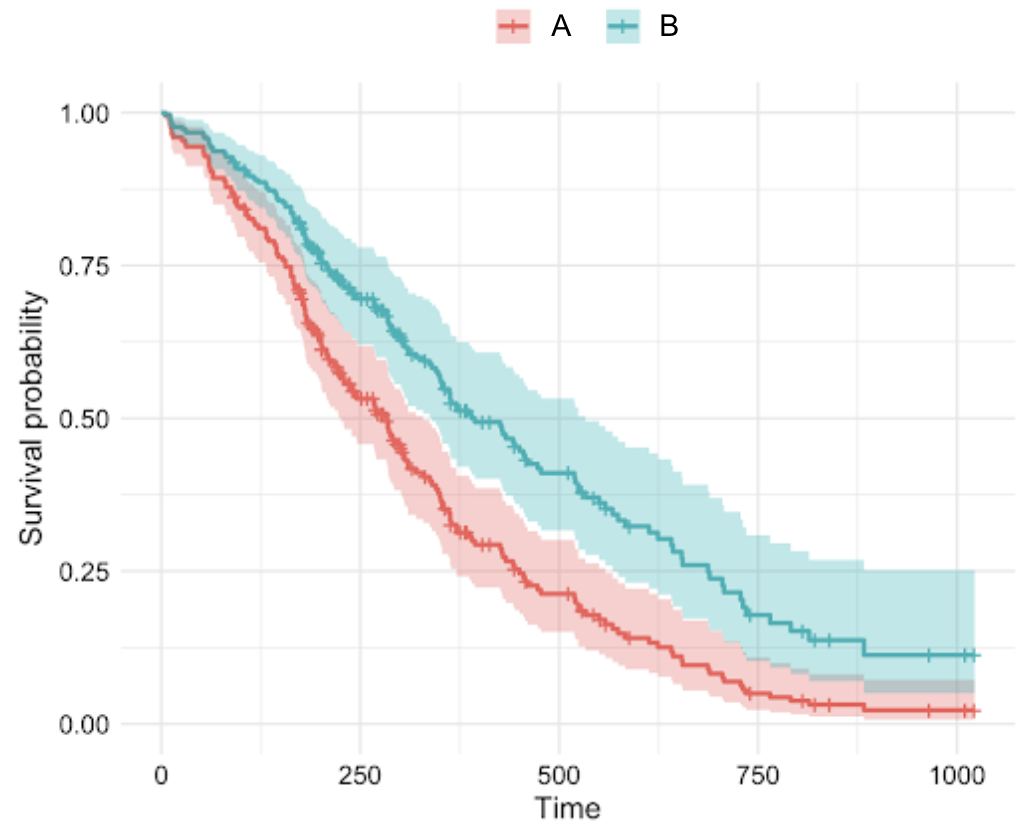
Het Cox Proportional Hazards‑model
Gebaseerd op de proportional hazards‑aanname: $$h(t|x)=b_0(t)exp\bigg(\sum^{n}_{i=1}b_i(x_i-\overline{x_i}\bigg)$$
$b_0(t)$: baseline‑hazard op populatieniveau, verandert met de tijd.
$exp\bigg(\sum^{n}_{i=1}b_i(x_i-\overline{x_i}\bigg)$: lineair verband tussen covariaten en de log‑hazard, verandert NIET met de tijd.
- Het Cox Proportional Hazards (Cox PH)‑model is een regressiemodel dat covariaten regresseert op time‑to‑event/duratie.
Datavereisten voor Cox PH‑model
- Durations: levensduur/duratie van individuen.
- Events: of het event is geobserveerd (1=Ja, 0=Nee, gecensureerd).
- Als niet opgegeven, gaat het model uit van geen censuur.
- Covariaten: continue of one‑hot gecodeerde categorische variabelen voor de regressie.
Het Cox PH‑model fitten
- Importeer en maak een
CoxPHFitteraanfrom lifelines import CoxPHFitter coxph = CoxPHFitter() - Roep
.fit()aan om het model te trainencoxph.fit(df, duration_col, event_col) - Bekijk eigenschappen: samenvatting, covariaten, coëfficiënten, predict, plot, etc.
coxph.summary()
coxph.predict()
Voorbeeld Cox PH‑model
- DataFrame:
mortgage_df - Covariaten:
houseprincipalinterestproperty_taxcredit_score
- Andere kolommen:
duration,paid_off
from lifelines import CoxPHFittercoxph = CoxPHFitter() coxph.fit(df=mortgage_df, duration_col="duration", event_col="paid_off")
Aangepast model
Filter het DataFrame:
new_df = mortgage_df.loc[:,
          mortgage_df.columns!="house"]
coxph.fit(df=new_df,
          duration_col="duration",
          event_col="paid_off")
Gebruik de parameter formula:
coxph.fit(df=mortgage_df,
          duration_col="duration",
          event_col="paid_off",
          formula="principal + interest
          + property_tax + credit_score")
- Handiger en duidelijker, maar schaalt niet bij veel covariaten.
Coëfficiënten interpreteren
print(coxph.summary)
<lifelines.CoxPHFitter: fitted with 1808 observations, 340 censored>
                        coef  exp(coef)  se(coef)      z       p
covariate house        -0.38       0.68      0.19. -1.98    0.05
          principal    -0.06       0.94      0.02  -2.61    0.01
          interest      0.31       1.37      0.31   1.02    0.31
          property_tax -0.15       0.86      0.21  -0.71    0.48
          credit_score -0.43       0.65      0.38  -1.14.   0.26
- Hazard ratio: $e^{coef}$
- Één eenheid stijging in
interestvanaf de mediaan -> de hazard verandert met factor $e^{0.31}=1.37$, dus 37% hoger dan de baseline.
- Één eenheid stijging in
Laten we oefenen!
Survivalanalyse in Python

