Feature engineering in R
Jorge Zazueta
Research Professor and Head of the Modeling Group at the School of Economics, UASLP
Met domeinkennis kun je relevante, nuttige features voor een model of taak vinden en maken.
Feature engineering is het maken van nieuwe inputfeatures uit bestaande.
Voorbeelden van domeinkennis:
We willen hotelannuleringen voorspellen op basis van deze featurevector:
features <-
c("IsCanceled", "LeadTime",
"arrival_date",
"StaysInWeekendNights",
"StaysInWeekNights",
"PreviousCancellations",
"PreviousBookingsNotCanceled",
"ReservedRoomType",
"AssignedRoomType","BookingChanges",
"DepositType","CustomerType",
"ADR","TotalOfSpecialRequests")
Features uit ruwe data
We kunnen informatieve features genereren uit arrival_date.

Maar dat wordt snel omslachtig. We moeten dit automatiseren!
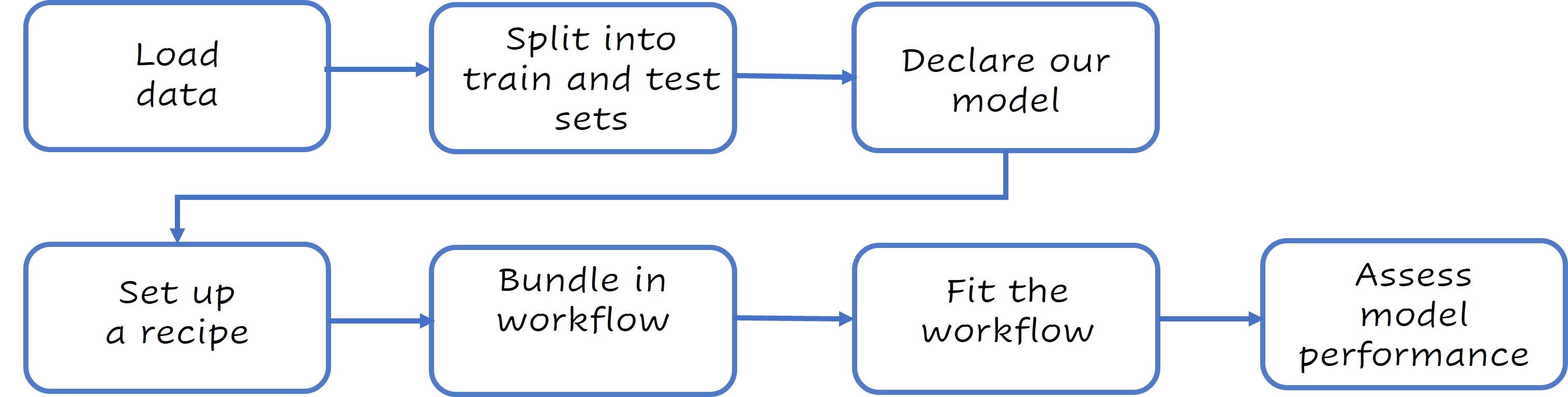
We gebruiken een workflow gebaseerd op tidymodels, een bundel pakketten voor modelleren en machine learning volgens tidyverse-principes (1), met nadruk op feature engineering.

Meer info: www.tidymodels.org
Laten we eerst de data klaarmaken.
cancelations <-
cancelations %>%
mutate(across(where(is_character),as.factor))
set.seed(123)
split <- cancellations %>%
initial_split(
strata = "IsCanceled")
train <- training(split)
test <- testing(split)
Met de prop-parameter pas je de train/test-split aan (standaard 3/4).
initial_split(data, prop = 3/4, strata = NULL)
Controleer of train en test vergelijkbare aandelen geannuleerde boekingen hebben.
train %>%
select(IsCanceled) %>% table() %>%
prop.table()
IsCanceled
0 1
0.5826946 0.4173054
test %>%
select(IsCanceled) %>% table() %>%
prop.table()
IsCanceled
0 1
0.5827788 0.4172212
Definieer het model
lr_model <- logistic_reg()
Maak een recipe
lr_recipe <-
recipe(IsCanceled ~., data = train) %>%
update_role(Agent, new_role = "ID" ) %>%
step_date(arrival_date,
features = c("dow", "week", "month")) %>%
step_holiday(arrival_date,
holidays = timeDate::listHolidays("US")) %>%
step_rm(arrival_date) %>%
step_dummy(all_nominal_predictors())
Print lr_recipe
Recipe
Inputs:
role #variables
ID 1
outcome 1
predictor 13
Operations:
Date features from arrival_date
Holiday features from arrival_date
Variables removed arrival_date
Dummy variables from all_nominal_predictors()
Bundel het model en de recipe in één workflow-object.
lr_workflow <-
workflow()%>%
add_model(lr_model)%>%
add_recipe(lr_recipe)
Fit de workflow
lr_fit <-
lr_workflow %>%
fit(data = train)
Gebruik tidy(lr_fit) om het model samen te vatten.
# A tibble: 65 × 5
term estimate std.error statistic p.value
<chr> <dbl> <dbl> <dbl> <dbl>
1 (Intercept) -1.92 0.228 -8.43 3.57e- 17
2 LeadTime 0.00414 0.000268 15.4 1.16e- 53
3 StaysInWeekendNights 0.0860 0.0382 2.25 2.45e- 2
4 StaysInWeekNights 0.0804 0.0185 4.34 1.40e- 5
5 PreviousCancellations 2.39 0.147 16.2 2.45e- 59
6 PreviousBookingsNotCanceled -0.440 0.0450 -9.77 1.45e- 22
7 BookingChanges -0.449 0.0463 -9.69 3.18e- 22
8 ADR 0.0104 0.000782 13.2 4.85e- 40
9 TotalOfSpecialRequests -0.727 0.0316 -23.0 5.29e-117
10 arrival_date_week 0.0245 0.0171 1.43 1.53e- 1
# … with 55 more rows
# ℹ Use `print(n = ...)` to see more rows
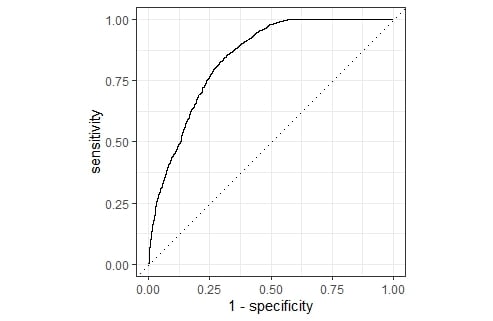
We kunnen nu de modelprestaties beoordelen.
lr_aug <- lr_fit %>% augment(test)
bind_rows(
lr_aug %>%
roc_auc(truth = IsCanceled,.pred_0),
lr_aug %>%
accuracy(truth = IsCanceled,.pred_class))
# A tibble: 2 × 3
.metric .estimator .estimate
<chr> <chr> <dbl>
1 roc_auc binary 0.842
2 accuracy binary 0.782
lr_aug %>%
roc_curve(truth = IsCanceled, .pred_0) %>%
autoplot()
Feature engineering in R