De bag-of-words-representatie

Introductie tot Natural Language Processing in R

Kasey Jones

Research Data Scientist

Het vorige voorbeeld

animal_farm %>%
  unnest_tokens(output = "word", token = "words",
                input = text_column) %>%
  anti_join(stop_words) %>%
  count(word, sort = TRUE)
# A tibble: 3,611 x 2
   word         n
   <chr>    <int>
 1 animals    248
 2 farm       163
 ...
Introductie tot Natural Language Processing in R

De bag-of-words-representatie

text1 <- c("Few words are important.")
text2 <- c("All words are important.")
text3 <- c("Most words are important.")

Unieke woorden:

  • few: alleen in text1
  • all: alleen in text2
  • most: alleen in text3
  • words, are, important
Introductie tot Natural Language Processing in R

Typische vectorrepresentaties

# Lowercase, zonder stopwoorden
word_vector <- c("few", "all", "most", "words", "important")
# Representatie voor text1
text1 <- c("Few words are important.")
text1_vector <- c(1, 0, 0, 1, 1)
# Representatie voor text2
text2 <- c("All words are important.")
text2_vector <- c(0, 1, 0, 1, 1)
# Representatie voor text3
text3 <- c("Most words are important.")
text3_vector <- c(0, 0, 1, 1, 1)
Introductie tot Natural Language Processing in R

tidytext-representatie

words <- animal_farm %>%
    unnest_tokens(output = "word", token = "words", input = text_column) %>%
    anti_join(stop_words) %>%
    count(chapter, word, sort = TRUE)
words
# A tibble: 6,807 x 3
   chapter    word         n
   <chr>      <chr>    <int>
 1 Chapter 8  napoleon    43
 2 Chapter 8  animals     41
 3 Chapter 9  boxer       34
...
Introductie tot Natural Language Processing in R

Voorbeeld met één woord

words %>%
  filter(word == 'napoleon') %>%
  arrange(desc(n))
# A tibble: 9 x 3
  chapter    word         n
  <chr>      <chr>    <int>
1 Chapter 8  napoleon    43
2 Chapter 7  napoleon    24
3 Chapter 5  napoleon    22
...
8 Chapter 3  napoleon     3
9 Chapter 4  napoleon     1
Introductie tot Natural Language Processing in R

Sparse matrices

library(tidytext); library(dplyr)
russian_tweets <- read.csv("russian_1.csv")
russian_tweets <- as_tibble(russian_tweets)

tidy_tweets <- russian_tweets %>%
  unnest_tokens(word, content) %>%
  anti_join(stop_words)
tidy_tweets %>%
  count(word, sort = TRUE)
# A tibble: 43,666 x 2
...
Introductie tot Natural Language Processing in R

Sparse matrices (vervolg)

Sparse matrix

  • 20.000 rijen (tweets)
  • 43.000 kolommen (woorden)
  • 20.000 * 43.000 = 860.000.000
  • Slechts 177.000 niet-nul items. Ongeveer 0,02%

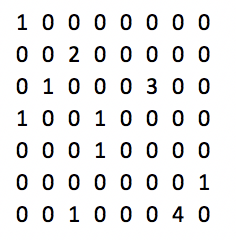
Voorbeeld sparse matrix: Sparse matrices hebben heel weinig niet-nulwaarden. Weergeven lijkt vooral op veel nullen.

Introductie tot Natural Language Processing in R

BoW-oefening

Introductie tot Natural Language Processing in R

Preparing Video For Download...