Deterministische en niet-deterministische processen combineren
Discrete Event Simulation in Python

Diogo Costa (PhD, MSc)
Adjunct Professor, University of Saskatchewan, Canada & CEO of ImpactBLUE-Scientific
Deterministische en niet-deterministische processen
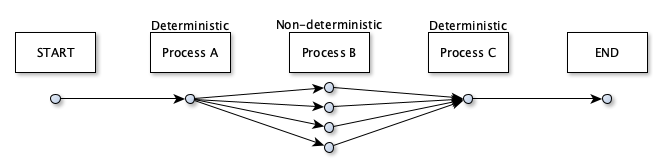
Voorbeeld: Beheer van passagiersstromen op luchthavens
- Niet-deterministisch: Tijdstip waarop een passagier op de luchthaven arriveert
- Deterministisch: Vervoer van bagage op de luchthaven na inchecken
Voorbeeld: Assemblagelijn in een fabriek
Niet-deterministische processen
- Bestelling van grondstoffen
- Handmatige assemblage van complexe onderdelen
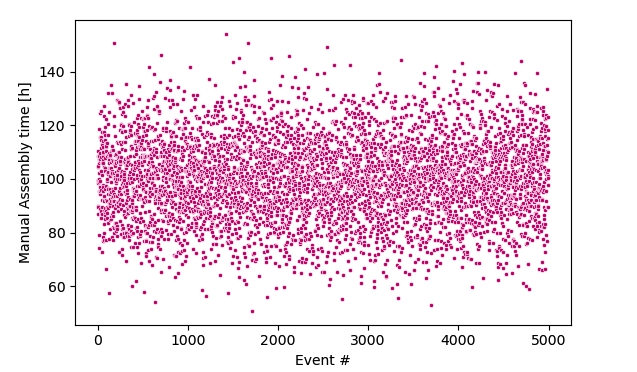
Bouw een gebeurtenisgestuurde simulatie
Productiesequentie van processen

Discreet-evenementmodel
# Initiate time-tracking variable time = numpy.zeros(number_of_processes)# Next-event time progression time[0] = 0 time[1] = time[0] + welding_1["time_hours"] time[2] = time[1] + rd.gauss(manual_assembly_1["time_hours"], manual_assembly_1["std_hours"]) time[3] = time[2] + rd.gauss(manual_assembly_2["time_hours"], manual_assembly_2["std_hours"]) time[4] = time[3] + welding_2["time_hours"] time[5] = time[4]

