Waardering en analyse van obligaties in Python
Joshua Mayhew
Options Trader

import numpy as np
import numpy_financial as npf
import pandas as pd
import matplotlib.pyplot as plt
bond_yields = np.arange(0, 20, 0.1)
print(bond_yields)
[0.0 0.1 0.2 0.3 0.4 0.5 0.6 0.7 0.8 0.9 1.0 1.1 1.2 1.3
...
18.5 18.6 18.7 18.8 18.9 19.0 19.1 19.2 19.3 19.4 19.5 19.6 19.7 19.8 19.9]
bond = pd.DataFrame(bond_yields, columns=['bond_yield'])
print(bond)
bond_yield
0 0.0
1 0.1
.. ...
198 19.8
199 19.9
[200 rows x 1 columns]
bond['bond_price'] = -npf.pv(rate=bond['bond_yield'] / 100, nper=10, pmt=5, fv=100)
print(bond)
bond_yield bond_price
0 0.0 150.000000
1 0.1 148.731575
.. ... ...
198 19.8 37.527719
199 19.9 37.319493
[200 rows x 2 columns]
plt.plot(bond['bond_yield'], bond['bond_price'])plt.xlabel('Yield (%)')plt.ylabel('Bond Price (USD)')plt.title("10 Year Bond 5% Annual Coupon")plt.show()
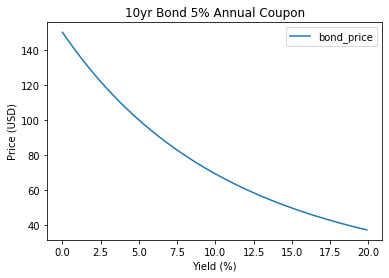
Koersen bewegen omgekeerd aan rendement
Hoger rendement = hogere discontovoet = lagere contante waarde
Hogere koers verlaagt het rendement (yield)

Premie- vs. disconto-obligaties
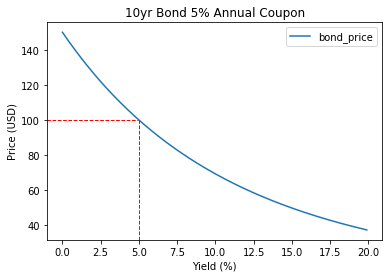
Disconto: Koers < 100, Rendement > Coupon
Pari: Koers = 100, Rendement = Coupon

Koers/rendement is niet-lineair
De lijn is geen rechte lijn
Dit komt door convexiteit

Samenvatting:

Waardering en analyse van obligaties in Python