Timing van grote aardbevingen

Casestudies in statistisch denken

Justin Bois

Lecturer, Caltech

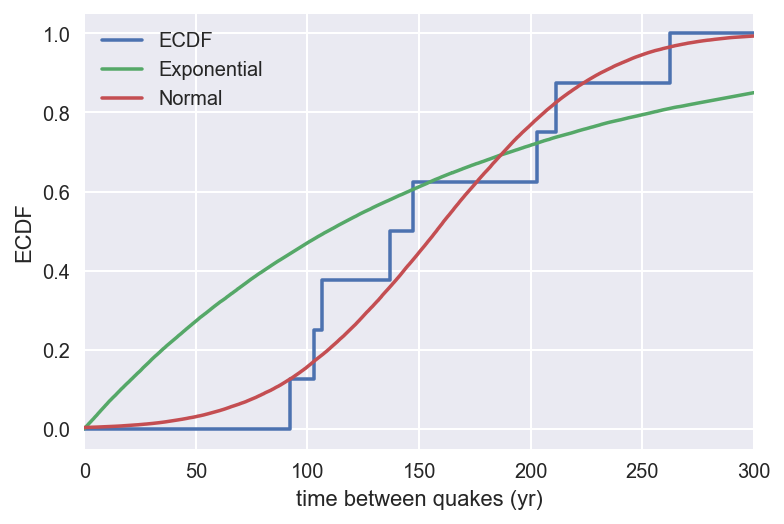
Modellen voor timing van aardbevingen

  • Exponentieel: aardbevingen volgen een Poisson-proces

  • Gaussiaans: aardbevingen hebben een vaste periode
Casestudies in statistisch denken

Aardbevingen in stabiele continentale regio's
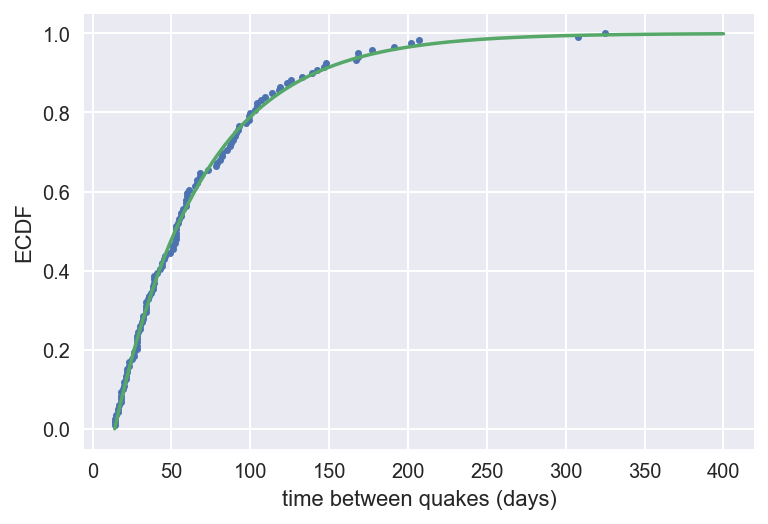
1 Gegevensbron: USGS Earthquake Catalog for Stable Continental Regions
Casestudies in statistisch denken

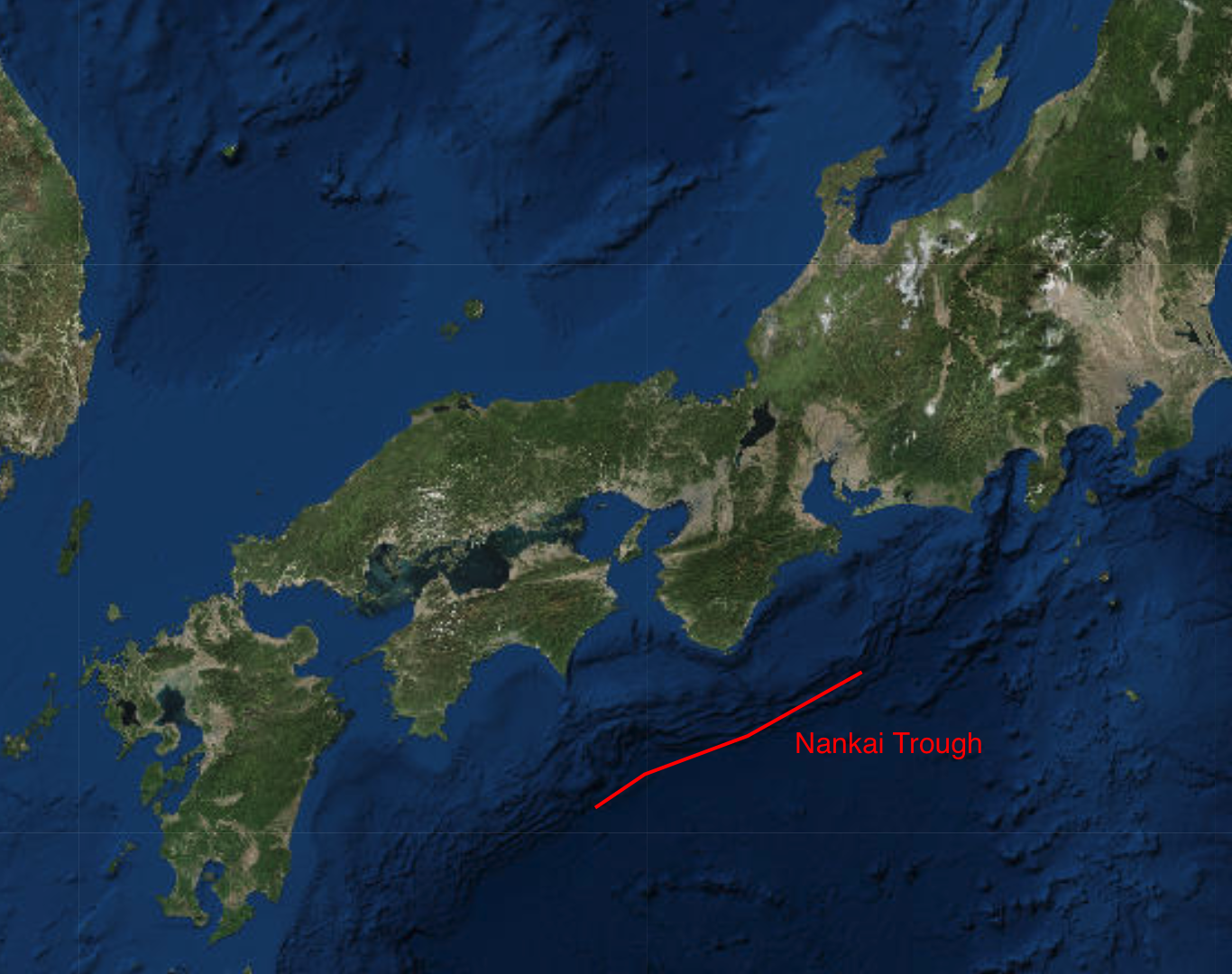
De Nankai-trog

Casestudies in statistisch denken

Aardbevingen in de Nankai-trog

Datum Magnitude
684-11-24 8.4
887-08-22 8.6
1099-02-16 8.0
1361-07-26 8.4
1498-09-11 8.6
1605-02-03 7.9
1707-10-18 8.6
1854-12-23 8.4
1946-12-24 8.1
Casestudies in statistisch denken

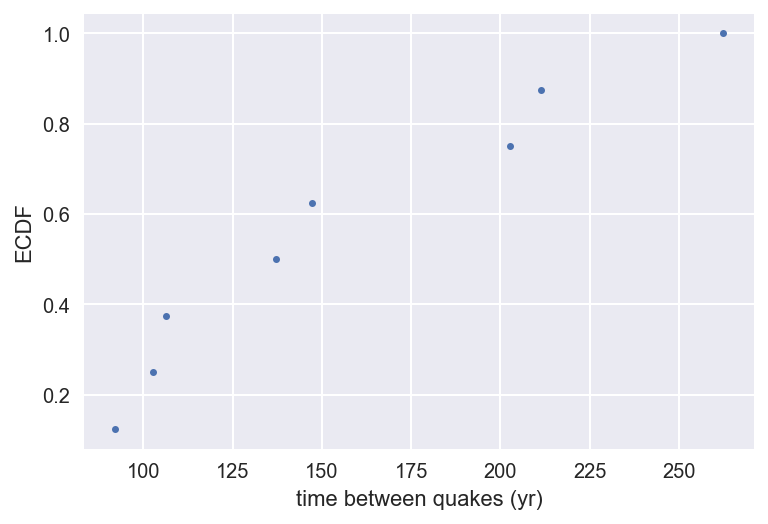
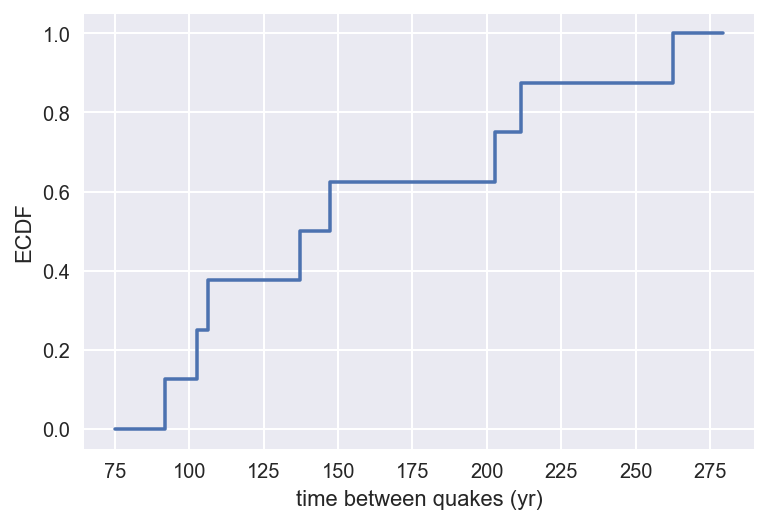
ECDF van tijd tussen Nankai-bevingen

Casestudies in statistisch denken

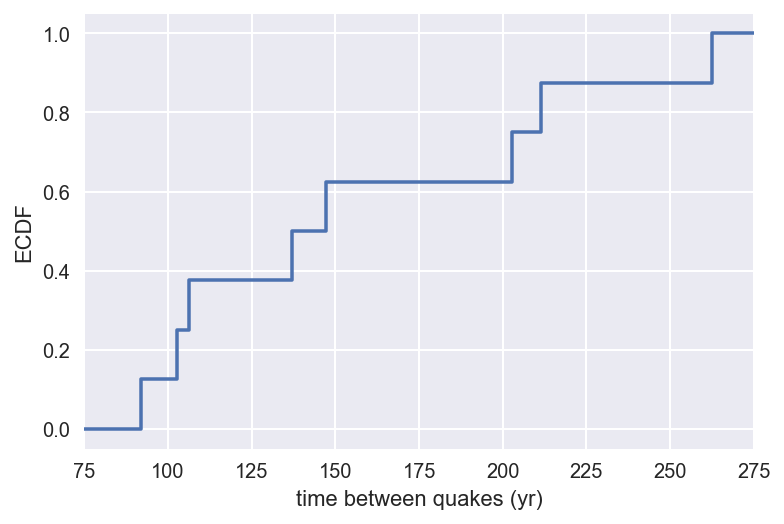
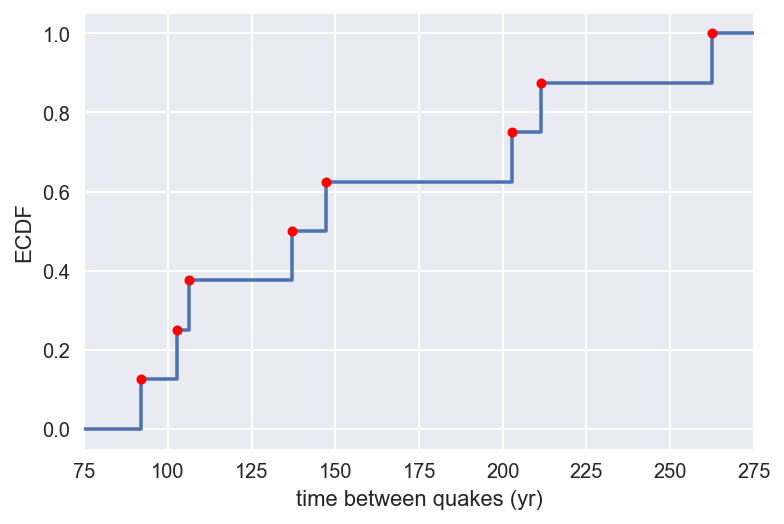
Formele ECDF's

ECDF(x) = fractie datapunten $\le$ x

Casestudies in statistisch denken

Formele ECDF's

Casestudies in statistisch denken

Formele ECDF's

Casestudies in statistisch denken
# time_gap is an array of interearthquake times
_ = plt.plot(*dcst.ecdf(time_gap, formal=True))
_ = plt.xlabel('time between quakes (yr)')
_ = plt.ylabel('ECDF')
Casestudies in statistisch denken
# Compute the mean time gap
mean_time_gap = np.mean(time_gap)

# Standard deviation of the time gap
std_time_gap = np.std(time_gap)
# Generate theoretical Exponential distribution of timings
time_gap_exp = np.random.exponential(mean_time_gap, size=100000)

# Generate theoretical Normal distribution of timings
time_gap_norm = np.random.normal(
  mean_time_gap, std_time_gap, size=100000
)
# Plot theoretical CDFs
_ = plt.plot(*dcst.ecdf(time_gap_exp))
_ = plt.plot(*dcst.ecdf(time_gap_norm))
Casestudies in statistisch denken

Model voor Nankai-trog

Casestudies in statistisch denken

Laten we oefenen!

Casestudies in statistisch denken

Preparing Video For Download...