Model Estimation and Likelihood

Pengantar Pemodelan Linear di Python

Jason Vestuto

Data Scientist

Estimation
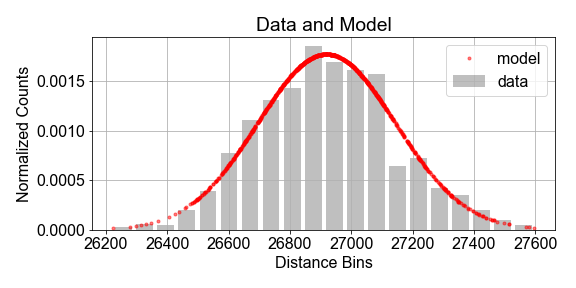
Plot of histogram, normalized counts versus distance bins, of data as grey bars, and of model as red gaussian bell shaped curve fitting closely the top of the grey bars

Pengantar Pemodelan Linear di Python

Estimation

# Define gaussian model function
def gaussian_model(x, mu, sigma):
    coeff_part = 1/(np.sqrt(2 * np.pi * sigma**2))
    exp_part = np.exp( - (x - mu)**2 / (2 * sigma**2) )
    return coeff_part*exp_part
# Compute sample statistics
mean = np.mean(sample)
stdev = np.std(sample)
# Model the population using sample statistics
population_model = gaussian(sample, mu=mean, sigma=stdev)
Pengantar Pemodelan Linear di Python

Likelihood vs Probability

  • Conditional Probability: $P( \text{outcome A} | \text{given B})$
  • Probability: $P( \text{data} | \text{model} )$
  • Likelihood: $L( \text{model} | \text{data} )$
Pengantar Pemodelan Linear di Python

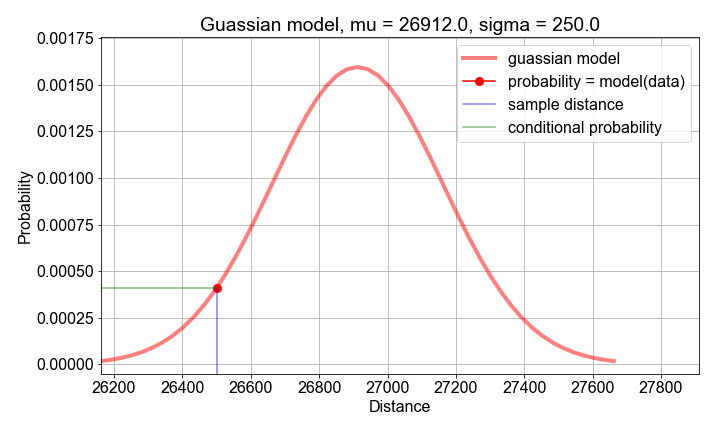
Computing Likelihood

Plot of probability versus distance, as a red gaussian bell shaped curve, with a point near the left edge, and horizontal and vertical line segments connecting this point to each axis

Pengantar Pemodelan Linear di Python

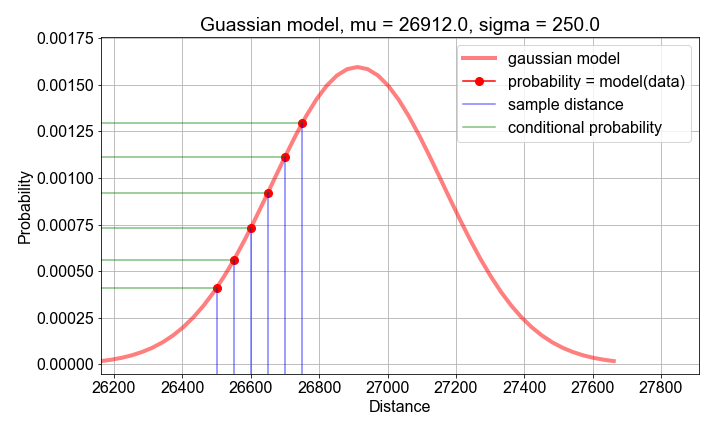
Computing Likelihood

Plot of probability versus distance, as a red gaussian bell shaped curve, with 6 points from the left edge toward the center, with horizontal and vertical line segments connecting each point to both axes

Pengantar Pemodelan Linear di Python

Likelihood from Probabilities

# Guess parameters
mu_guess = np.mean(sample_distances)
sigma_guess = np.std(sample_distances)
# For each sample point, compute a probability
probabilities = np.zeros(len(sample_distances))
for n, distance in enumerate(sample_distances):
    probabilities[n] = gaussian_model(distance, mu=mu_guess, sigma=sigma_guess)
likelihood = np.product(probs)
loglikelihood = np.sum(np.log(probs))
Pengantar Pemodelan Linear di Python

Maximum Likelihood Estimation

# Create an array of mu guesses
low_guess = sample_mean - 2*sample_stdev
high_guess = sample_mean + 2*sample_stdev
mu_guesses = np.linspace(low_guess, high_guess, 101)
# Compute the loglikelihood for each guess
loglikelihoods = np.zeros(len(mu_guesses))
for n, mu_guess in enumerate(mu_guesses):
    loglikelihoods[n] = compute_loglikelihood(sample_distances, mu=mu_guess, sigma=sample_stdev)
# Find the best guess
max_loglikelihood = np.max(loglikelihoods)
best_mu = mu_guesses[loglikelihoods == max_loglikelihood]
Pengantar Pemodelan Linear di Python

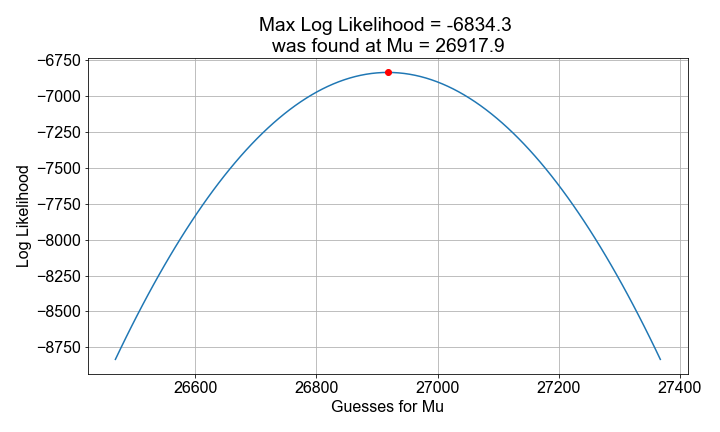
Maximum Likelihood Estimation

Plot of down-turned parabola, with red point at the maximum, plotted on axes loglikelihood versus values of mu

Pengantar Pemodelan Linear di Python

Let's practice!

Pengantar Pemodelan Linear di Python

Preparing Video For Download...