Pengenalan model bahasa

Recurrent Neural Networks (RNN) untuk Pemodelan Bahasa dengan Keras

David Cecchini

Data Scientist

Probabilitas kalimat

Banyak model tersedia

  • Probabilitas "I loved this movie".
  • Unigram
    • $$P(\text{sentence}) = P(\text{I})P(\text{loved})P(\text{this})P(\text{movie})$$
  • N-gram
    • N = 2 (bigram): $$P(\text{sentence}) = P(\text{I})P(\text{loved} | \text{I})P(\text{this} | \text{loved})P(\text{movie} | \text{this})$$
    • N = 3 (trigram): $$P(\text{sentence}) = P(\text{I})P(\text{loved} | \text{I})P(\text{this} | \text{I loved})P(\text{movie} | \text{loved this})$$
Recurrent Neural Networks (RNN) untuk Pemodelan Bahasa dengan Keras

Probabilitas kalimat (lanj.)

  • Skip gram
    • $$P(\text{sentence}) = P(\text{context of I} | \text{I})P(\text{context of loved} | \text{loved}) \ $$ $$P(\text{context of this} | \text{this})P(\text{context of movie} | \text{movie})$$
  • Neural Networks
    • Probabilitas kalimat diberikan oleh fungsi softmax pada lapisan keluaran jaringan
Recurrent Neural Networks (RNN) untuk Pemodelan Bahasa dengan Keras

Kaitan dengan RNN

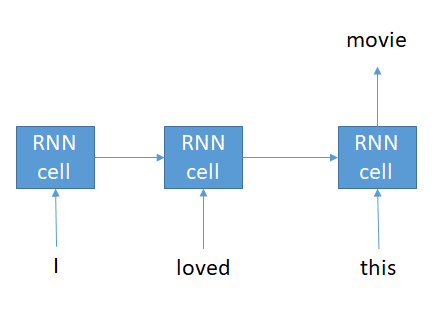
Model bahasa ada di mana-mana dalam RNN!

  • Jaringan itu sendiri

Model RNN dapat dipandang sebagai model bahasa karena dapat digunakan untuk memprediksi kata berikutnya.

Recurrent Neural Networks (RNN) untuk Pemodelan Bahasa dengan Keras

Kaitan dengan RNN (lanj.)

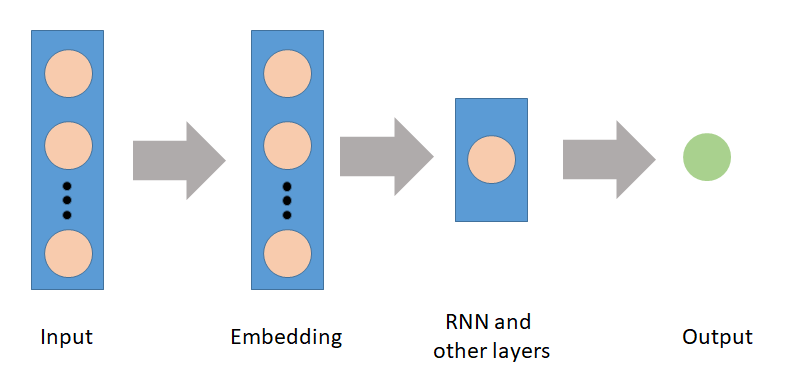
  • Lapisan embedding

Menampilkan representasi makro lapisan dalam model. Lapisan embedding harus menjadi lapisan pertama setelah lapisan masukan, dan menghasilkan representasi padat dari kata-kata.

Recurrent Neural Networks (RNN) untuk Pemodelan Bahasa dengan Keras

Membangun kamus kosakata

# Get unique words
unique_words = list(set(text.split(' ')))
# Create dictionary: word is key, index is value
word_to_index = {k:v for (v,k) in enumerate(unique_words)}
# Create dictionary: index is key, word is value
index_to_word = {k:v for (k,v) in enumerate(unique_words)}
Recurrent Neural Networks (RNN) untuk Pemodelan Bahasa dengan Keras

Prapemrosesan masukan

# Initialize variables X and y
X = []
y = []

# Loop over the text: length `sentence_size` per time with step equal to `step` for i in range(0, len(text) - sentence_size, step):
X.append(text[i:i + sentence_size]) y.append(text[i + sentence_size])
# Example (numbers are numerical indexes of vocabulary):
# Sentence is: "i loved this movie" -> (["i", "loved", "this"], "movie")
X[0],y[0] = ([10, 444, 11], 17)
Recurrent Neural Networks (RNN) untuk Pemodelan Bahasa dengan Keras

Mengonversi teks baru

# Create list to keep the sentences of indexes
new_text_split = []

# Loop and get the indexes from dictionary for sentence in new_text:
sent_split = []
for wd in sentence.split(' '):
ix = wd_to_index[wd]
sent_split.append(ix)
new_text_split.append(sent_split)
Recurrent Neural Networks (RNN) untuk Pemodelan Bahasa dengan Keras

Ayo berlatih!

Recurrent Neural Networks (RNN) untuk Pemodelan Bahasa dengan Keras

Preparing Video For Download...