Feature Engineering in R
Jorge Zazueta
Research Professor and Head of the Modeling Group at the School of Economics, UASLP
Assegna un indice a ogni vettore in base ai valori di testo.
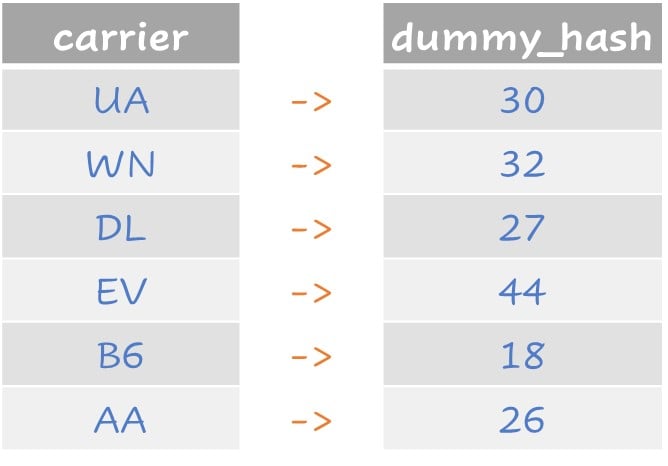
Il dataset flights include i vettori come fattori, ma non sappiamo se compariranno nuovi vettori con nuovi dati.
flights %>%
select(carrier) %>%
table()
carrier
9E AA AS B6 DL EV F9 FL HA MQ OO UA US VX WN YV
859 1744 26 2503 2619 3014 38 186 14 1540 2 3367 1228 244 757 41
Possiamo creare hash dummy per rappresentare i valori del fattore, usando il package textrecipes.
recipe <- recipe(~carrier,
data = flights_train) %>%
step_dummy_hash(carrier, prefix = NULL,
signed = FALSE,
num_terms = 50L)
# Prep the recipe
object <- recipe %>%
prep()
# Bake the recipe object con nuovi dati
baked <- bake(object,
new_data = flights_test)
Uno sguardo alla rappresentazione di step_dummy_hash().
bind_cols(flights_test$carrier,baked)[1:6,c(1,18:20)]
New names:
• `` -> `...1`
# A tibble: 10 × 4
...1 `_carrier_17` `_carrier_18` `_carrier_19`
<chr> <int> <int> <int>
1 EV 0 0 0
2 B6 0 1 0
3 EV 0 0 0
4 MQ 0 0 0
5 DL 0 0 0
6 EV 0 0 0
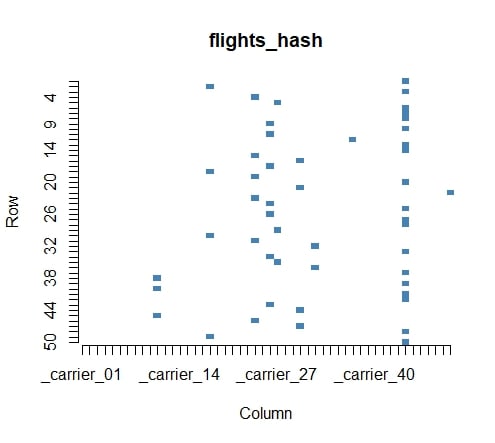
Possiamo ispezionare la matrice con il package plot.matrix.
flights_hash <-
as.matrix(baked)[1:50,]
plot(flights_hash,
col = c("white","steelblue"),
key = NULL,
border = NA)

Feature Engineering in R