Digit analysis using Benford's Law

Rilevamento delle frodi in R

Bart Baesens

Professor Data Science at KU Leuven

Introduction

  • Take a newspaper at a random page and write down the first or leftmost digit (1,2,...,9) of all numbers.
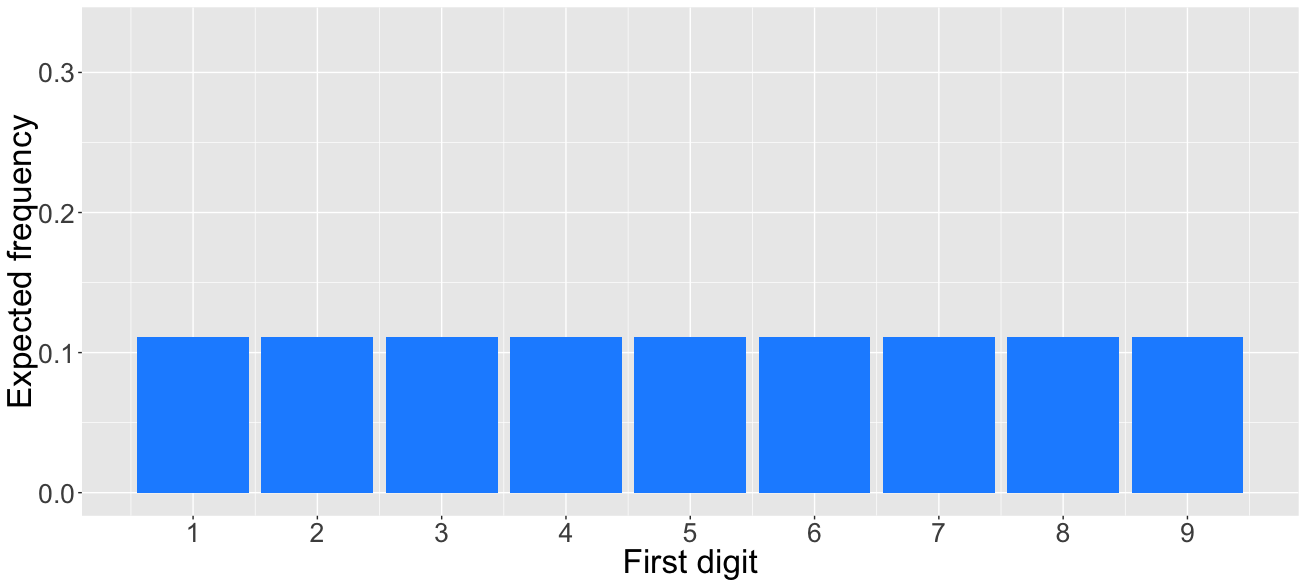
  • What are the expected frequencies of these digits?

newspaper

Rilevamento delle frodi in R

Introduction

  • Take a newspaper at a random page and write down the first or leftmost digit (1,2,...,9) of all numbers.
  • What are the expected frequencies of these digits?
  • Natural guess will be about 1/9 = 11%

barplotrnd

Rilevamento delle frodi in R

Introduction

  • Take a newspaper at a random page and write down the first or leftmost digit (1,2,...,9) of all numbers.
  • What are the expected frequencies of these digits?
  • Natural guess will be about 1/9
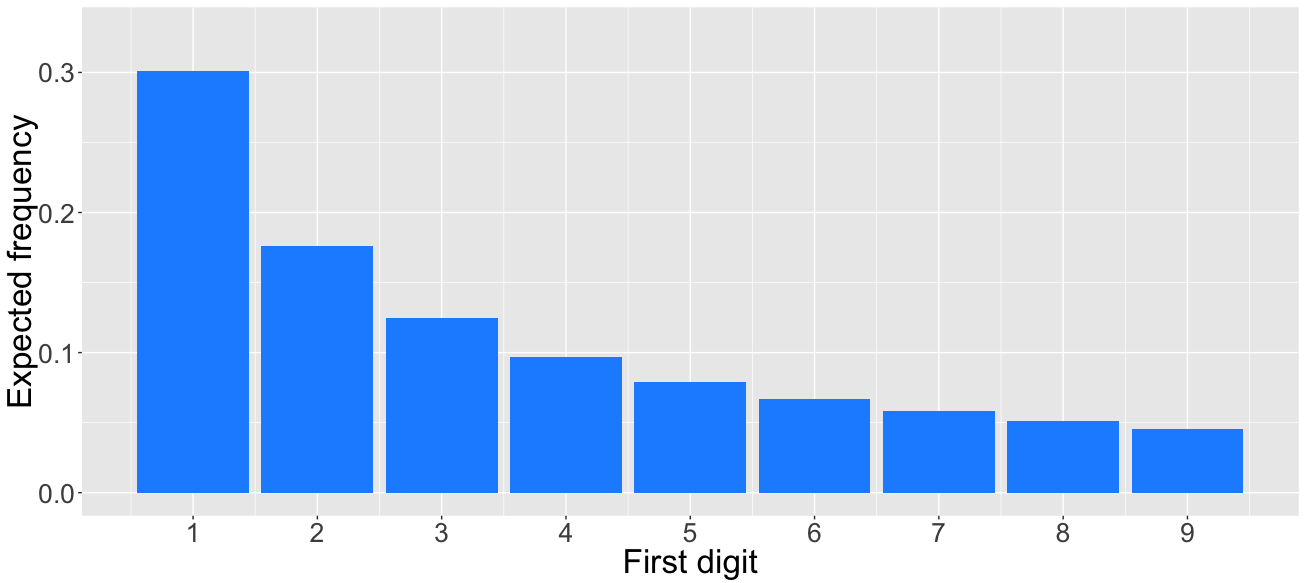
  • Benford's law: expected frequencies
    • digit 1 $\approx$ 30%
    • digit 9 $\approx$ 4.6%

barplotbf

Rilevamento delle frodi in R

Newcomb and Benford

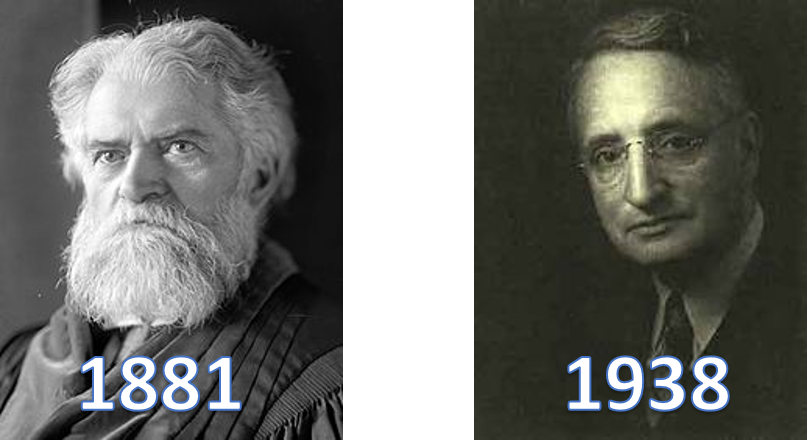
  • "That the ten digits do not occur with equal frequency must be evident to any one making much use of logarithmic tables, and noticing how much faster the first pages wear out than the last ones." (Newcomb, 1881)
  • Benford observed the first digit of numbers in 20 different datasets.

newben

Rilevamento delle frodi in R

Benford's law for the first digit

A dataset satisfies Benford's Law for the first digit if the probability that the first digit $D_1$ equals $d_1$ is approximately: $$P(D_1=d_1)=\log(d_1+1)-\log(d_1)=\log\left(1+\frac{1}{d_1}\right) \qquad d_1=1,\ldots,9$$

  • Examples

    • $P(D_1=1)=\log\left(1+\frac{1}{1}\right)=\log(2)=0.3010300$
    • $P(D_1=2)=\log\left(1+\frac{1}{2}\right)=\log(1.5)=0.1760913$
    • $P(D_1=9)=\log\left(1+\frac{1}{9}\right)=\log(1.111111)=0.04575749$
  • Pinkham discovered that Benford's law is invariant by scaling.

Rilevamento delle frodi in R

Benford's law for the first digit

benlaw <- function(d) log10(1 + 1 / d)
benlaw(1)
0.30103
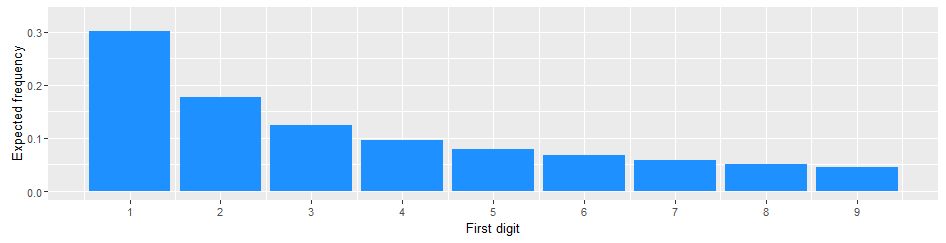
barplotbf

Rilevamento delle frodi in R

We generate the first 1000 Fibonacci numbers.

fibnum <- numeric(1000)
fibnum[1] <- fibnum[2] <- 1
for (i in 3:1000) { fibnum[i] <- fibnum[i-1] + fibnum[i-2] } 
head(fibnum)
1 1 2 3 5 8

We also generate the first 1000 powers of 2.

pow2 <- 2^(1:1000)
head(pow2)
2 4 8 16 32 64
Rilevamento delle frodi in R

Function `benford` from package benford.anaysis

library(benford.analysis)
bfd.fib <- benford(fibnum,
                   number.of.digits = 1)
plot(bfd.fib)
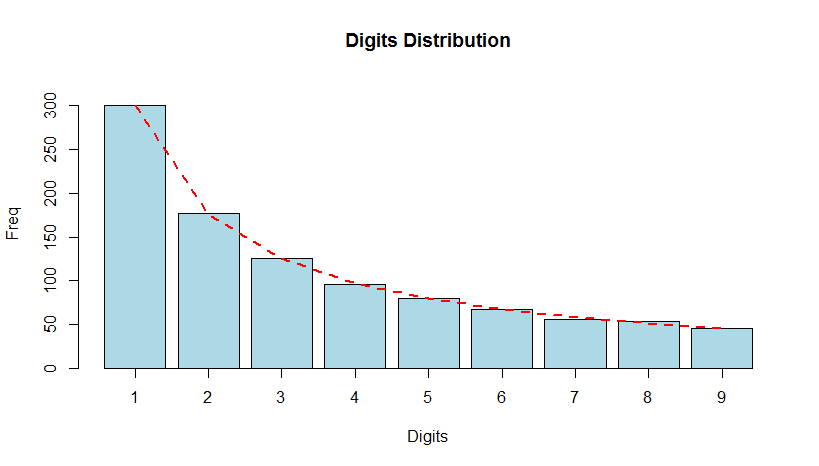
fibonacci

library(benford.analysis)
bfd.pow2 <- benford(pow2,
                    number.of.digits = 1)
plot(bfd.pow2)
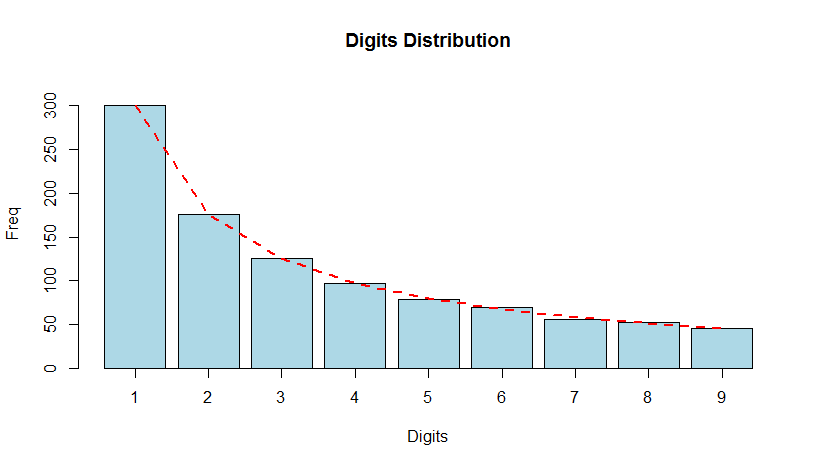
pow2

Rilevamento delle frodi in R

Let's practice!

Rilevamento delle frodi in R

Preparing Video For Download...