Bayesian regression with a categorical predictor

Modeling bayesiano con RJAGS

Alicia Johnson

Associate Professor, Macalester College

Chapter 4 goals

  • Incorporate categorical predictors into Bayesian models
  • Engineer multivariate Bayesian regression models
  • Extend our methodology for Normal regression models to generalized linear models: Poisson regression
Modeling bayesiano con RJAGS

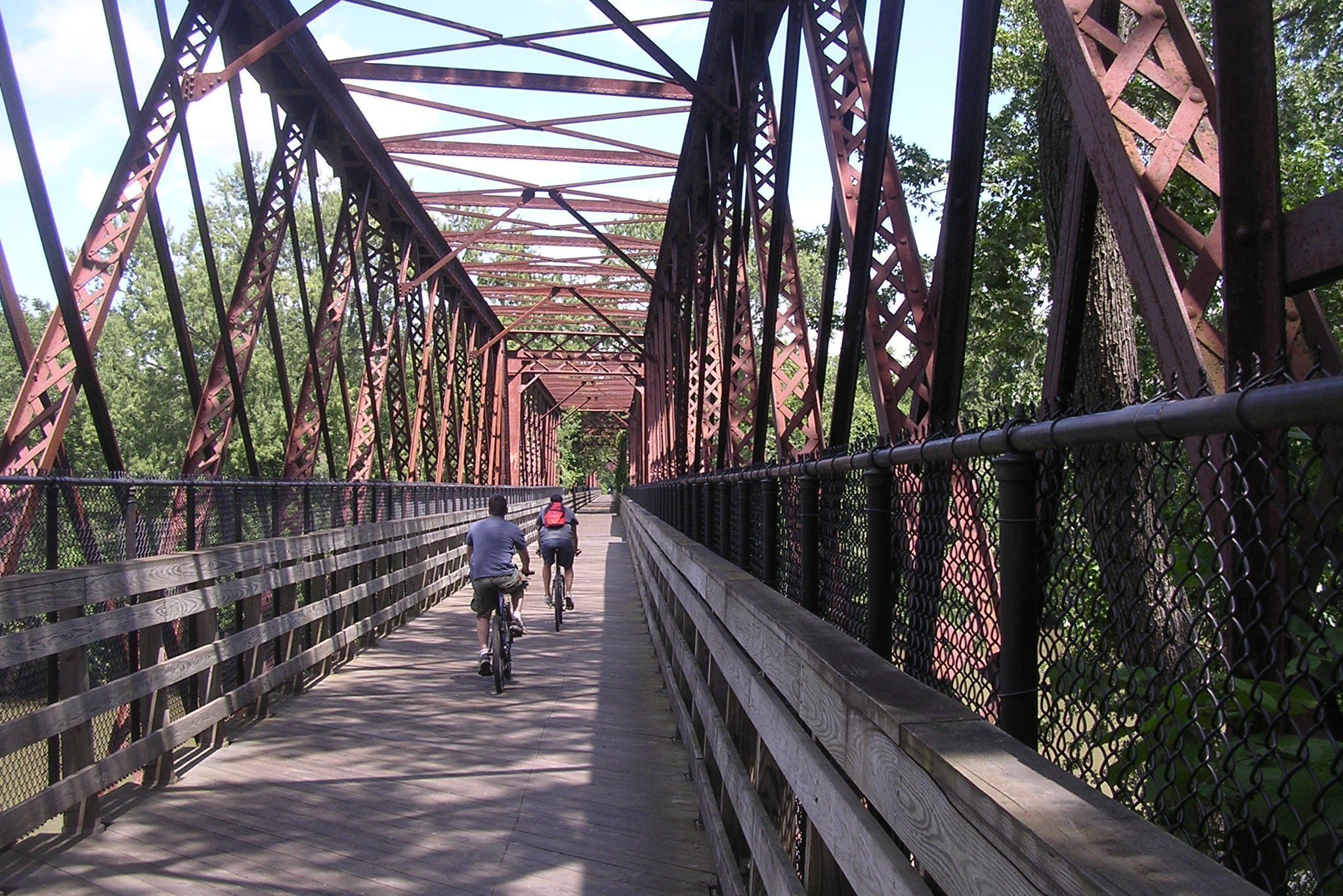
Rail-trail volume

Goal:
Explore daily volume on a rail-trail in Massachusetts.

1 Photo courtesy commons.wikimedia.org
Modeling bayesiano con RJAGS

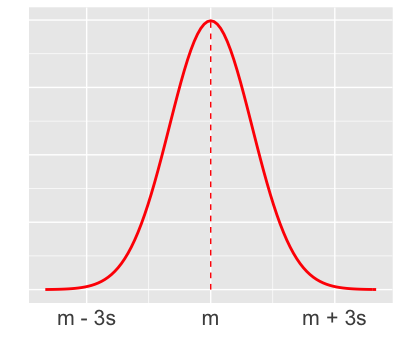
Modeling volume

$Y_i$ = trail volume (# of users) on day $i$ $ \; $
$ \;$

Model
$Y_i \sim N(m_i, s^2)$

Modeling bayesiano con RJAGS

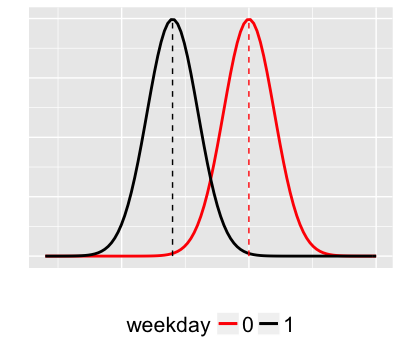
Modeling volume by weekday

$Y_i$ = trail volume (# of users) on day $i$
$X_i$ = 1 for weekdays, 0 for weekends

Model
$Y_i \sim N(m_i, s^2)$

Modeling bayesiano con RJAGS

Modeling volume by weekday

$Y_i$ = trail volume (# of users) on day $i$
$X_i$ = 1 for weekdays, 0 for weekends

Model
$Y_i \sim N(m_i, s^2)$

Modeling bayesiano con RJAGS

Modeling volume by weekday

$Y_i$ = trail volume (# of users) on day $i$
$X_i$ = 1 for weekdays, 0 for weekends

Model
$Y_i \sim N(m_i, s^2)$
$m_i = a + bX_i$

Modeling bayesiano con RJAGS

Modeling volume by weekday

$Y_i$ = trail volume (# of users) on day $i$
$X_i$ = 1 for weekdays, 0 for weekends

Model
$Y_i \sim N(m_i, s^2)$
$m_i = a + bX_i$

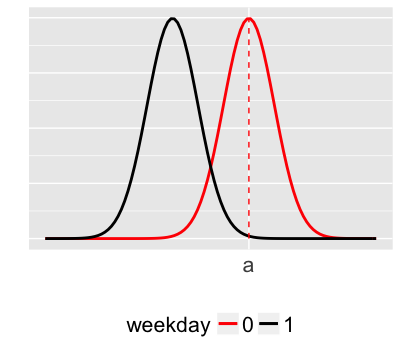
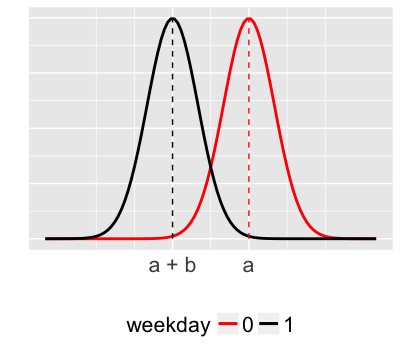
  • $a$ = typical weekend volume

Modeling bayesiano con RJAGS

$Y_i$ = trail volume (# of users) on day $i$
$X_i$ = 1 for weekdays, 0 for weekends

Model
$Y_i \sim N(m_i, s^2)$
$m_i = a + bX_i$

  • $a$ = typical weekend volume
  • $a + b$ = typical weekday volume

  • $b$ = contrast between typical weekday vs weekend volume
  • $s$ = residual standard deviation
Modeling bayesiano con RJAGS

Priors for $a$ & $b$

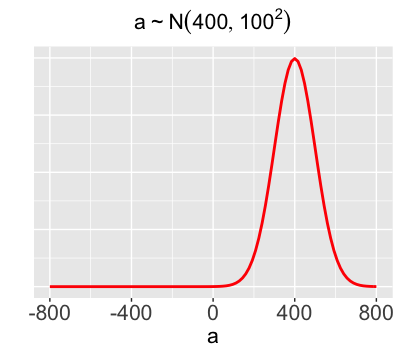
Typical weekend volume is most likely around 400 users per day, but possibly as low as 100 or as high as 700 users.
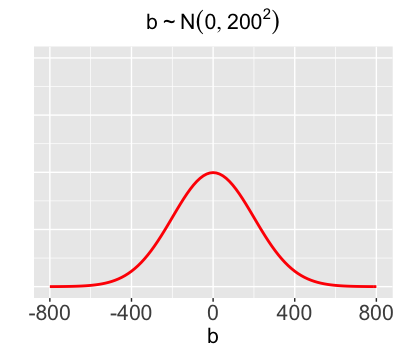
We lack certainty about how weekday volume compares to weekend volume. It could be more, it could be less.

Modeling bayesiano con RJAGS

Prior for $s$

$\;$

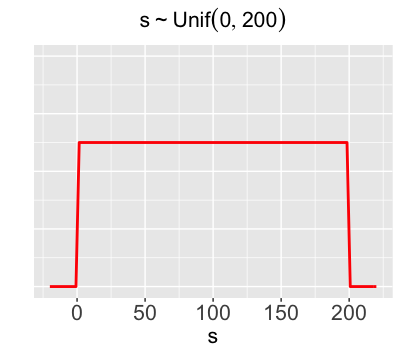
The standard deviation in volume from day to day (whether on weekdays or weekends) is equally likely to be anywhere between 0 and 200 users.

Modeling bayesiano con RJAGS

Bayesian model of volume by weekday status

$Y_i \sim N(m_i, s^2)$
$m_i = a + b X_i$
$a \sim N(400, 100^2)$
$b \sim N(0, 200^2)$
$s \sim \text{Unif}(0, 200)$

Modeling bayesiano con RJAGS

DEFINE the Bayesian model in RJAGS

$Y_i \sim N(m_i, s^2)$
$m_i = a + b X_i$
$a \sim N(400, 100^2)$
$b \sim N(0, 200^2)$
$s \sim \text{Unif}(0, 200)$

rail_model_1 <- "model{
    # Likelihood model for Y[i]


    # Prior models for a, b, s


}"  
Modeling bayesiano con RJAGS

DEFINE the Bayesian model in RJAGS

$Y_i \sim N(m_i, s^2)$
$m_i = a + b X_i$
$a \sim N(400, 100^2)$
$b \sim N(0, 200^2)$
$s \sim \text{Unif}(0, 200)$

rail_model_1 <- "model{
    # Likelihood model for Y[i]
    for(i in 1:length(Y)) {
        Y[i] ~ dnorm(m[i], s^(-2))

    }

    # Prior models for a, b, s
    a ~ dnorm(400, 100^(-2))
    s ~ dunif(0, 200)


}"  
Modeling bayesiano con RJAGS

DEFINE the Bayesian model in RJAGS

m[i] <- a + b[X[i]]

  • X[1] = weekend, X[2] = weekday
  • b has 2 levels: b[1], b[2]
  • weekend trend ($m_i = a$)
    m[i] <- a + b[1]
rail_model_1 <- "model{
    # Likelihood model for Y[i]
    for(i in 1:length(Y)) {
        Y[i] ~ dnorm(m[i], s^(-2))
        m[i] <- a + b[X[i]]
    }

    # Prior models for a, b, s
    a ~ dnorm(400, 100^(-2))
    s ~ dunif(0, 200)


}"  
Modeling bayesiano con RJAGS

DEFINE the Bayesian model in RJAGS

m[i] <- a + b[X[i]]

  • X[1] = weekend, X[2] = weekday
  • b has 2 levels: b[1], b[2]
  • weekend trend ($m_i = a$)
    m[i] <- a + b[1]
    b[1] <- 0
rail_model_1 <- "model{
    # Likelihood model for Y[i]
    for(i in 1:length(Y)) {
        Y[i] ~ dnorm(m[i], s^(-2))
        m[i] <- a + b[X[i]]
    }

    # Prior models for a, b, s
    a ~ dnorm(400, 100^(-2))
    s ~ dunif(0, 200)
    b[1] <- 0

}"  
Modeling bayesiano con RJAGS

DEFINE the Bayesian model in RJAGS

m[i] <- a + b[X[i]]

  • X[1] = weekend,X[2] = weekday
  • b has 2 levels: b[1], b[2]
  • weekend trend ($m_i = a$)
    m[i] <- a + b[1]
    b[1] <- 0
  • weekday ($m_i = a + b$)
    m[i] <- a + b[2]
rail_model_1 <- "model{
    # Likelihood model for Y[i]
    for(i in 1:length(Y)) {
        Y[i] ~ dnorm(m[i], s^(-2))
        m[i] <- a + b[X[i]]
    }

    # Prior models for a, b, s
    a ~ dnorm(400, 100^(-2))
    s ~ dunif(0, 200)
    b[1] <- 0
    b[2] ~ dnorm(0, 200^(-2))
}"  

b[2] ~ dnorm(0, 200^(-2))

Modeling bayesiano con RJAGS

Let's practice!

Modeling bayesiano con RJAGS

Preparing Video For Download...