Progettare pipeline di forecasting per la produzione
Rami Krispin
Senior Manager, Data Science and Engineering
statsforecastmlforecast negli esercizi

import pandas as pd
import datetime
from statsforecast import StatsForecast
from statsforecast.models import (
DynamicOptimizedTheta,
SeasonalNaive,
AutoARIMA,
HoltWinters,
MSTL
)
from utilsforecast.plotting import plot_series
Formato input dati:
unique_id - ID della serieds - timestamp della seriey - valori della seriets = pd.read_csv("data/data.csv")
ts["ds"] = pd.to_datetime(ts["ds"])
ts = ts.sort_values("ds")
ts = ts[["unique_id", "ds", "y"]]
os.environ['NIXTLA_ID_AS_COL'] = '1'
unique_id ds y
0 1 2022-11-11 23:00:00 456403
1 1 2022-11-12 00:00:00 458842
2 1 2022-11-12 01:00:00 455111
3 1 2022-11-12 02:00:00 448035
4 1 2022-11-12 03:00:00 438165
datetime.timedeltatest_length = 72
train_end = end - datetime.timedelta(hours = test_length)
train = ts[ts["ds"] <= train_end]
test = ts[ts["ds"] > train_end]
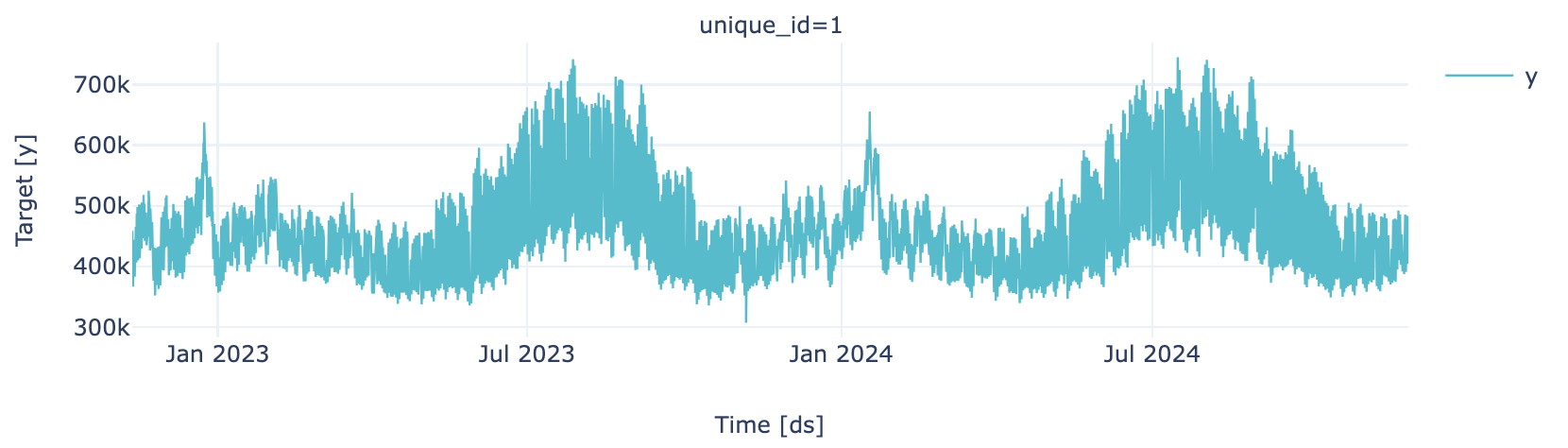
plot_series(train, engine = "plotly")

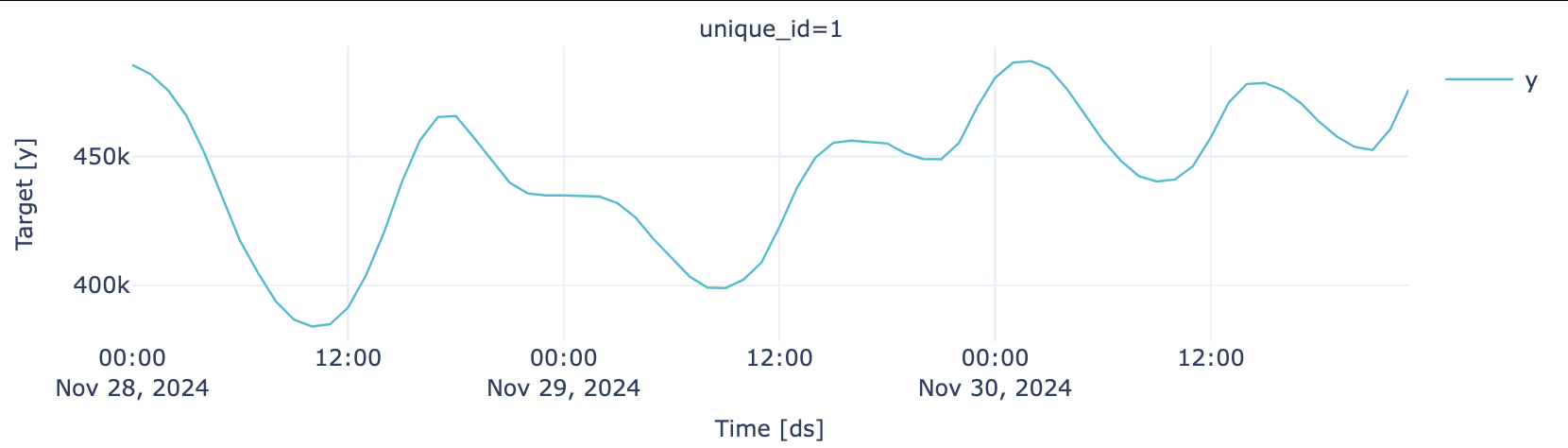
plot_series(test, engine = "plotly")

# Istanzia modelli con stagionalità oraria auto_arima = AutoARIMA() s_naive = SeasonalNaive(season_length=24) theta = DynamicOptimizedTheta(season_length=24)# Istanzia modelli con stagionalità oraria e settimanale mstl1 = MSTL(season_length=[24, 24 * 7], trend_forecaster=AutoARIMA(), alias="MSTL_ARIMA_trend") mstl2 = MSTL(season_length=[24, 24 * 7], trend_forecaster=HoltWinters(), alias="MSTL_Holt_trend")
# Combina i modelli in una lista stats_models = [auto_arima, s_naive, theta, mstl1, mstl2]# Istanzia l'oggetto modello sf = StatsForecast( models=stats_models, freq="h", fallback_model = AutoARIMA(), n_jobs= -1)
# Combina i modelli in una lista stats_models = [auto_arima, s_naive, theta, mstl1, mstl2]# Istanzia l'oggetto modello sf = StatsForecast( models=stats_models, freq="h", fallback_model = AutoARIMA(), n_jobs= -1)# Crea il forecast forecast_stats = sf.forecast(df=train, h=72, level=[95])
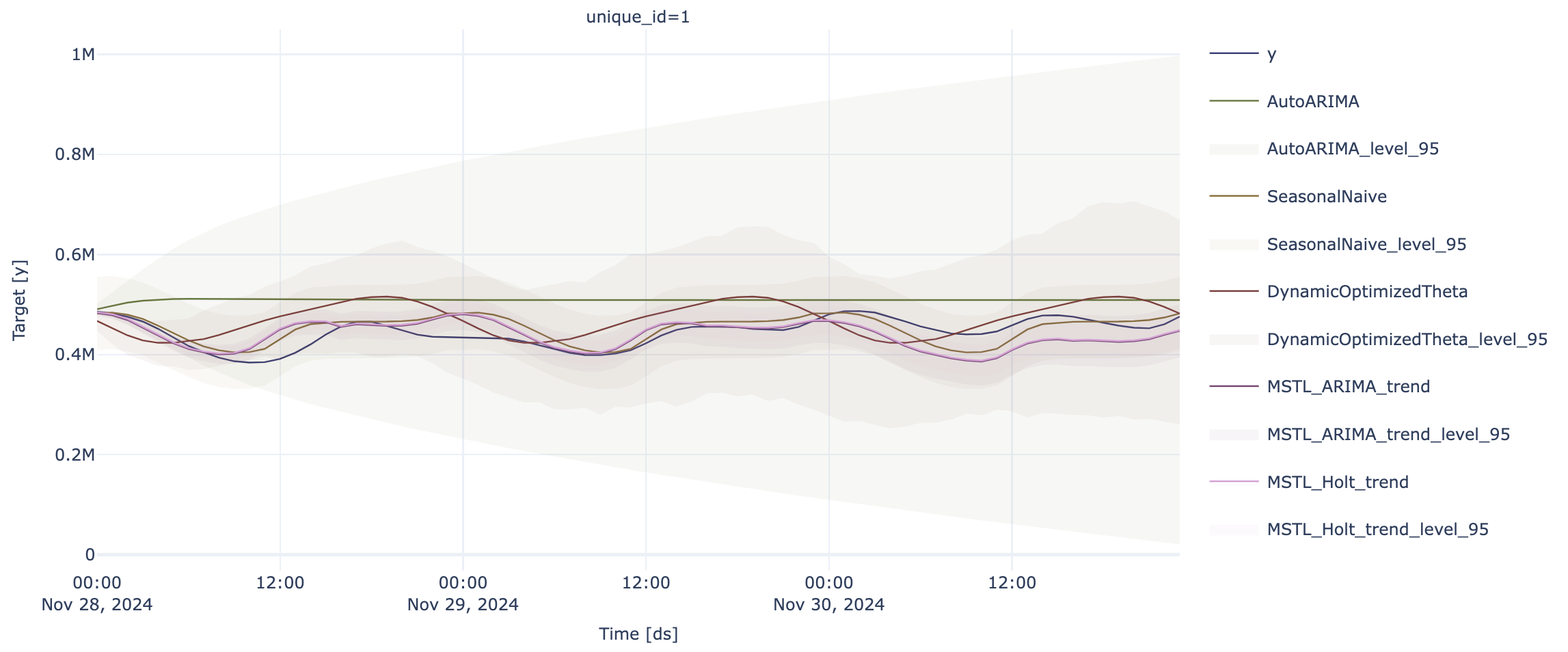
p = sf.plot(test, forecast_stats, engine = "plotly", level=[95])
p.update_layout(height=400)
def mape(y, yhat):
mape = mean(abs(y - yhat)/ y)
return mape
def rmse(y, yhat):
rmse = (mean((y - yhat) ** 2 )) ** 0.5
return rmse
def coverage(y, lower, upper):
coverage = sum((y <= upper) & (y >= lower)) / len(y)
return coverage
fc = forecast_stats.merge(test, how="left", on="ds") fc_performance = None for i in [str(m) for m in stats_models]: m = mape(y = fc["y"], yhat = fc[i]) r = rmse(y = fc["y"], yhat = fc[i]) c = coverage(y = fc["y"], lower = fc[i + "-lo-95"], upper = fc[i + "-hi-95"])perf = {"model": i, "mape": m, "rmse": r, "coverage": c} if fc_performance is None: fc_performance = pd.DataFrame([perf]) else: fc_performance = pd.concat([fc_performance, pd.DataFrame([perf])]) fc_performance.reset_index(drop=True, inplace=True)
print(fc_performance.sort_values("rmse"))
model mape rmse coverage
1 SeasonalNaive 0.041340 22410.483959 1.000000
4 MSTL_Holt_trend 0.053939 30201.299395 0.513889
3 MSTL_ARIMA_trend 0.053771 30428.240235 0.666667
2 DynamicOptimizedTheta 0.090566 45189.869437 0.916667
0 AutoARIMA 0.149790 70483.617198 1.000000
print(fc_performance.sort_values("rmse"))
model mape rmse coverage
1 SeasonalNaive 0.041340 22410.483959 1.000000
4 MSTL_Holt_trend 0.053939 30201.299395 0.513889
3 MSTL_ARIMA_trend 0.053771 30428.240235 0.666667
2 DynamicOptimizedTheta 0.090566 45189.869437 0.916667
0 AutoARIMA 0.149790 70483.617198 1.000000
Progettare pipeline di forecasting per la produzione