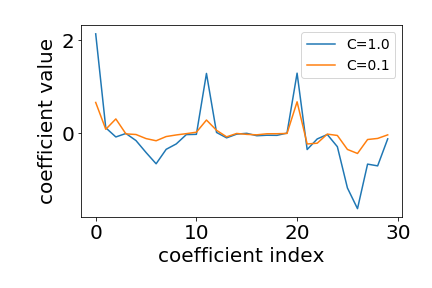
Logistic regression and regularization

Bộ phân loại tuyến tính với Python

Michael (Mike) Gelbart

Instructor, The University of British Columbia

Regularized logistic regression
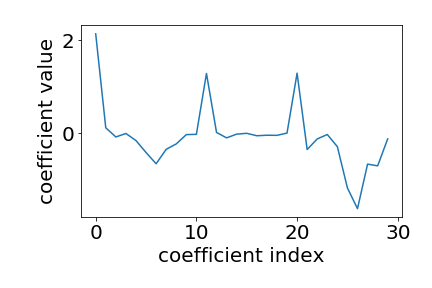
Bộ phân loại tuyến tính với Python

Regularized logistic regression

Bộ phân loại tuyến tính với Python

How does regularization affect training accuracy?

lr_weak_reg = LogisticRegression(C=100)
lr_strong_reg = LogisticRegression(C=0.01)

lr_weak_reg.fit(X_train, y_train) lr_strong_reg.fit(X_train, y_train)
lr_weak_reg.score(X_train, y_train) lr_strong_reg.score(X_train, y_train)
1.0
0.92

$\text{regularized loss = original loss + large coefficient penalty}$

  • more regularization: lower training accuracy
Bộ phân loại tuyến tính với Python

How does regularization affect test accuracy?

lr_weak_reg.score(X_test, y_test)
0.86
lr_strong_reg.score(X_test, y_test)
0.88

$\text{regularized loss = original loss + large coefficient penalty}$

  • more regularization: lower training accuracy
  • more regularization: (almost always) higher test accuracy
Bộ phân loại tuyến tính với Python

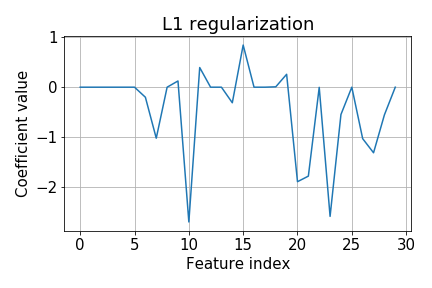
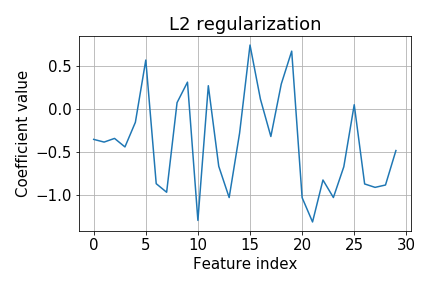
L1 vs. L2 regularization

  • Lasso = linear regression with L1 regularization
  • Ridge = linear regression with L2 regularization
  • For other models like logistic regression we just say L1, L2, etc.
lr_L1 = LogisticRegression(solver='liblinear', penalty='l1')
lr_L2 = LogisticRegression() # penalty='l2' by default

lr_L1.fit(X_train, y_train)
lr_L2.fit(X_train, y_train)
plt.plot(lr_L1.coef_.flatten())
plt.plot(lr_L2.coef_.flatten())
Bộ phân loại tuyến tính với Python

L2 vs. L1 regularization

Bộ phân loại tuyến tính với Python

Let's practice!

Bộ phân loại tuyến tính với Python

Preparing Video For Download...