Ước lượng mô hình Cox Proportional Hazards
Phân tích sống sót bằng Python

Shae Wang
Senior Data Scientist
Hàm nguy cơ và tốc độ nguy cơ
Hàm nguy cơ $h(t)$: xác suất sự kiện xảy ra tại thời điểm t, với điều kiện đã sống sót đến t.
Tốc độ nguy cơ: tốc độ tức thời xảy ra sự kiện
$$h(t)=-\frac{d}{dt}logS(t)$$
$h(t)$ và hàm sống sót $S(t)$ có thể suy ra lẫn nhau.
Giả định nguy cơ tỷ lệ
Giả định nguy cơ tỷ lệ: nguy cơ của mọi cá nhân tỷ lệ với nhau.
Với cá nhân $A$ và $B$: $$h_A(t)=ch_B(t)$$
- Có nguy cơ gốc và các nguy cơ khác được xác định bằng hệ số co giãn.
- Tác động tương đối đến sống sót của một biến không đổi theo thời gian (bất biến theo thời gian).
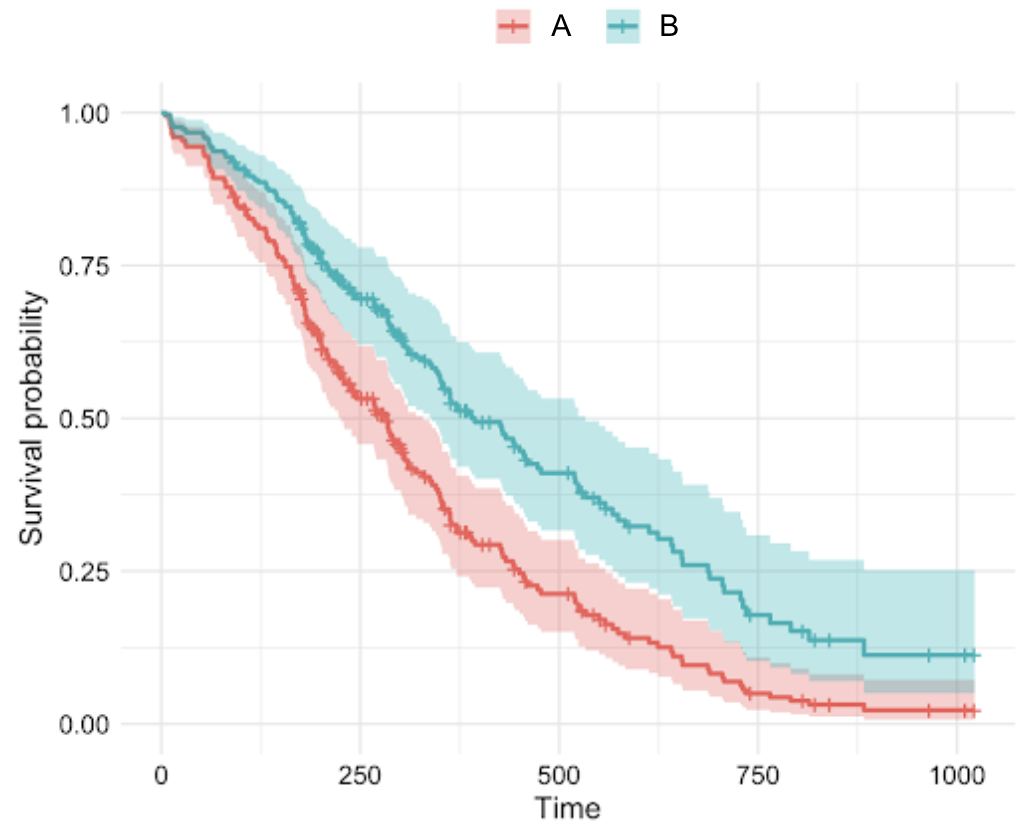
Mô hình Cox Proportional Hazards
Dựa trên giả định nguy cơ tỷ lệ: $$h(t|x)=b_0(t)exp\bigg(\sum^{n}_{i=1}b_i(x_i-\overline{x_i}\bigg)$$
$b_0(t)$: nguy cơ gốc ở mức quần thể, thay đổi theo thời gian.
$exp\bigg(\sum^{n}_{i=1}b_i(x_i-\overline{x_i}\bigg)$: quan hệ tuyến tính giữa biến đồng biến và log nguy cơ, KHÔNG đổi theo thời gian.
- Mô hình Cox Proportional Hazards (Cox PH) là một mô hình hồi quy hồi quy các biến đồng biến lên thời gian đến sự kiện/khoảng thời gian.
Yêu cầu dữ liệu cho mô hình Cox PH
- Durations: thời gian sống/khoảng thời gian của cá nhân.
- Events: sự kiện có được quan sát không (1=Có, 0=Không, bị kiểm duyệt).
- Nếu không cung cấp, mô hình giả định không có đối tượng bị kiểm duyệt.
- Covariates: biến liên tục hoặc biến phân loại mã hóa one-hot cho hồi quy.
Ước lượng mô hình Cox PH
- Import và khởi tạo lớp
CoxPHFitterfrom lifelines import CoxPHFitter coxph = CoxPHFitter() - Gọi
.fit()để huấn luyện mô hình với dữ liệucoxph.fit(df, duration_col, event_col) - Truy cập các thuộc tính khác để xem tóm tắt, biến, hệ số, dự đoán, vẽ, v.v.
coxph.summary()
coxph.predict()
Ví dụ mô hình Cox PH
- DataFrame:
mortgage_df - Biến đồng biến:
houseprincipalinterestproperty_taxcredit_score
- Cột khác:
duration,paid_off
from lifelines import CoxPHFittercoxph = CoxPHFitter() coxph.fit(df=mortgage_df, duration_col="duration", event_col="paid_off")
Tùy chỉnh mô hình
Lọc DataFrame:
new_df = mortgage_df.loc[:,
          mortgage_df.columns!="house"]
coxph.fit(df=new_df,
          duration_col="duration",
          event_col="paid_off")
Dùng tham số formula:
coxph.fit(df=mortgage_df,
          duration_col="duration",
          event_col="paid_off",
          formula="principal + interest
          + property_tax + credit_score")
- Thuận tiện, rõ ràng hơn, nhưng không mở rộng tốt khi nhiều biến đồng biến.
Diễn giải hệ số
print(coxph.summary)
<lifelines.CoxPHFitter: fitted with 1808 observations, 340 censored>
                        coef  exp(coef)  se(coef)      z       p
covariate house        -0.38       0.68      0.19. -1.98    0.05
          principal    -0.06       0.94      0.02  -2.61    0.01
          interest      0.31       1.37      0.31   1.02    0.31
          property_tax -0.15       0.86      0.21  -0.71    0.48
          credit_score -0.43       0.65      0.38  -1.14.   0.26
- Tỷ số nguy cơ (hazard ratio): $e^{coef}$
- Tăng
interest1 đơn vị từ trung vị -> nguy cơ thay đổi theo hệ số $e^{0.31}=1.37$, tức tăng 37% so với nguy cơ gốc.
- Tăng
Ayo berlatih!
Phân tích sống sót bằng Python

