Pipeline học có giám sát
Thiết kế quy trình Machine Learning bằng Python

Dr. Chris Anagnostopoulos
Honorary Associate Professor
Dữ liệu có nhãn
- Biến đặc trưng (viết tắt:
X) - Nhãn hoặc lớp (viết tắt:
y)
credit_scoring.head(4)
  checking_status  duration  ...  foreign_worker class
0            '<0'         6  ...             yes  good
1      '0<=X<200'        48  ...             yes   bad
2   'no checking'        12  ...             yes  good
3            '<0'        42  ...             yes  good
Kỹ thuật đặc trưng
- Hầu hết bộ phân loại cần đặc trưng số
- Cần chuyển cột chuỗi thành số
Tiền xử lý với LabelEncoder từ sklearn.preprocessing:
le = LabelEncoder()
le.fit_transform(credit_scoring['checking_status'])[:4]
array([1, 0, 3, 1])
Huấn luyện mô hình
.fit(features, labels).predict(features)
features, labels = credit_scoring.drop('class', 1), credit_scoring['class']model_nb = GaussianNB() model_nb.fit(features, labels) model_nb.predict(features.head(5))
['good' 'bad' 'good' 'bad' 'good']
Độ chính xác 60% trên 5 mẫu đầu.
Chọn mô hình
.fit()tối ưu tham số của mô hình- Còn các mô hình khác thì sao?
AdaBoostClassifier vượt GaussianNB trên 5 điểm dữ liệu đầu:
model_ab = AdaBoostClassifier()
model_ab.fit(features, labels)
model_ab.predict(features.head(5))
numpy.array(labels[0:5])
['good' 'bad' 'good' 'good' 'bad']
['good' 'bad' 'good' 'good' 'bad']
Đánh giá hiệu năng
Mẫu lớn hơn => ước lượng độ chính xác tốt hơn:
from sklearn.metrics import accuracy_score
accuracy_score(labels, model_nb.predict(features)) # naive bayes
0.706
accuracy_score(labels, model_ab.predict(features)) # adaboost
0.802
Tính toán này sai ở đâu?
Overfitting và chia dữ liệu
Overfitting: mô hình luôn hoạt động tốt hơn trên dữ liệu huấn luyện so với dữ liệu chưa thấy.
Huấn luyện trên X_train, y_train, đánh giá độ chính xác trên X_test, y_test:
from sklearn.model_selection import train_test_split X_train, X_test, y_train, y_test = train_test_split(X, y, test_size=0.2)GaussianNB().fit(X_train, y_train).predict(X_test)
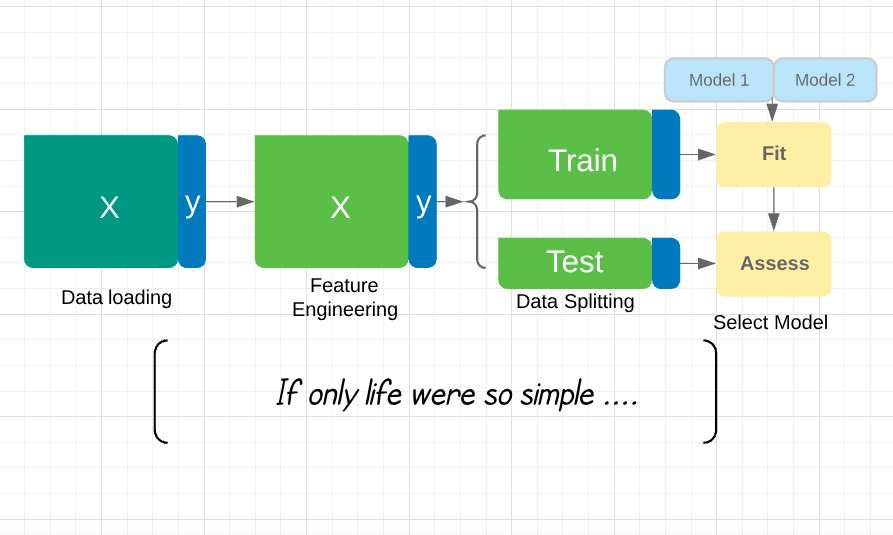
Vậy khóa học này nói về gì?
- Cách tinh chỉnh pipeline ở quy mô lớn.
- Đảm bảo dự đoán phù hợp bằng cách mời chuyên gia miền.
- Đảm bảo mô hình duy trì hiệu năng theo thời gian.
- Huấn luyện khi thiếu nhãn.
Bạn có thể ngăn khủng hoảng thế chấp không?
Thiết kế quy trình Machine Learning bằng Python

