Sử dụng Jinja nâng cao với dbt
Nghiên cứu tình huống: Xây dựng mô hình dữ liệu E-Commerce với dbt

Susan Sun
Freelance Data Scientist
Statement Jinja: vòng lặp
Các statement Jinja được bao trong {% %}:
- Lặp qua các phần tử
- Mẫu:
{% for ... %} ... {% endfor %} - Ví dụ:
{% for order_status in order_statuses %}
  SUM(
      CASE WHEN status = '{{ order_status }}'
        THEN order_id
      END)
{% endfor %}
- Mẫu:
Statement Jinja: vòng lặp
SQL lặp lại:
SELECT
    user_id,
    SUM(CASE WHEN status = 'Shipped' THEN 1 ELSE 0 END)
        AS num_orders_Shipped,
    SUM(CASE WHEN status = 'Complete' THEN 1 ELSE 0 END)
        AS num_orders_Complete,
    SUM(CASE WHEN status = 'Processing' THEN 1 ELSE 0 END)
        AS num_orders_Processing,
FROM {{ ref('stg_looker__orders') }}
GROUP BY 1
Statement Jinja: vòng lặp
{% set order_statuses = ['Shipped', 'Complete', 'Processing'] %}

SELECT
    user_id,
    -- Vòng lặp Jinja
    {% for order_status in order_statuses %}
        SUM(CASE WHEN status = '{{ order_status }}' THEN 1 ELSE 0 END)
        -- Tên cột tham số hóa
        AS num_orders_{{ order_status }}
    {% endfor %}
FROM {{ ref('stg_looker__orders') }}
GROUP BY 1
Statement Jinja: vòng lặp
Kết quả dbt compile:
SELECT
    user_id,
    SUM(CASE WHEN status = 'Shipped' THEN 1 ELSE 0 END)
        AS num_orders_Shipped,
    SUM(CASE WHEN status = 'Complete' THEN 1 ELSE 0 END)
        AS num_orders_Complete,
    SUM(CASE WHEN status = 'Processing' THEN 1 ELSE 0 END)
        AS num_orders_Processing,
FROM "dbt"."main"."stg_looker__orders"
GROUP BY 1
Statement Jinja: macro
Một macro Jinja:
- Là một hàm, viết bằng Jinja
- Có thể tái sử dụng
- Lưu trong thư mục
/macros
COALESCE():
- trả về giá trị khác null đầu tiên
- cú pháp:
COALESCE(value1, value2, ...) - ví dụ:
COALESCE(nickname, first_name)
Ví dụ một hàm macro:
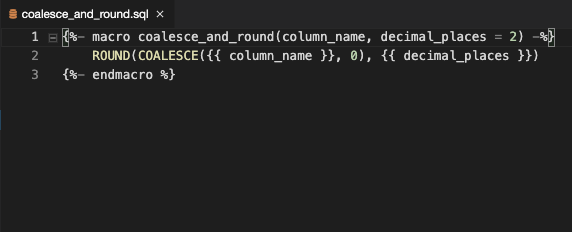
Statement Jinja: macro
Các statement Jinja được bao trong {% %}:
- Hàm macro tái sử dụng:
- Mẫu:
{% macro ... %} ... {% endmacro %} - Ví dụ:
{% macro coalesce_and_round(column_name, decimal_places = 2) %}
      ROUND(COALESCE({{ column_name }}, 0), {{ decimal_places }})
{% endmacro %}
- Mẫu:
Statement Jinja: macro
- SQL lặp lại
ROUND(COALESCE(sales_amount, 0), 2) AS sales_amount, ROUND(COALESCE(cost_of_goods_sold, 0), 2) AS cost_of_goods_sold, - DRY (Don't Repeat Yourself)
- Tạo macro tên
coalesce_and_round.sql - Lưu trong
/macros - Gọi:
{{ coalesce_and_round('sales_amount', 2) }} AS sales_amount,
{{ coalesce_and_round('cost_of_goods_sold', 2) }} AS cost_of_goods_sold,
- Tạo macro tên
Quản lý khoảng trắng trong Jinja
Như đã viết:
{% set traffic_source_values = ['Adwords', 'Email', 'Facebook'] %}
{% set browser_values = ['Chrome', 'Firefox', 'Safari', 'IE', 'Other'] %}

SELECT
    user_id,
    COUNT(DISTINCT session_id) AS num_web_sessions,
...
Quản lý khoảng trắng trong Jinja
Sau biên dịch:
SELECT
    user_id,
    COUNT(DISTINCT session_id) AS num_web_sessions,
...
Quản lý khoảng trắng trong Jinja
{%- ... %}loại bỏ khoảng trắng trước.{% ... -%}loại bỏ khoảng trắng sau.{%- ... -%}loại bỏ cả hai.Ví dụ:
{%- set traffic_source_values = ['Adwords', 'Email', 'Facebook'] -%}
{%- set browser_values = ['Chrome', 'Firefox', 'Safari', 'IE', 'Other'] -%}

SELECT
    user_id,
    COUNT(DISTINCT session_id) AS num_web_sessions,
...
Ayo berlatih!
Nghiên cứu tình huống: Xây dựng mô hình dữ liệu E-Commerce với dbt

