Nhận diện luật kết hợp
Phân tích giỏ hàng trong Python

Isaiah Hull
Visiting Associate Professor of Finance, BI Norwegian Business School
Tải và chuẩn bị dữ liệu
import pandas as pd

# Load transactions from pandas.
books = pd.read_csv("datasets/bookstore.csv")
# Split transaction strings into lists.
transactions = books['Transaction'].apply(lambda t: t.split(','))
# Convert DataFrame into list of strings.
transactions = list(transactions)
Khám phá dữ liệu
print(transactions[:5])
[['language', 'travel', 'humor', 'fiction'],
 ['humor', 'language'],
 ['humor', 'biography', 'cooking'],
 ['cooking', 'language'],
 ['travel']]
Luật kết hợp
Luật kết hợp
- Gồm tiền đề và kết quả
- {sức khỏe} $\rightarrow$ {nấu ăn}
- Gồm tiền đề và kết quả
Luật nhiều tiền đề
- {hài hước, du lịch} $\rightarrow$ {ngôn ngữ}
Luật nhiều kết quả
- {tiểu sử} $\rightarrow$ {lịch sử, ngôn ngữ}
Khó khăn khi chọn luật
Tìm luật hữu ích là khó.
- Tập luật khả dĩ rất lớn.
- Phần lớn không hữu ích.
- Cần loại bỏ hầu hết.
Nếu chỉ xét luật đơn giản thì sao?
- Một tiền đề và một kết quả.
- Vẫn khó, ngay cả với dữ liệu nhỏ.
Tạo luật
- tiểu thuyết
- thơ
- lịch sử
- tiểu sử
- nấu ăn
- sức khỏe
- du lịch
- ngôn ngữ
- hài hước
Tạo luật
| Luật Tiểu thuyết | Luật Thơ | ... | Luật Hài hước |
|---|---|---|---|
| tiểu thuyết->thơ | thơ->tiểu thuyết | ... | hài hước->tiểu thuyết |
| tiểu thuyết->lịch sử | thơ->lịch sử | ... | hài hước->lịch sử |
| tiểu thuyết->tiểu sử | thơ->tiểu sử | ... | hài hước->tiểu sử |
| tiểu thuyết->nấu ăn | thơ->nấu ăn | ... | hài hước->nấu ăn |
| ... | ... | ... | ... |
| tiểu thuyết->hài hước | thơ->hài hước | ... |
Tạo luật với itertools
from itertools import permutations

# Extract unique items.
flattened = [item for transaction in transactions for item in transaction]
items = list(set(flattened))
# Compute and print rules.
rules = list(permutations(items, 2))
print(rules)
[('fiction', 'poetry'),
 ('fiction', 'history'),
 ...
 ('humor', 'travel'),
 ('humor', 'language')]
Đếm số luật
# Print the number of rules
print(len(rules))
72
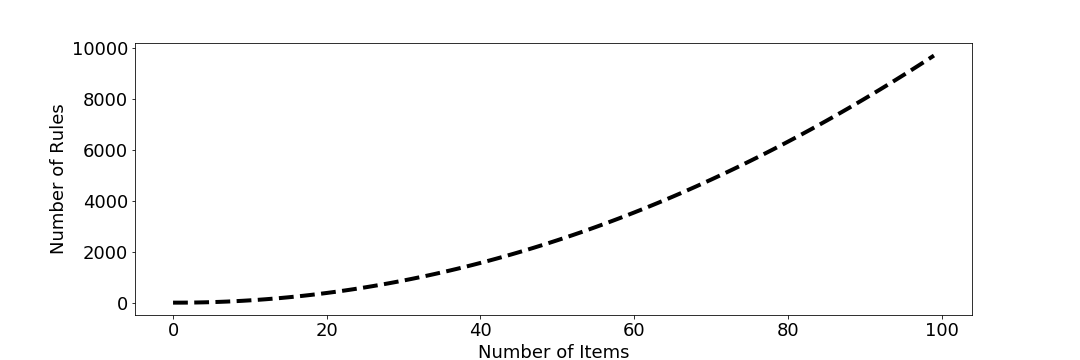
Nhìn trước
# Import the association rules function
from mlxtend.frequent_patterns import association_rules
from mlxtend.frequent_patterns import apriori

# Compute frequent itemsets using the Apriori algorithm
frequent_itemsets = apriori(onehot, min_support = 0.001,
                            max_len = 2, use_colnames = True)

# Compute all association rules for frequent_itemsets
rules = association_rules(frequent_itemsets,
                            metric = "lift",
                             min_threshold = 1.0)
Ayo berlatih!
Phân tích giỏ hàng trong Python

