Python의 statsmodels로 배우는 중급 회귀
Maarten Van den Broeck
Content Developer at DataCamp
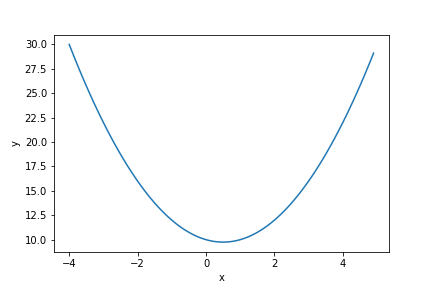
이차함수 선 그래프
x = np.arange(-4, 5, 0.1)
y = x ** 2 - x + 10

xy_data = pd.DataFrame({"x": x,
                        "y": y})

sns.lineplot(x="x",
             y="y",
             data=xy_data)
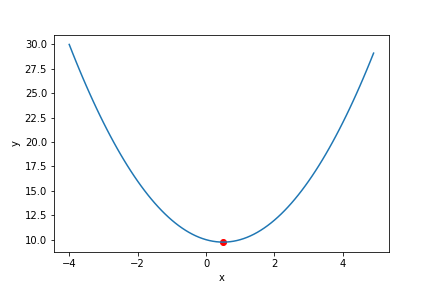
$y = x ^ 2 - x + 10$
$\frac{\partial y}{\partial x} = 2 x - 1$
$0 = 2 x - 1$
$x = 0.5$
$y = 0.5 ^ 2 - 0.5 + 10 = 9.75$
이해되지 않아도 걱정하지 마세요. 연습에는 필요하지 않습니다.
from scipy.optimize import minimize
def calc_quadratic(x):
  y = x ** 2 - x + 10
  return y
minimize(fun=calc_quadratic,
         x0=3)
      fun: 9.75
 hess_inv: array([[0.5]])
      jac: array([0.])
  message: 'Optimization terminated successfully.'
     nfev: 6
      nit: 2
     njev: 3
   status: 0
  success: True
        x: array([0.49999998])
제곱합(metric)을 계산하는 함수를 정의합니다.
minimize()로 이 함수를 최소화하는 계수를 구합니다.
minimize()
def calc_sum_of_squares(coeffs):
  intercept, slope = coeffs
  # More calculation!
minimize(
  fun=calc_sum_of_squares,
  x0=0
)