프로덕션을 위한 Machine Learning 모델 개발
Sinan Ozdemir
Data Scientist, Entrepreneur, and Author
패키징 방법
직렬화: ML 모델 저장·불러오기
환경 패키징: 모델을 위한 일관되고 재현 가능한 환경
컨테이너화: 모델·의존성·환경을 하나의 "컨테이너"로 패키징
scikit-learn 모델을 pickle로 직렬화:
import pickle
model = ... # Train the scikit-learn model
# Serialize the model to a file
with open('model.pkl', 'wb') as f:
pickle.dump(model, f)
# Load the serialized model from the file
with open('model.pkl', 'rb') as f:
model = pickle.load(f)
scikit-learn 모델을 HDF5 형식으로 직렬화:
import h5py
import numpy as np
from sklearn.externals import joblib
model = ... # Train the scikit-learn model
# Serialize the model to an HDF5 file
with h5py.File('model.h5', 'w') as f:
f.create_dataset('model_weights',
data=joblib.dump(model))
# Load the serialized model from the HDF5 file
with h5py.File('model.h5', 'r') as f:
model = joblib.load(f['model_weights'][:])
PyTorch 모델 직렬화:
import torch
# Train a PyTorch model and store it in a variable
trained_model = ...
# Serialize the trained model to a file
serialized_model_path = 'model.pt'
torch.save(trained_model.state_dict(), serialized_model_path)
# Load the serialized model from a file
loaded_model = ... # Initialize the model
loaded_model.load_state_dict(
torch.load(serialized_model_path))
TensorFlow 모델 직렬화:
import tensorflow as tf
# Train a Tensorflow model
trained_model = ...
# Save the trained model to a directory
saved_model_directory = 'model/'
tf.saved_model.save
(trained_model, saved_model_directory)
# Load the saved model from the directory
loaded_model = tf.saved_model.load(
saved_model_directory)

# Use an existing image as the base image
FROM python:3.8-slim
# Set the working directory
WORKDIR /app
# Copy the requirements file to the image
COPY requirements.txt .
# Install the required dependencies
RUN pip install -r requirements.txt
# Copy the ML model and its dependencies to the image
COPY model/ .
# Set the entrypoint to run the model
ENTRYPOINT ["python", "run_model.py"]
<---- Python 3.8 베이스 이미지 사용
<---- 작업 디렉터리 설정
<---- requirements.txt 복사
<---- 의존 패키지 설치
<---- 모델 파일 복사
<---- 컨테이너 시작 방법 지정
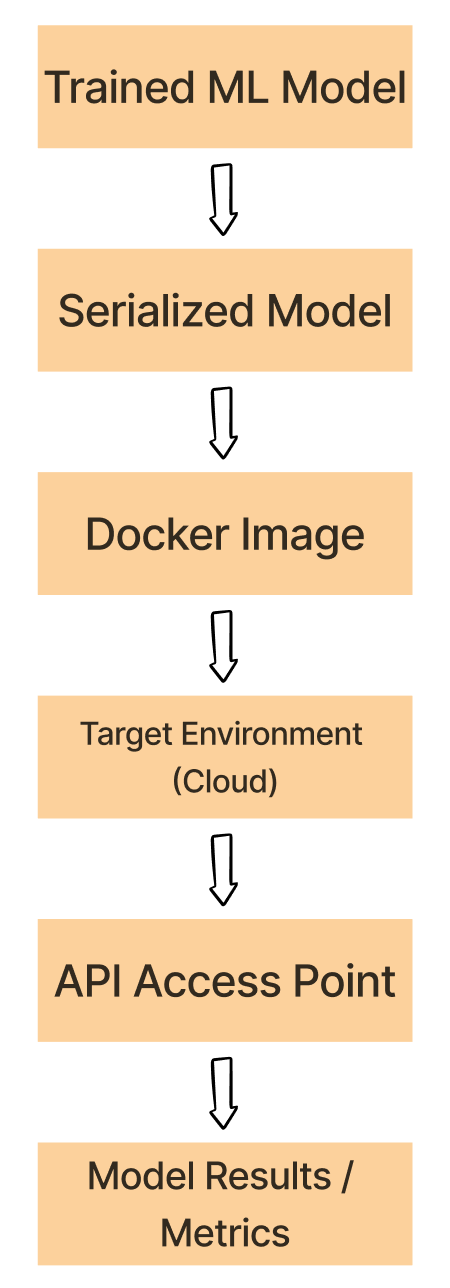
학습된 ML 모델을 pickle, HDF5, PyTorch 등으로 직렬화합니다.
직렬화된 모델, 의존성, 환경을 컨테이너화합니다.
Docker 이미지를 클라우드 등 대상 환경에 배포합니다.
배포된 이미지로 컨테이너를 실행하고 모델을 구동합니다.
컨테이너 내 모델을 API 등으로 사용합니다.

프로덕션을 위한 Machine Learning 모델 개발