몇몇 산업의 재무 비율 한눈에 보기
Python으로 재무제표 분석하기

Rohan Chatterjee
Risk Modeler
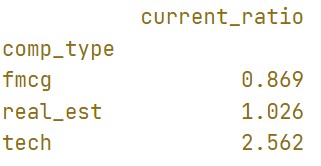
평균 유동비율
- 유동비율 = $\dfrac{\text{Current Assets}}{\text{Current Liabilities}}$
- 산업별 평균 유동비율:
balance_sheet["current_ratio"] =
                      balance_sheet["Total Current Assets"]/
                      balance_sheet["Total Current Liabilities"]
balance_sheet.pivot_table(index="comp_type", values="current_ratio")
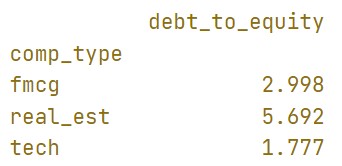
평균 부채비율
- 부채비율(D/E) = $\dfrac{\text{Total liabilities}}{\text{Total shareholders equity}}$
- 산업별 평균 부채비율:
balance_sheet["debt_to_equity"] =
                      balance_sheet["Total Liabilities"]/
                      balance_sheet["Total Shareholders Equity"]
balance_sheet.pivot_table(index="comp_type", values="debt_to_equity")
업종 평균과 시각적으로 비교하기
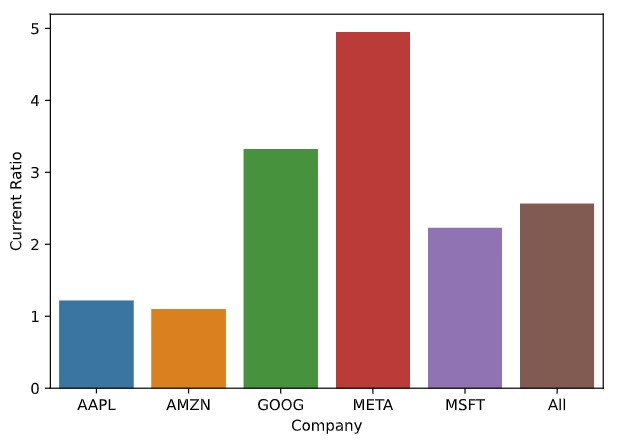
막대그래프 만들기
plot = balance_sheet_tech.pivot_table(index="company", values = "current_ratio",
                                      margins = True).reset_index()
plot
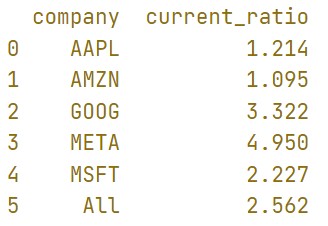
막대그래프 만들기
sns.barplot(data=plot, x = "company", y = "current_ratio")
plt.ylabel("Current Ratio"), plt.xlabel("Company")
plt.show()

