Pythonで学ぶDeep Reinforcement Learning
Timothée Carayol
Principal Machine Learning Engineer, Komment

for step = 1 to T do: # 価値関数に基づく最適な行動を取る # 次状態と報酬を観測 # 遷移をリプレイバッファに追加# 最高優先度 (1) を付与# 過去の遷移をバッチでサンプリング# 優先度に基づく (2)# バッチの TD 誤差を計算# 損失を計算し Q ネットワークを更新# 重要度サンプリング重みを使用 (4)# サンプルした遷移の優先度を更新 (3)# 時間とともに重要度サンプリングを増加 (5)
(1) 新しい遷移は最高優先度で追加: $p_i = \max_k(p_k)$
(2) 遷移 $i$ のサンプル確率 $$P(i) = p_i^{\alpha} / \sum_k p_k^{\alpha}\ \ \ \ \ \ \ \ (0<\alpha<1)$$
(3) サンプル済み遷移の優先度を TD 誤差に更新: $p_i = |\delta_i| + \varepsilon$
(4) 重要度サンプリング重み $$w_i = \left( \frac{1}{N} \cdot \frac{1}{P(i)} \right)^\beta\ \ \ \ \ \ \ \ (0<\beta<1)$$
(5) $\beta$ を徐々に 1 に近づける
def __init__(self, capacity, alpha=0.6, beta=0.4, beta_increment=0.001, epsilon=0.001): # メモリバッファを初期化 self.memory = deque(maxlen=capacity)# パラメータを保持し優先度を初期化 self.alpha, self.beta, self.beta_increment, self.epsilon = (alpha, beta, beta_increment, epsilon) self.priorities = deque(maxlen=capacity)...
... def push(self, state, action, reward, next_state, done): # 経験をメモリに追加 experience_tuple = (state, action, reward, next_state, done) self.memory.append(experience_tuple)# 新規遷移の優先度を最大値に設定 max_priority = max(self.priorities) if self.memory else 1.0 self.priorities.append(max_priority)...
def sample(self, batch_size): priorities = np.array(self.priorities) # サンプリング確率を計算 probabilities = priorities**self.alpha / np.sum(priorities**self.alpha)# インデックスを確率的にサンプリング indices = np.random.choice(len(self.memory), batch_size, p=probabilities)# 重みを計算 weights = (1 / (len(self.memory) * probabilities)) ** self.beta weights /= np.max(weights) states, actions, rewards, next_states, dones = zip(*[self.memory[idx] for idx in indices]) weights = [weights[idx] for idx in indices] states, actions, rewards, next_states, dones = (zip(*[self.memory[idx] for idx in indices]))# テンソルを返す states = torch.tensor(states, dtype=torch.float32) ... # rewards, next_states, dones, weights も同様に actions = torch.tensor(actions, dtype=torch.long).unsqueeze(1) return (states, actions, rewards, next_states, dones, indices, weights)
... def update_priorities(self, indices, td_errors: torch.Tensor): # サンプルした遷移の優先度を更新 for idx, td_error in zip(indices, td_errors.abs()): self.priorities[idx] = abs(td_error.item()) + self.epsilondef increase_beta(self): # beta を 1 に近づけて増加 self.beta = min(1.0, self.beta + self.beta_increment)
ループ前のコード:
buffer = PrioritizedReplayBuffer(capacity)
各エピソードの開始時:
buffer.increase_beta()
3. 各ステップで:
# 行動選択後 buffer.push(state, action, reward, next_state, done) ...# TD 誤差を計算する前: replay_buffer.sample(batch_size) ...# TD 誤差を計算した後 buffer.update_priorities(indices, td_errors)loss = torch.sum(weights * (td_errors ** 2))
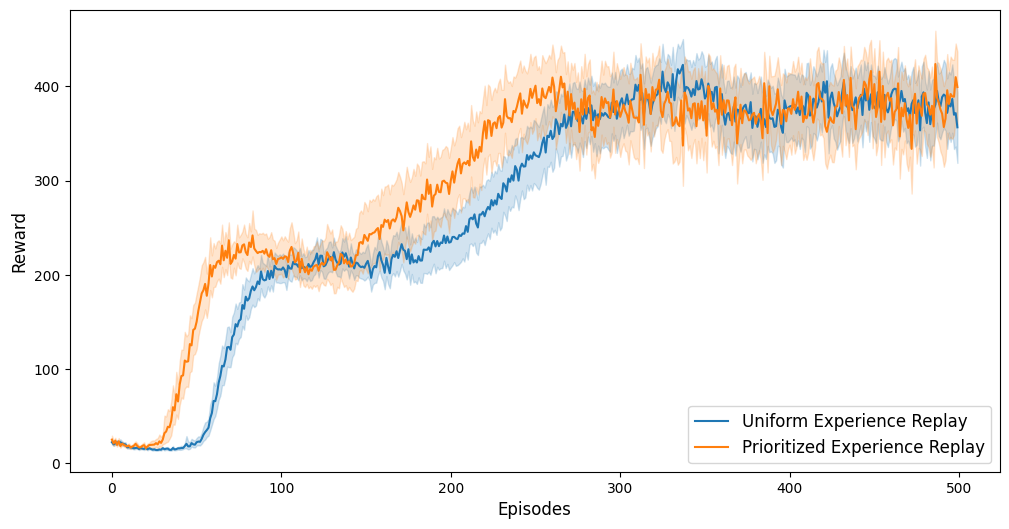
Cartpole 環境での 100 回の学習:

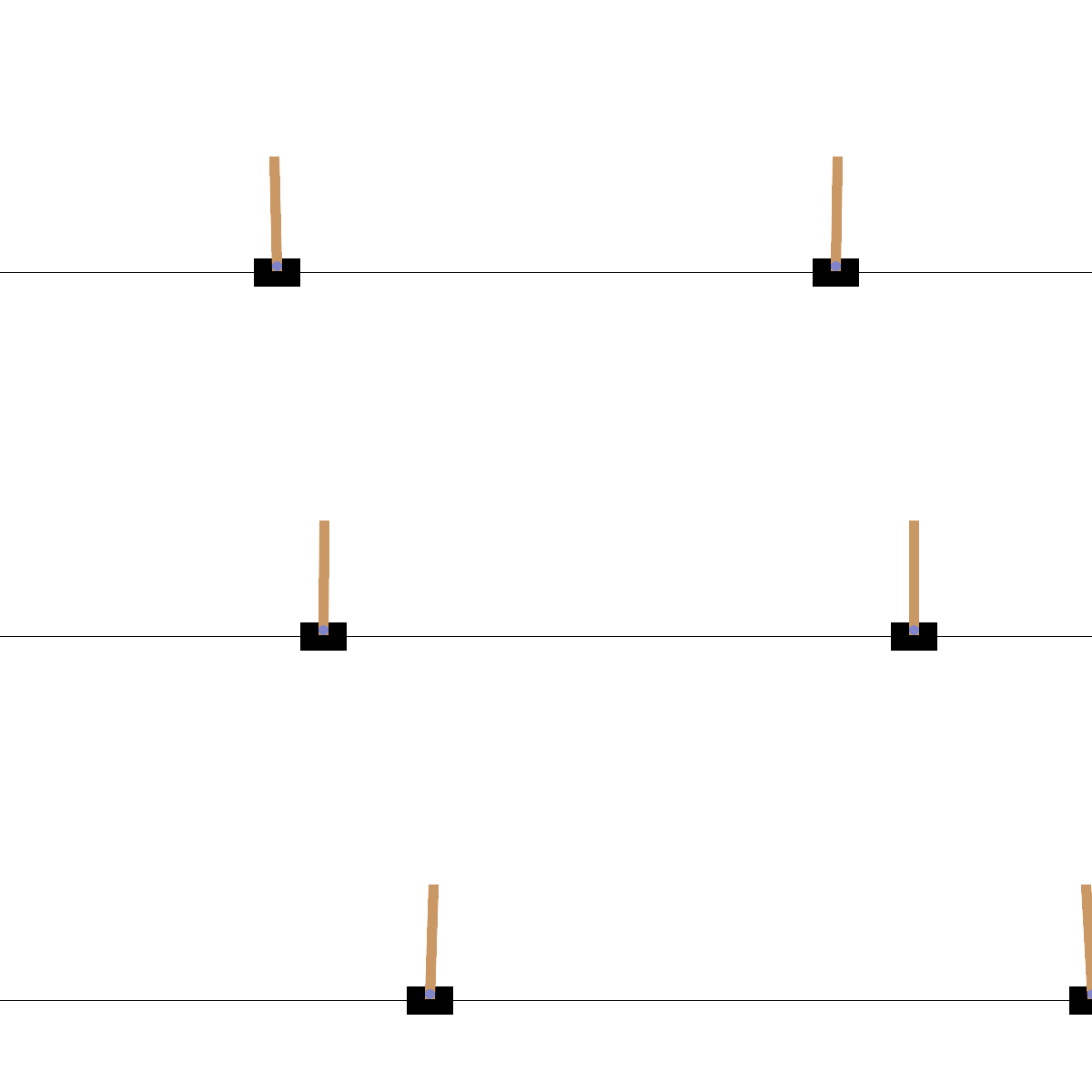
100 エポック後:

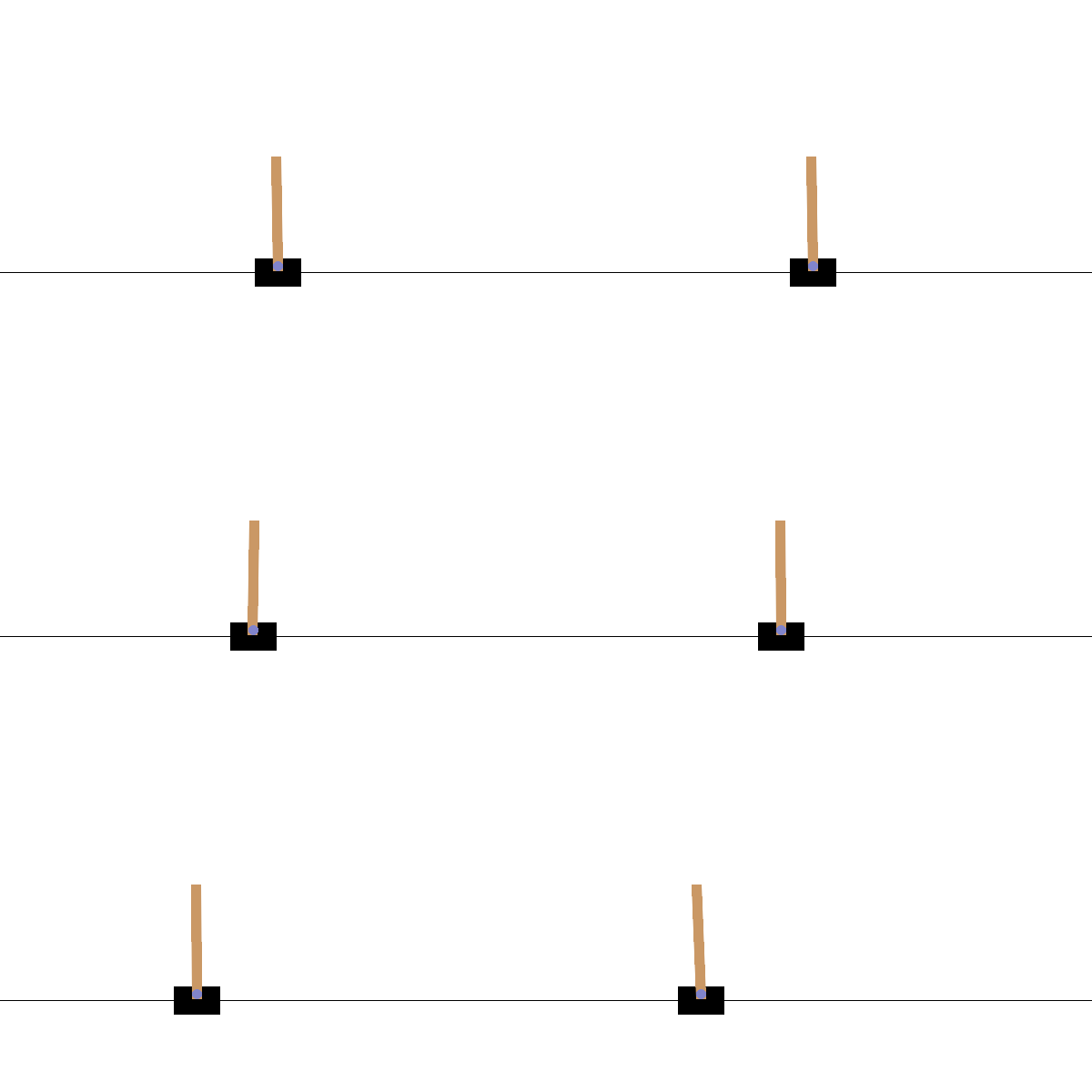
400 エポック後:


Pythonで学ぶDeep Reinforcement Learning