購入予測のためのデータ準備

Pythonで学ぶマーケティングのための機械学習

Karolis Urbonas

Head of Analytics & Science, Amazon

回帰:連続変数を予測する

  • 回帰:教師あり学習の一種
  • 目的変数:連続値またはカウント
  • 最も基本:線形回帰
  • カウントデータ(例:稼働日数)はポアソン/負の二項回帰が有効な場合あり
Pythonで学ぶマーケティングのための機械学習

Recency・Frequency・Monetary(RFM)特徴量

  • RFM:多くの特徴量設計の基礎となる手法
  • Recency:最後の取引からの経過日数
  • Frequency:観測期間の購入回数
  • Monetary:観測期間の合計支出
Pythonで学ぶマーケティングのための機械学習

月別の売上分布を確認

# Explore monthly distribution of observations
online.groupby(['InvoiceMonth']).size()
InvoiceMonth
2010-12    4893
2011-01    3580
2011-02    3648
2011-03    4764
2011-04    4148
2011-05    5018
2011-06    4669
2011-07    4610
2011-08    4744
2011-09    7189
2011-10    8808
2011-11    9513
dtype: int64
Pythonで学ぶマーケティングのための機械学習

特徴量データを分離

# Exclude target variable
online_X = online[online['InvoiceMonth']!='2011-11']

# Define snapshot date NOW = dt.datetime(2011,11,1)
# Build the features features = online_X.groupby('CustomerID').agg({ 'InvoiceDate': lambda x: (NOW - x.max()).days, 'InvoiceNo': pd.Series.nunique, 'TotalSum': np.sum, 'Quantity': ['mean', 'sum'] }).reset_index()
features.columns = ['CustomerID', 'recency', 'frequency', 'monetary', 'quantity_avg', 'quantity_total']
Pythonで学ぶマーケティングのための機械学習

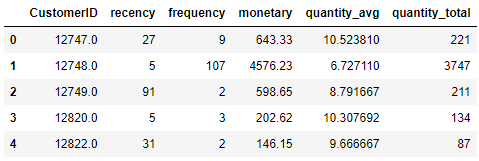
特徴量の確認

print(features.head())

特徴量の先頭

Pythonで学ぶマーケティングのための機械学習

目的変数を算出する

# Build pivot table with monthly transactions per customer
cust_month_tx = pd.pivot_table(data=online, index=['CustomerID'], 
                               values='InvoiceNo',
                               columns=['InvoiceMonth'],
                               aggfunc=pd.Series.nunique, fill_value=0)
print(cust_month_tx.head())
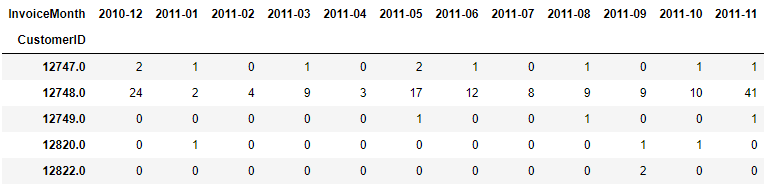
顧客ごとの月次ピボットテーブル

Pythonで学ぶマーケティングのための機械学習

データ準備を完了し学習/テストに分割

# Store identifier and target variable column names
custid = ['CustomerID']
target = ['2011-11']

# Extract target variable Y = cust_month_tx[target]
# Extract feature column names cols = [col for col in features.columns if col not in custid]
# Store features X = features[cols]
Pythonで学ぶマーケティングのための機械学習

学習用とテスト用に分割

# Randomly split 25% of the data to testing
from sklearn.model_selection import train_test_split
train_X, test_X, train_Y, test_Y = train_test_split(X, Y, 
                                                    test_size=0.25, 
                                                    random_state=99)

# Print shapes of the datasets print(train_X.shape, train_Y.shape, test_X.shape, test_Y.shape)
(2529, 5) (2529, 1) (843, 5) (843, 1)
Pythonで学ぶマーケティングのための機械学習

データ準備の演習に取り組みましょう

Pythonで学ぶマーケティングのための機械学習

Preparing Video For Download...