Rで学ぶSupport Vector Machines
Kailash Awati
Instructor
tune.svm()
cost = 10^(-1:3)
gamma = c(0.1,1,10)
coef0 = c(0.1,1,10)
tune_out <- tune.svm(x = trainset[,-3], y = trainset[,3],
                     type = "C-classification", kernel = "polynomial", degree = 2,
                     cost = 10^(-1:2), gamma = c(0.1,1,10), coef0 = c(0.1,1,10))

#print out tuned parameters
tune_out$best.parameters$cost
tune_out$best.parameters$gamma
tune_out$best.parameters$coef0
tune_out <- tune.svm(x = trainset[,-3], y = trainset[,3], type = "C-classification", kernel = "polynomial", degree = 2, cost = 10^(-1:2), gamma = c(0.1,1,10), coef0 = c(0.1,1,10))
#print out tuned parameters tune_out$best.parameters$cost tune_out$best.parameters$gamma tune_out$best.parameters$coef0
0.1
10
1
svm_model <- svm(y ~ ., data = trainset, type = "C-classification", kernel = "polynomial", degree = 2,
        cost = tune_out$best.parameters$cost,
        gamma = tune_out$best.parameters$gamma,
        coef0 = tune_out$best.parameters$coef0)
pred_train <- predict(svm_model, trainset)
mean(pred_train == trainset$y)
pred_test <- predict(svm_model, testset)
mean(pred_test == testset$y)
1

0.9677419
1
0.9677419
#plot using svm plot
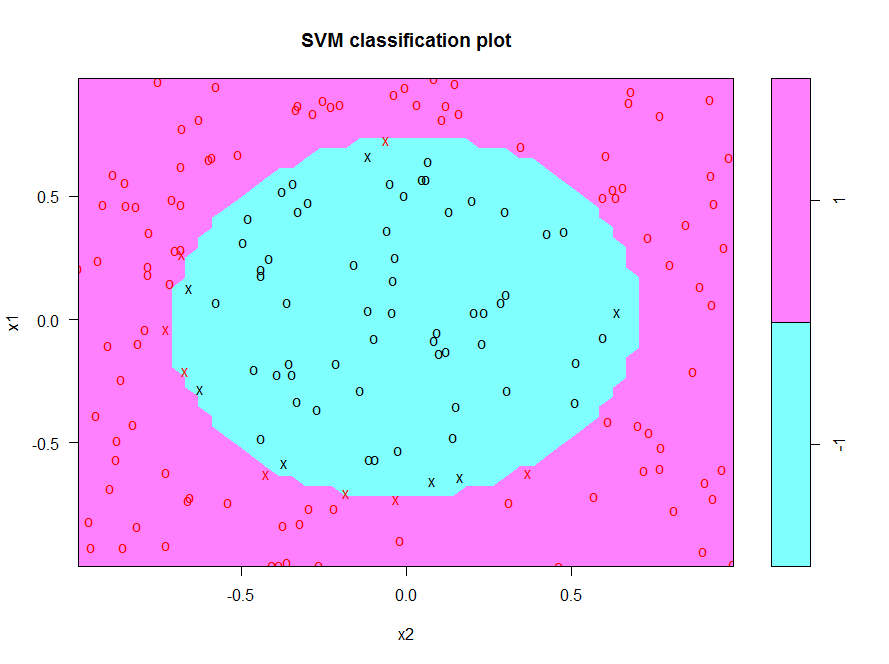
plot(svm_model, trainset)