進化変数の活用

Pythonで学ぶ中級予測分析

Nele Verbiest

Senior Data Scientist @PythonPredictions

予測モデルの構築

# Import the linear_model module
from sklearn import linear_model

# Predictive variables variables = ["gender","age", "donations_last_year", "ratio_month_year"]
# Select predictors and target X = basetable[variables] y = basetable[["target"]]
# Construct the logistic regression model logreg = linear_model.LogisticRegression() logreg.fit(X, y)
Pythonで学ぶ中級予測分析

予測の実行

# Import the linear_model module
from sklearn import linear_model

# Predictive variables variables = ["gender","age", "donations_last_year", "ratio_month_year"]
# Select predictors and target X = basetable[variables] y = basetable[["target"]]
# Construct the logistic regression model logreg = linear_model.LogisticRegression() logreg.fit(X, y)
# Make predictions
predictions = logreg.predict_proba(X)[:,1]
Pythonで学ぶ中級予測分析

AUC によるモデル評価

# Import roc_auc_score module from sklearn.metrics
from sklearn.metrics import roc_auc_score

# Calculate the AUC auc= roc_auc_score(y, predictions) print(round(auc,2))
0.56
Pythonで学ぶ中級予測分析

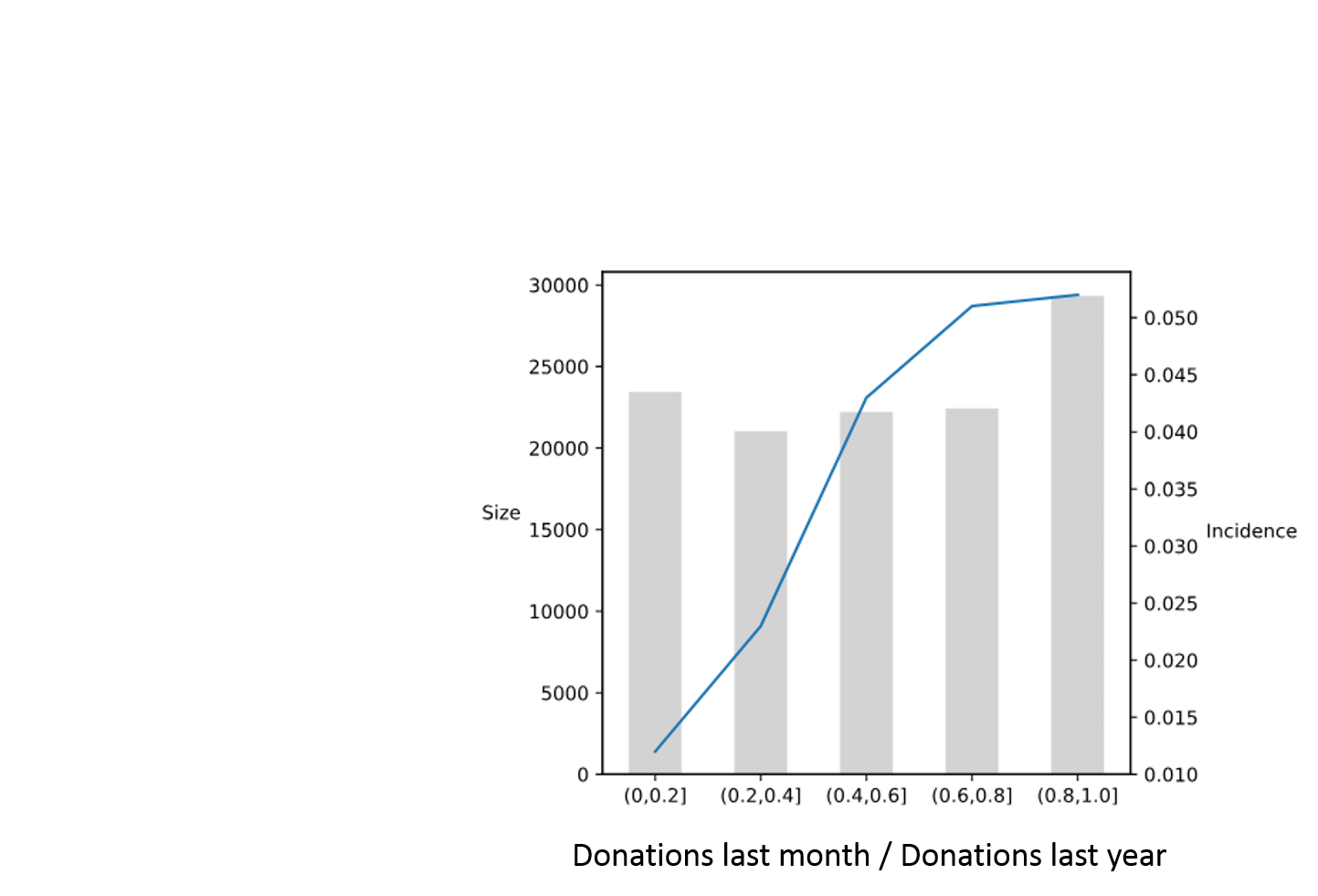
Predictor Insight Graph(PIG)

# Discretize the variable in 5 bins and add to the basetable
basetable["ratio_month_year_disc"] = pd.qcut(basetable["ratio_month_year"], 5)

# Construct the predictor insight graph table pig_table = create_pig_table(basetable, "target","ratio_month_year_disc") ```{python} # Plot the predictor insight graph plot_pig(pig_table, "ratio_month_year_disc")
Pythonで学ぶ中級予測分析

PIG の読み取り方

Pythonで学ぶ中級予測分析

演習に進みましょう!

Pythonで学ぶ中級予測分析

Preparing Video For Download...