Rで学ぶマーケットバスケット分析
Christopher Bruffaerts
Statistician
トランザクション: 何かを売買する行為。
トランザクションデータ: 1回の購入で、1人の顧客が買ったアイテムの一覧。
トランザクション例:
  TID Product
1   1   Bread
2   1  Cheese
3   1  Cheese
4   1  Cheese
Transactions クラス: アイテム集合やルール抽出に用いるトランザクションデータを表します。
変換元:
ただし、事前にデータ準備が必要です。
トランザクションデータで重要な点
製品を識別するフィールド/列
トランザクションを識別するフィールド/列
店舗のトランザクションデータ
my_transactions = data.frame(
  "TID" = c(1,1,1,1, 2,2,2, 3,3, 4,4,4, 5,5, 6,6, 7,7),
  "Product" = c("Bread", "Cheese", "Cheese", "Cheese",
                "Bread", "Butter", "Wine",
                "Butter", "Butter",
                "Butter", "Wine", "Wine",
                "Butter", "Cheese",
                "Cheese", "Wine",
                "Wine", "Wine")
)
トランザクションの一部
head(my_transactions, 10)
   TID Product
1    1   Bread
2    1  Butter
3    1  Cheese
4    1    Wine
5    2   Bread
6    2  Butter
7    2    Wine
8    3   Bread
9    3  Butter
10   4  Butter
split 関数でリストを作成する
# TID を因子に変換
my_transactions$TID =
  factor(my_transactions$TID)

# グループに分割
data_list = split(my_transactions$Product,
                   my_transactions$TID)
data_list
$`1`
[1] Bread  Butter Cheese Wine
Levels: Bread Butter Cheese Wine

$`2`
[1] Bread  Butter Wine
Levels: Bread Butter Cheese Wine

$`3`
[1] Bread  Butter
Levels: Bread Butter Cheese Wine
transaction クラスへ変換
# トランザクションデータに変換
data_trx = as(data_list,"transactions")

# トランザクションを確認
inspect(data_trx)
トランザクションデータの確認
    items                      transactionID
[1] {Bread,Butter,Cheese,Wine} 1
[2] {Bread,Butter,Wine}        2
[3] {Bread,Butter}             3
[4] {Butter,Cheese,Wine}       4
[5] {Butter,Cheese}            5
[6] {Cheese,Wine}              6
[7] {Butter,Wine}              7
トランザクションの概要
inspect(head(data_trx))
    items                      transactionID
[1] {Bread,Butter,Cheese,Wine} 1
[2] {Bread,Butter,Wine}        2
[3] {Bread,Butter}             3
[4] {Butter,Cheese,Wine}       4
[5] {Butter,Cheese}            5
[6] {Cheese,Wine}              6
特定のトランザクションにアクセス
inspect(data_trx[1])
inspect(data_trx[1:3])
transaction オブジェクトの要約
summary(data_trx)
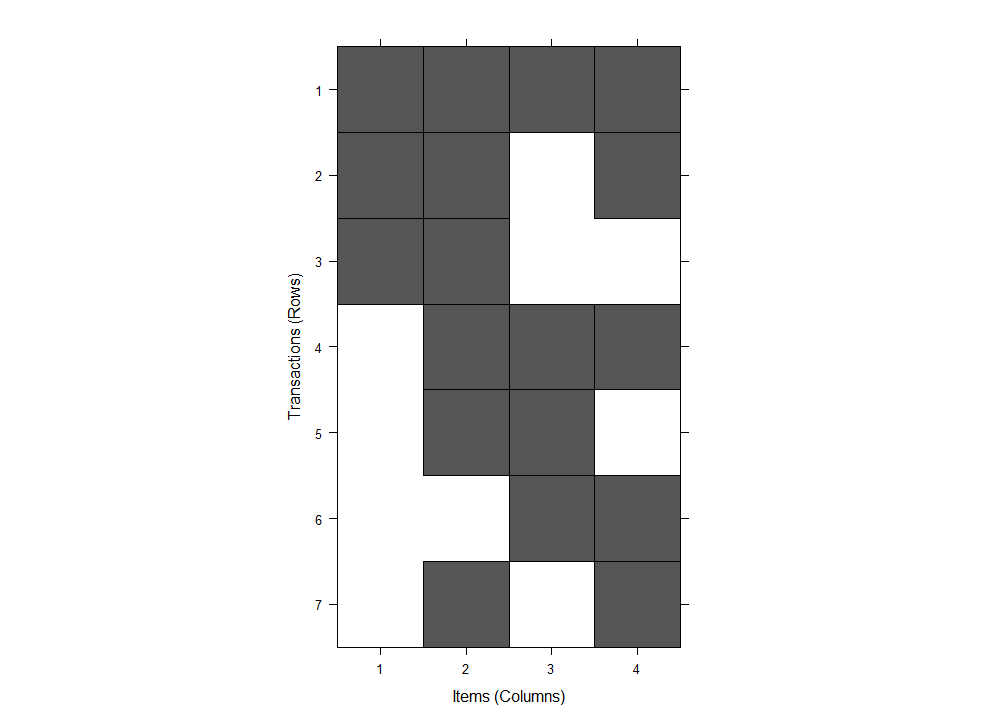
ItemMatrix をプロット
image(data_trx)
注意: この関数は少数のトランザクションで使用してください
判別に有用:
密度 = 18/28 = 0.64