RJAGS によるベイズモデリング
Alicia Johnson
Associate Professor, Macalester College


「良い」マルコフ連鎖とはどのようなものか?
マルコフ連鎖による事後分布の近似精度は?
何回反復すればよいか?


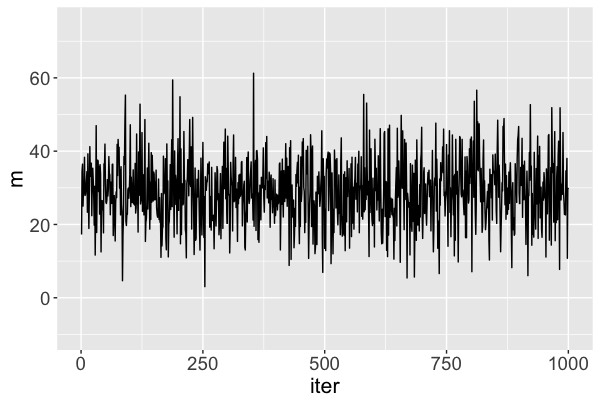
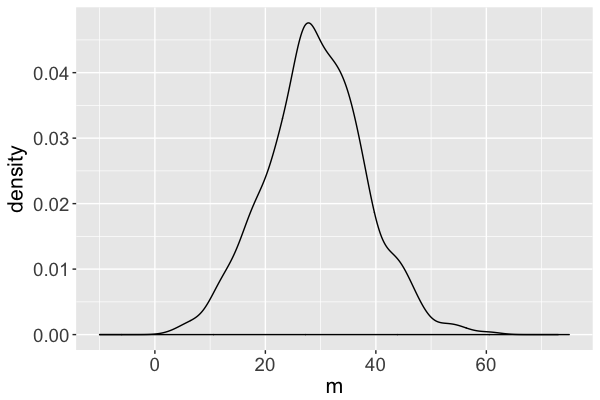
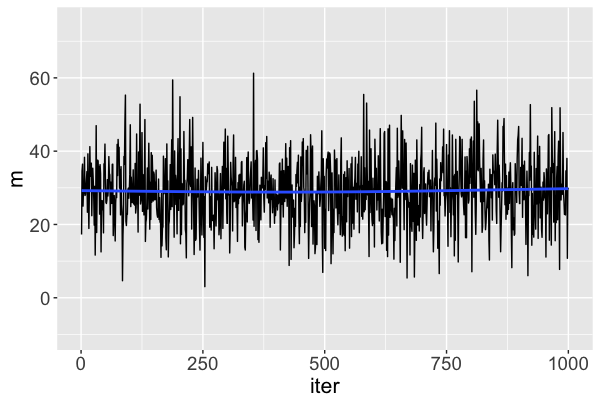
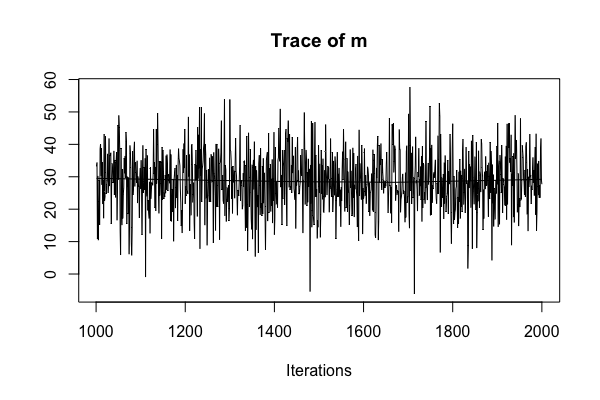
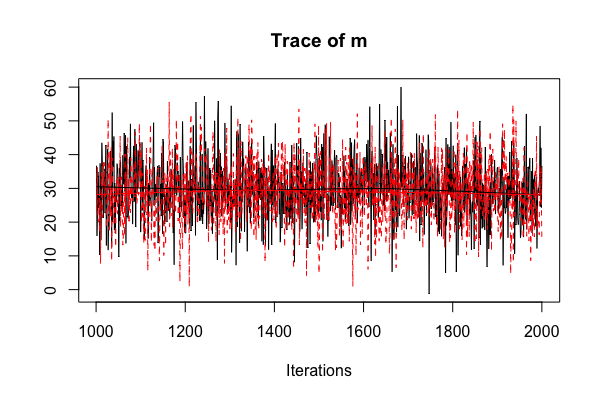
良い例: 安定性!

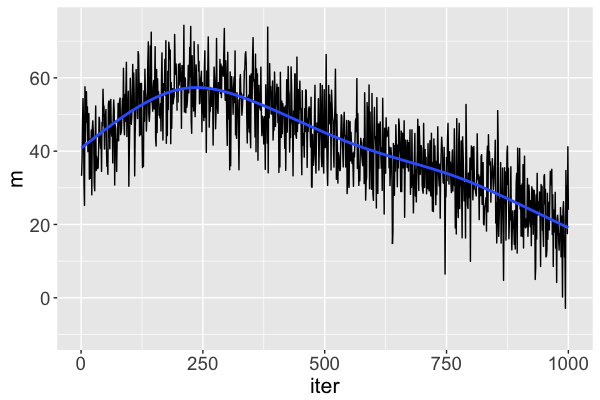
悪い例: 不安定
# COMPILE the model
sleep_jags <- jags.model(..., n.chains = 1)
# COMPILE the model
sleep_jags <- jags.model(..., n.chains = 2)
# COMPILE the model
sleep_jags <- jags.model(..., n.chains = 4)
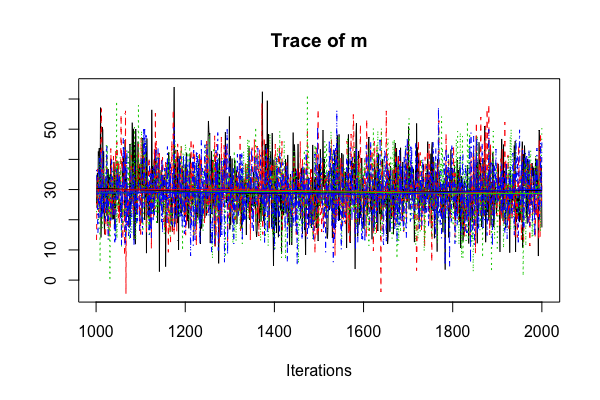
# COMPILE the model
sleep_jags <- jags.model(..., n.chains = 4)

summary(sleep_sim)
1. Empirical mean and standard deviation for each variable,
plus standard error of the mean:
Mean SD Naive SE Time-series SE
m 29.10 8.968 0.2836 0.2820
s 40.07 7.887 0.2494 0.4227
2. Quantiles for each variable:
2.5% 25% 50% 75% 97.5%
m 11.42 23.27 28.85 34.76 46.76
s 28.31 34.65 38.93 43.91 57.56
$m$ の事後平均の推定値 = 29.10 ms
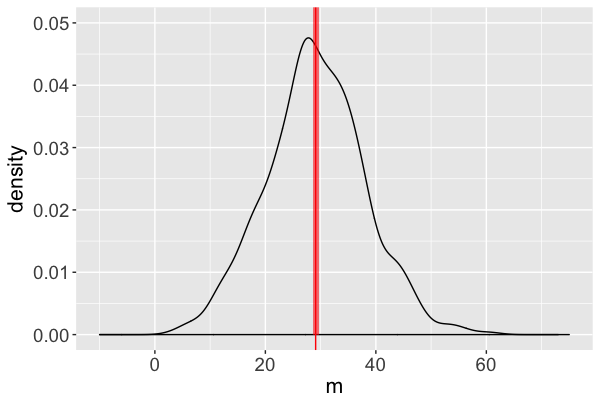
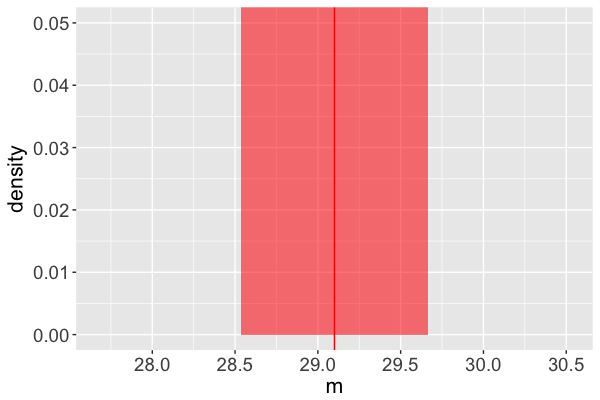
この推定値の(単純)標準誤差 = 0.2836 ms
SD / $\sqrt{\text{number of iterations}}$

推定平均 = 29.10 ms
(単純)標準誤差 = 0.2836 ms

モデルの定義・コンパイル・シミュレーション
以下の診断を確認
シミュレーションの確定
sleep_jags <- jags.model(textConnection(sleep_model),
data = list(Y = sleep_study$diff_3),
inits = list(.RNG.name = "base::Wichmann-Hill",
.RNG.seed = 1989))
RJAGS によるベイズモデリング