So sánh kế thừa và biểu diễn chuỗi
Nhập môn Lập trình Hướng đối tượng với Python

George Boorman
Curriculum Manager, DataCamp
So sánh các đối tượng từ các lớp khác nhau
class Customer:
    def __init__(self, acc_id, name):
        self.acc_id, self.name = acc_id, name

    def __eq__(self, other):
        # Returns True if the objects have the same attributes
        # and are of the same type
        return (self.acc_id == other.acc_id) and (self.name == other.name)\n            and (type(self) == type(other))
So sánh các đối tượng bằng kế thừa
Điều gì sẽ xảy ra nếu một đối tượng kế thừa từ lớp của đối tượng kia?
Tài khoản ngân hàng và tiết kiệm
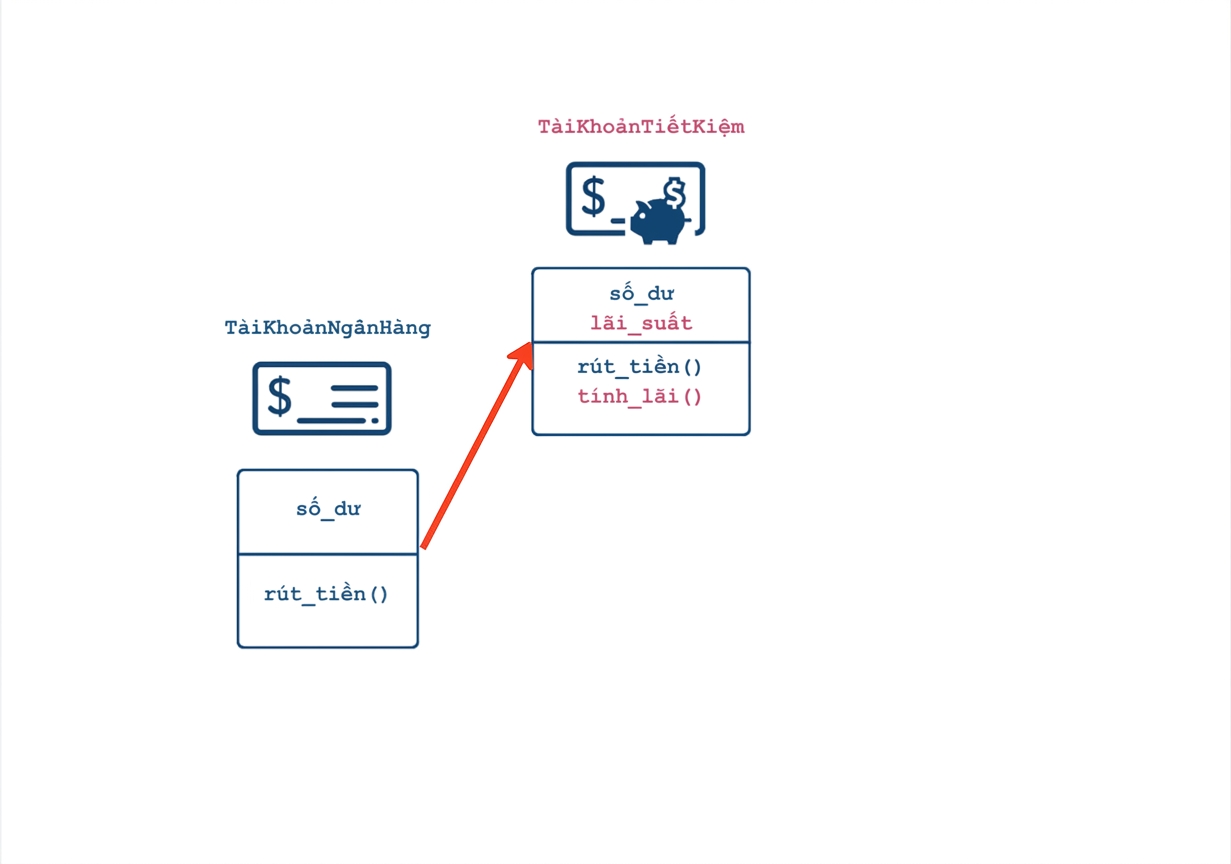
__eq__ trong các lớp cha/con
class BankAccount:
    def __init__(self, number, balance=0):
        self.balance = balance
        self.number = number

    def withdraw(self, amount):
        self.balance -= amount

    # Define __eq__ that returns True
    # if the number attributes are equal
    def __eq__(self, other):
        print("BankAccount __eq__() called")
        return self.number == other.number
class SavingsAccount(BankAccount):
    def __init__(self, number, balance, interest_rate):
        BankAccount.__init__(self, number,
                             balance)
          self.interest_rate = interest_rate

    # Define __eq__ that returns True
    # if the number attributes are equal
    def __eq__(self, other):
        print("SavingsAccount __eq__() called")
        return self.number == other.number
So sánh đối tượng cha và đối tượng con
ba = BankAccount(123, 10000)
sa = SavingsAccount(456, 2000, 0.05)
# Compare the two objects
ba == sa
SavingsAccount __eq__() called
False
sa == ba
SavingsAccount __eq__() called
False
In đối tượng
class Customer:
    def __init__(self, name, balance):
        self.name, self.balance = name, balance

cust = Customer("Maryam Azar", 3000)
print(cust)
<__main__.Customer at 0x1f8598e2240>
a_list = [1,2,3]
print(a_list)
[1, 2, 3]
__str__()
print(obj),str(obj)
print(np.array([1,2,3]))
[1 2 3]
str(np.array([1,2,3]))
'[1 2 3]'
- không trang trọng, dành cho người dùng cuối
- strbiểu diễn
__repr__()
repr(obj), in ra trong console
repr(np.array([1,2,3]))
'array([1,2,3])'
np.array([1,2,3])
array([1, 2, 3])
- trang trọng, dành cho nhà phát triển
- reproducible representation
- phương án dự phòng cho
print()
Triển khai: repr
class Customer: def __init__(self, name, balance): self.name = name self.balance = balance def __repr__(self):# Notice the '...' around name return f"Customer('{self.name}', {self.balance})"cust = Customer("Maryam Azar", 3000) # Will implicitly call __repr__() cust
Customer('Maryam Azar', 3000)
Triển khai: str
class Customer:
    def __init__(self, name, balance):
        self.name = name
        self.balance = balance
    def __str__(self):
        cust_str = f"""
        Customer:
            name: {self.name}
            balance: {self.balance}
            """
        return cust_str
cust = Customer("Maryam Azar", 3000)

# Will implicitly call __str__()
print(cust)
Customer:
  name: Maryam Azar
  balance: 3000
Hãy luyện tập!
Nhập môn Lập trình Hướng đối tượng với Python

