Validace mimo vzorek a křížová validace
Machine Learning for Marketing Analytics in R

Verena Pflieger
Data Scientist at INWT Statistics
Fit mimo vzorek: trénovací a testovací data
1) Rozdělení datové sady na trénovací a testovací data
# Generating random index for training and test set
# set.seed ensures reproducibility of random components
set.seed(534381)

churnData$isTrain <- rbinom(nrow(churnData), 1, 0.66)
train <- subset(churnData, churnData$isTrain == 1)
test <- subset(churnData, churnData$isTrain == 0)
Fit mimo vzorek: sestavení modelu
2) Sestavení modelu na základě trénovacích dat
# Modeling logitTrainNew
logitTrainNew <- glm( returnCustomer ~ title + newsletter +
                     websiteDesign + paymentMethod + couponDiscount +
                     purchaseValue + throughAffiliate +
                     shippingFees + dvd + blueray + vinyl +
                     videogameDownload + prodOthers + prodRemitted,
                     family = binomial, data = train)

# Out-of-sample prediction for logitTrainNew
test$predNew <- predict(logitTrainNew, type = "response",
                        newdata = test)
Přesnost mimo vzorek
# Calculating the confusion matrix
confMatrixNew <- confusion.matrix(test$returnCustomer, test$predNew,
                 threshold = 0.3)
confMatrixNew

# Calculating the accuracy
accuracyNew <- sum(diag(confMatrixNew)) / sum(confMatrixNew)
accuracyNew
    obs
pred     0    1
   0 11939 2449
   1   716  350

0.7951987
Křížová validace: nastavení
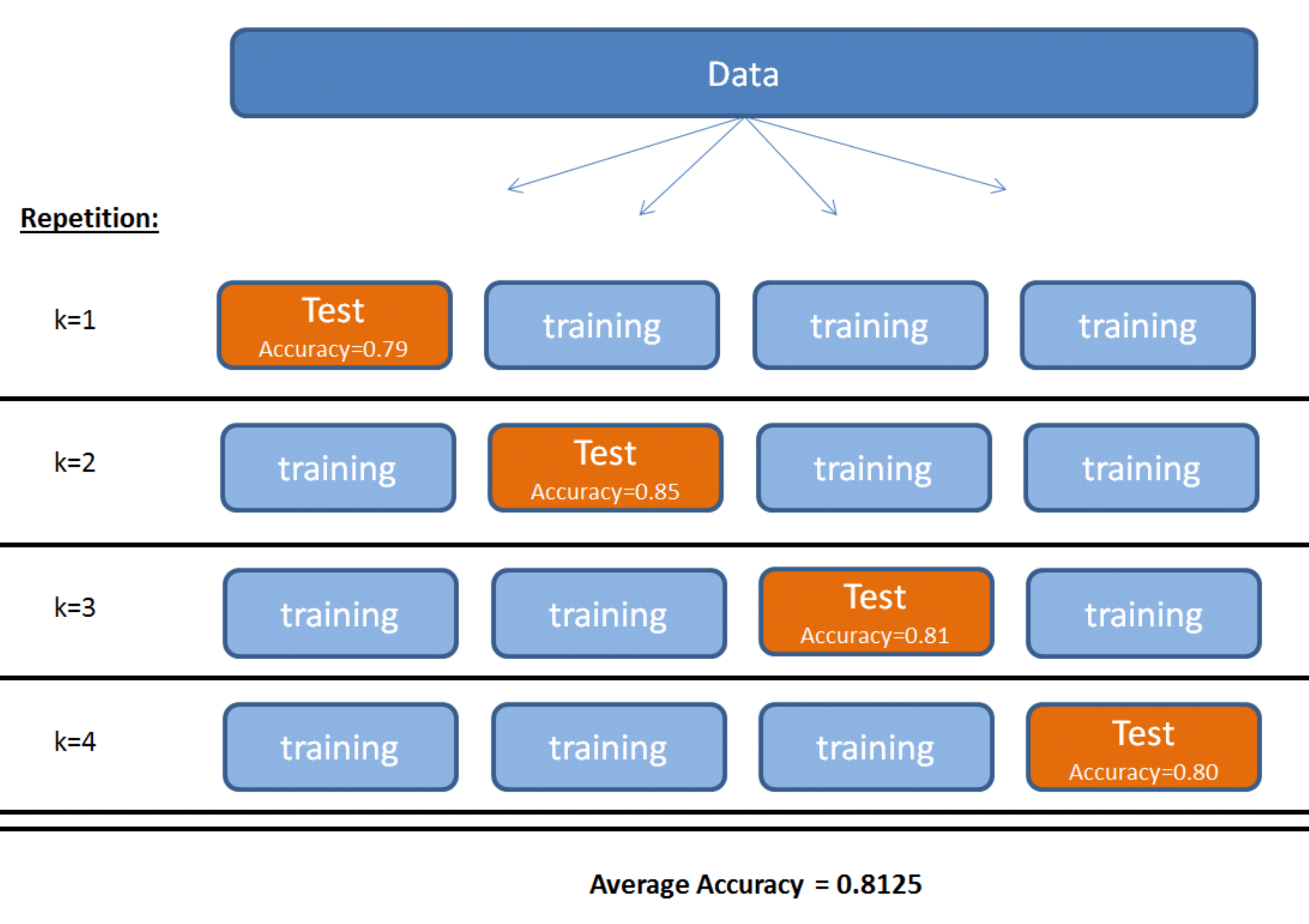
Křížová validace: přesnost
Výpočet přesnosti křížové validace
library(boot)
# Accuracy function with threshold = 0.3
Acc03 <- function(r, pi = 0) {
  cm <- confusion.matrix(r, pi, threshold = 0.3)
  acc <- sum(diag(cm)) / sum(cm)
  return(acc)}
# Accuracy
set.seed(534381)
cv.glm(churnData, logitModelNew, cost = Acc03, K = 6)$delta
0.7943894
| Poznatky – logistická regrese | |
|---|---|
| Naučili jste se... | jak identifikovat zákazníky e-shopu s rizikem odchodu |
| používat binární logistickou regresi pro výpočet pravděpodobností | |
| že volba prahu je klíčová |
| Poznatky z modelu | |
|---|---|
| Naučili jste se... | že zákazníci přihlášení k odběru newsletteru se pravděpodobněji vrátí |
| že zákazníci s kupónem se méně pravděpodobně vrátí | |
| že zákazníci bez poplatků za dopravu se pravděpodobněji vrátí | |
| atd... |
Poslední cvičení!
Machine Learning for Marketing Analytics in R

