Diagnostika problémů s biasem a variancí
Machine Learning with Tree-Based Models in Python

Elie Kawerk
Data Scientist
Odhad chyby generalizace
Jak odhadnout chybu generalizace modelu?
Nelze to provést přímo, protože:
$f$ je neznámé,
obvykle máte k dispozici pouze jeden dataset,
šum je nepředvídatelný.
Odhad chyby generalizace
Řešení:
- rozdělení dat na trénovací a testovací sadu,
- natrénování $\hat{f}$ na trénovací sadě,
- vyhodnocení chyby $\hat{f}$ na neviděné testovací sadě.
- chyba generalizace $\hat{f} \approx$ chyba $\hat{f}$ na testovací sadě.
Lepší vyhodnocení modelu pomocí křížové validace
Testovací sada by neměla být použita, dokud si nejsme jisti výkonem $\hat{f}$.
Vyhodnocení $\hat{f}$ na trénovací sadě: zkreslený odhad, $\hat{f}$ již viděl všechny trénovací body.
Řešení $\rightarrow$ křížová validace (CV):
K-Fold CV,
Hold-Out CV.
K-Fold CV
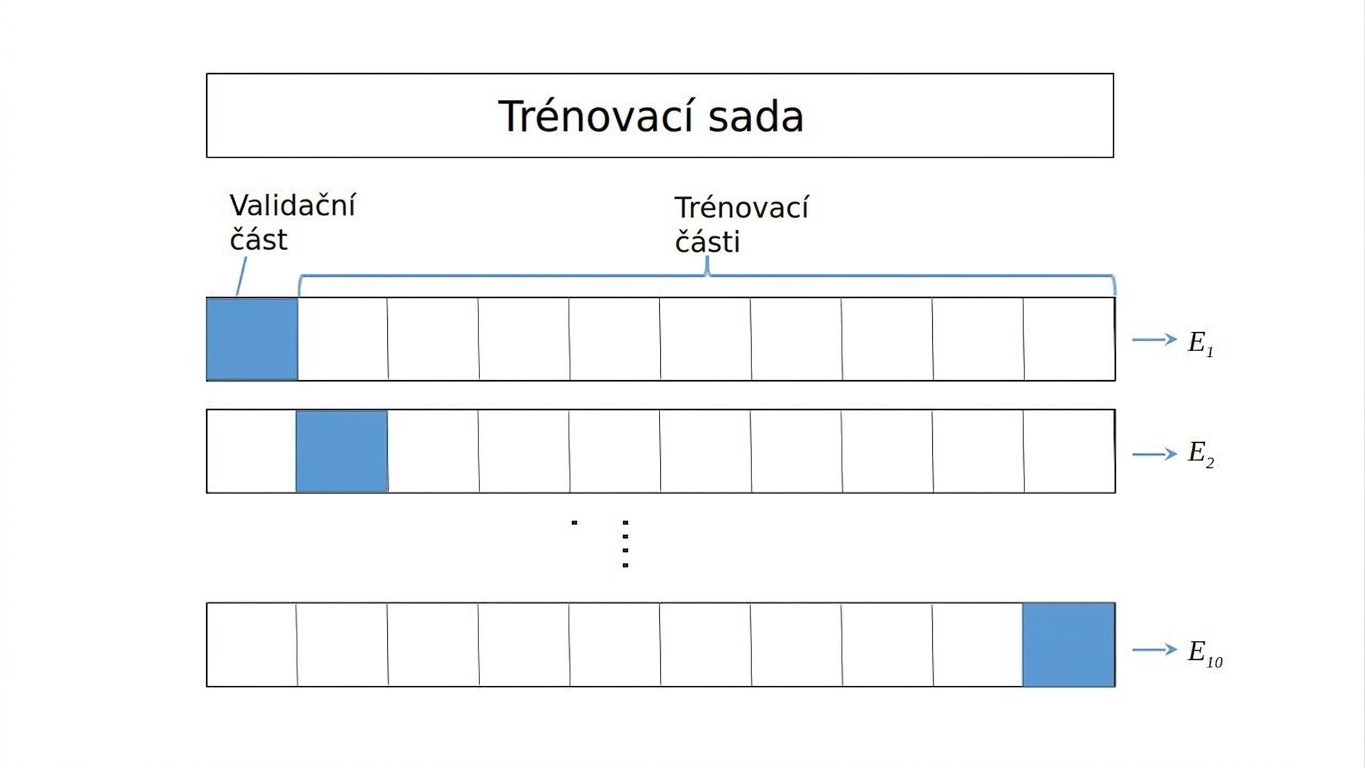
K-Fold CV
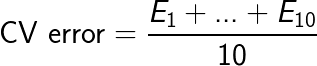
Diagnostika problémů s variancí
Pokud $\hat{f}$ trpí vysokou variancí:
CV chyba $\hat{f}$ > chyba $\hat{f}$ na trénovací sadě.
- Říkáme, že $\hat{f}$ přeučuje trénovací sadu. Řešení přeučení:
- snížení složitosti modelu,
- např.: snížení max. hloubky, zvýšení min. počtu vzorků na list, ...
- získání více dat, ..
Diagnostika problémů s biasem
Pokud $\hat{f}$ trpí vysokým biasem:
CV chyba $\hat{f} \approx$ chyba $\hat{f}$ na trénovací sadě $>>$ požadovaná chyba.
Říkáme, že $\hat{f}$ podučuje trénovací sadu. Řešení podučení:
- zvýšení složitosti modelu
- např.: zvýšení max. hloubky, snížení min. počtu vzorků na list, ...
- získání relevantnějších příznaků
K-Fold CV v sklearn na datasetu Auto
from sklearn.tree import DecisionTreeRegressor from sklearn.model_selection import train_test_split from sklearn.metrics import mean_squared_error as MSE from sklearn.model_selection import cross_val_score# Set seed for reproducibility SEED = 123 # Split data into 70% train and 30% test X_train, X_test, y_train, y_test = train_test_split(X,y, test_size=0.3, random_state=SEED)# Instantiate decision tree regressor and assign it to 'dt' dt = DecisionTreeRegressor(max_depth=4, min_samples_leaf=0.14, random_state=SEED)
K-Fold CV v sklearn na datasetu Auto
# Evaluate the list of MSE ontained by 10-fold CV # Set n_jobs to -1 in order to exploit all CPU cores in computation MSE_CV = - cross_val_score(dt, X_train, y_train, cv= 10, scoring='neg_mean_squared_error', n_jobs = -1)# Fit 'dt' to the training set dt.fit(X_train, y_train) # Predict the labels of training set y_predict_train = dt.predict(X_train) # Predict the labels of test set y_predict_test = dt.predict(X_test)
# CV MSE
print('CV MSE: {:.2f}'.format(MSE_CV.mean()))
CV MSE: 20.51
# Training set MSE
print('Train MSE: {:.2f}'.format(MSE(y_train, y_predict_train)))
Train MSE: 15.30
# Test set MSE
print('Test MSE: {:.2f}'.format(MSE(y_test, y_predict_test)))
Test MSE: 20.92
Pojďme si procvičit!
Machine Learning with Tree-Based Models in Python

